
Commemorative postage stamps Program
International Day of the Blind

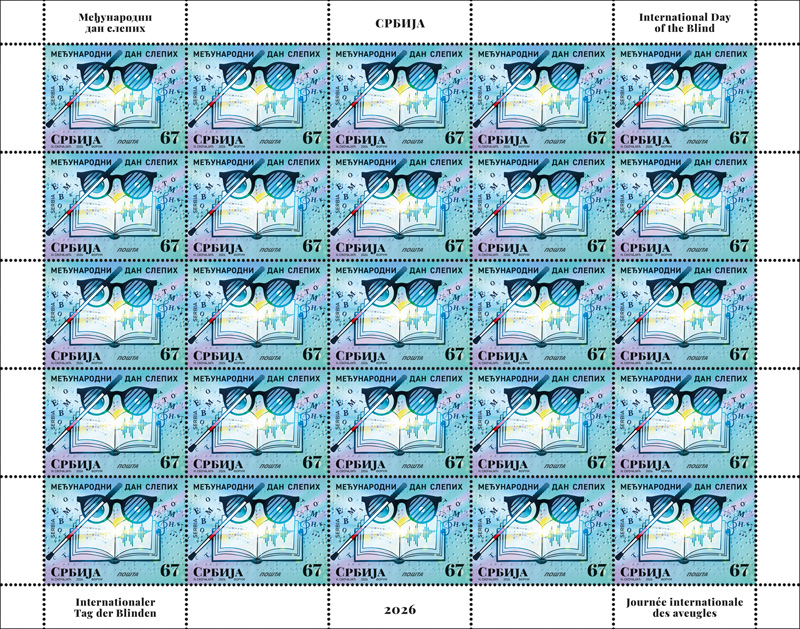
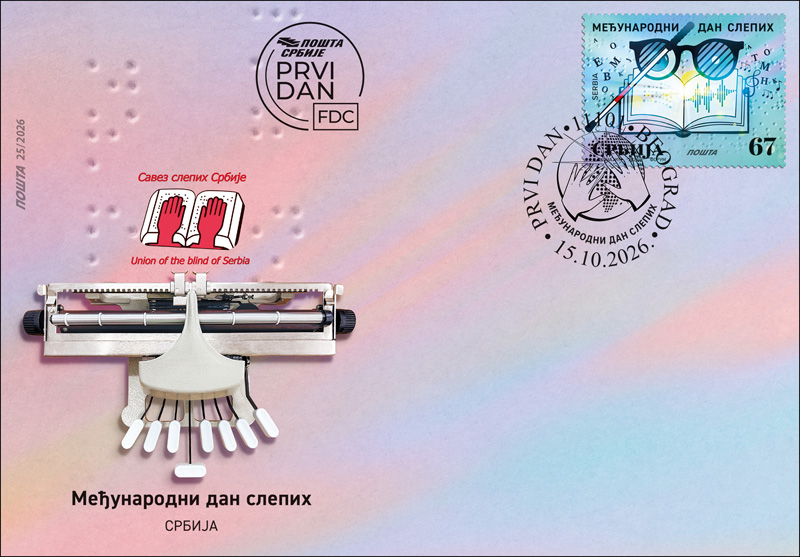

October is the month when several days are observed worldwide to raise the awareness about the rights, dignity, and equal participation of blind and visually impaired persons in society. These international observances highlight the importance of accessibility, education, independent living, and the removal of barriers that limit the full realisation of human rights. The year 2026 marks two significant national anniversaries: the 80th anniversary of the Union of the Blind of Serbia and the 55th anniversary of the "Dr Milan Budimir" Specialised Library.
Founded in 1946, the Union of the Blind of Serbia has served for eight decades as the umbrella organisation representing the interests of blind and visually impaired persons, developing a network of local organisations and implementing programmes aimed at improving the quality of life, education, employment, cultural engagement, and social inclusion of blind and visually impaired individuals.
The "Dr Milan Budimir" Specialised Library, established in 1971 as part of the Union, serves as a unique centre of knowledge and culture. Through its collection of publications in Braille, audiobooks, and editions in other accessible formats, the library facilitates access to information, education, and literature, upholding the right to read and making cultural heritage accessible to all users.
Thanks to the development of assistive technologies, improvements in the legislative framework, and greater social awareness, the position of blind and visually impaired persons is significantly more favourable today than in the past. Nevertheless, the full realisation of equal opportunities still requires the concerted effort of institutions, the professional community, and society as a whole. The anniversaries of the Union of the Blind of Serbia and the "Dr Milan Budimir" Library reaffirm the enduring value of solidarity, accessibility, and inclusion as the foundations of a society of equal opportunities.
Expert collaboration on the issue: Union of the Blind of Serbia
Artistic realization of the issue: MA Nadežda Skočajić, Academic Graphic Artist
Technical details
Date of issue: 15. 10. 2026
Number of stamps in set: 1
Denomination:1468: 67.00 RSD
Print run: 25.000
FDC: 1
Sheet of: 25
Dimensions of stamp: 42 x 31,9 mm
Artistic realization: Nadežda Skočajić
Subject: International Day of the Blind
1468: Symbolic representation of assistive devices for the blind and visually impaired persons: glasses, white cane, Braille, and an audio book.
Perforations: 13 3/4
Printer: Forum Novi Sad
Srbijafila XVI
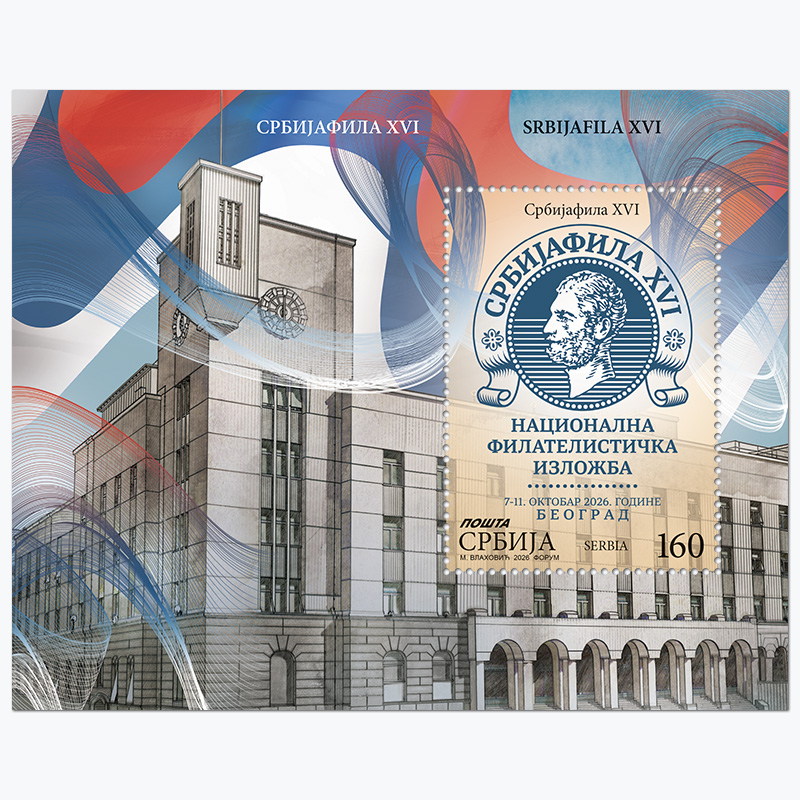

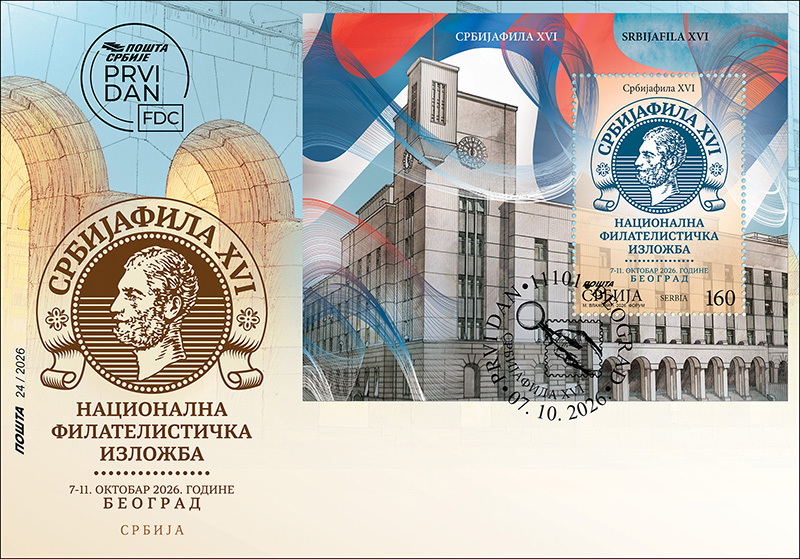
SRBIJAFILA XVI continues the 75-year-old tradition of national philatelic exhibitions in Serbia – a tradition upheld by the Union of Philatelists of Serbia since the First Republic Philatelic Exhibition held in Belgrade in 1951. From 7 to 11 October 2026, the Serbian Armed Forces Club ”Belgrade” – a distinguished building in the very heart of the Serbian capital – will serve as a gathering place for philately enthusiasts from both home and abroad.
This year’s exhibition features approximately 400 display frames; a defining characteristic of SRBIJAFILA XVI is its regional scope, focusing on the philately of the former Yugoslavia. In addition to exhibitors from Serbia and neighboring countries, participants include philatelists from other parts of the world who collect and study material from this region.
A special place is reserved for the honorary class, featuring selected items from the collection of Aleksandar Boričić; this showcase highlights a portion of the rich philatelic heritage of one of Serbia’s most prominent collectors.
SRBIJAFILA XVI is organized with the support of the Post of Serbia (General Sponsor) and the FIP (International Federation of Philately), and holds the recognition of FEPA (Federation of European Philatelic Associations), establishing itself as a significant cultural event in Serbia in 2026.
Professional cooperation on the issue: Vladimir Milić FRPSL,
President of the Union of Philatelists of Serbia
Artistic realisation of the issue: MA Marija Vlahovic, Academic Graphic Artist
Technical details
Date of issue: 07. 10. 2026.
Number of stamps in set: block with 1 stamp
Denomination:
Block 119: 160.00 RSD
Print run: 10.000
FDC: 1
Sheet of: block
Dimensions of block: 100 x 80 mm
Dimensions of stamp in block: 35 x 49.3 mm
Artistic realization: Marija Vlahović
Subject: Srbijafila XVI
119: Central Military Club in Belgrade, Serbian flag and sign of Srbijafila XVI exhibition
Perforations: 13 ¾
Printer: Forum Novi Sad
World Postcard Day – Postcrossing

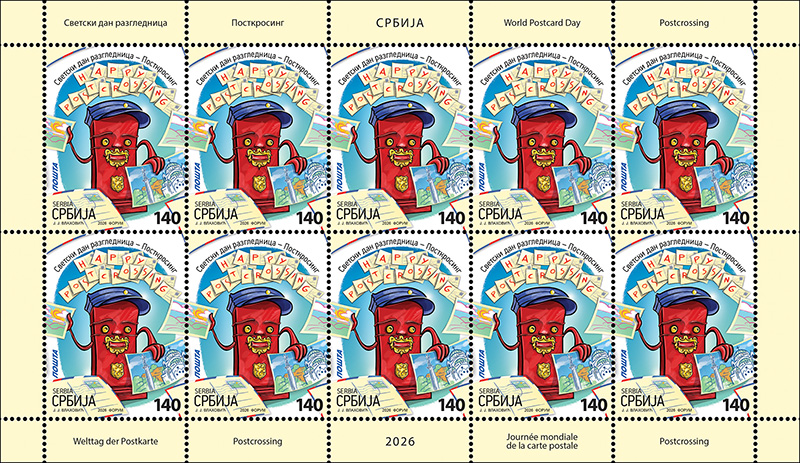
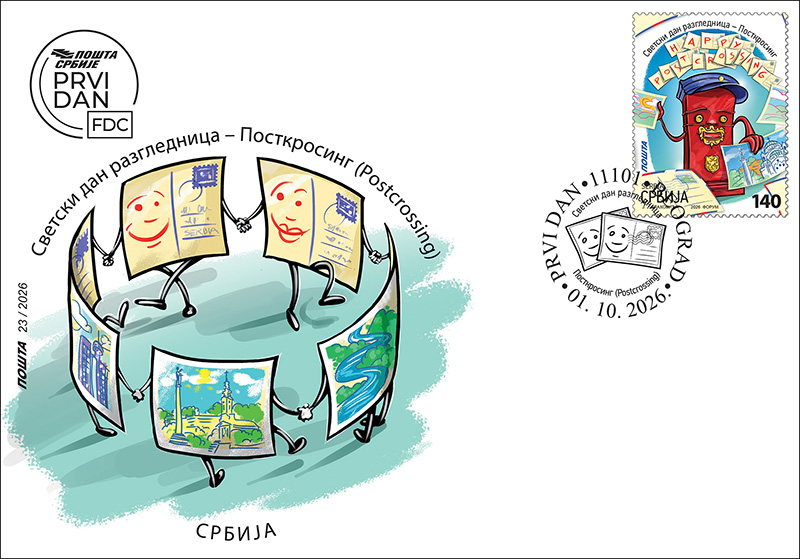

World Postcard Day – Postcrossing
Postcrossing is a global postcard exchange project that connects people through real mail. It allows anyone to send a postcard to a random member somewhere in the world and, in return, receive a postcard back from another random member. What begins with a simple postcard often becomes a meaningful connection between people, cultures, and places.
Over the years, Postcrossing has grown into a worldwide community spanning more than 200 countries and territories. More than 85 million postcards have travelled across the globe through the project, carrying messages, stamps, handwriting, and small glimpses of everyday life. In a fast digital world, Postcrossing celebrates the lasting charm of handwritten communication and the joy of finding something personal in the mailbox.
Postcrossing also started World Postcard Day, celebrated each year on 1 October, the anniversary of the first postcard ever sent. The day honors postcards and the unique way they bring people together across distances. Events to celebrate this special day are organized all over the world, from simple gatherings of postcard enthusiasts to museum exhibitions and school activities.
This stamp issue celebrates both the spirit of postcard sending and the international community that continues to make it relevant today.
Professional cooperation: Paulo Magalhães, founder of Postcrossing
Artistic realization: MA Jakša Vlahović, academic graphic artist
Technical details
Date of issue: 01. 10. 2026.
Number of stamps in set: 1
Denomination:
1466: 140.00 RSD
Print run: 15.000
FDC: 1
Sheet of: 10
Dimensions of stamp: 31,9 x 42 mm
Artistic realization: Jakša Vlahović
Subject: World Postcard Day – Postcrossing
1466: Witty illustration of mailbox presented as postman who shows postcards with motives from Serbia.
Perforations: 13 3/4
Printer: Forum Novi Sad
Joy of Europe
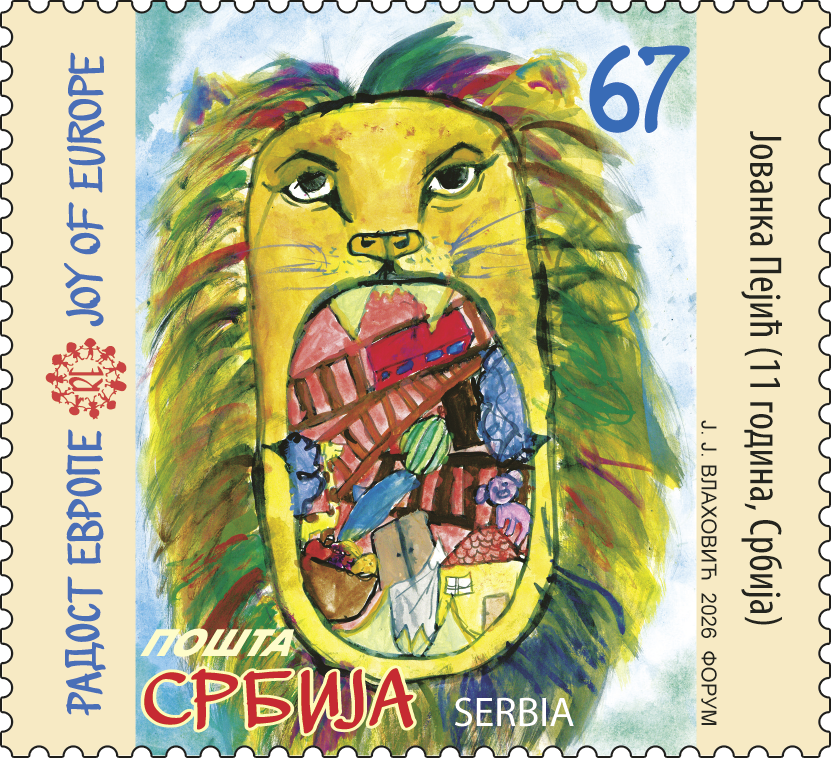
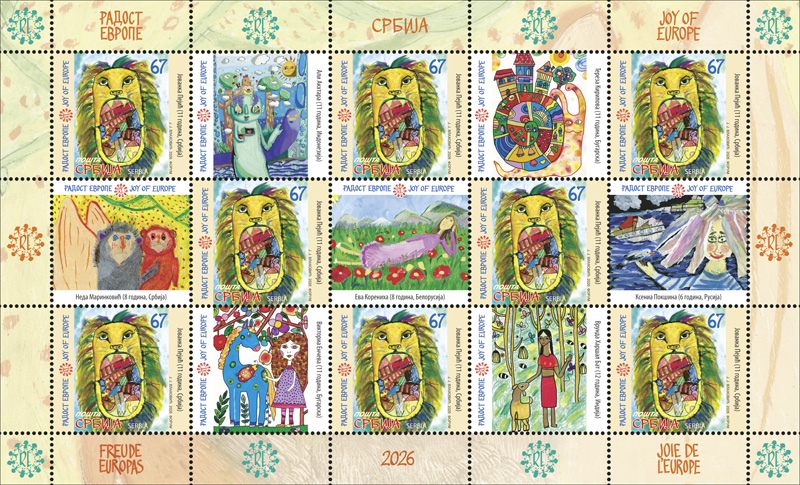
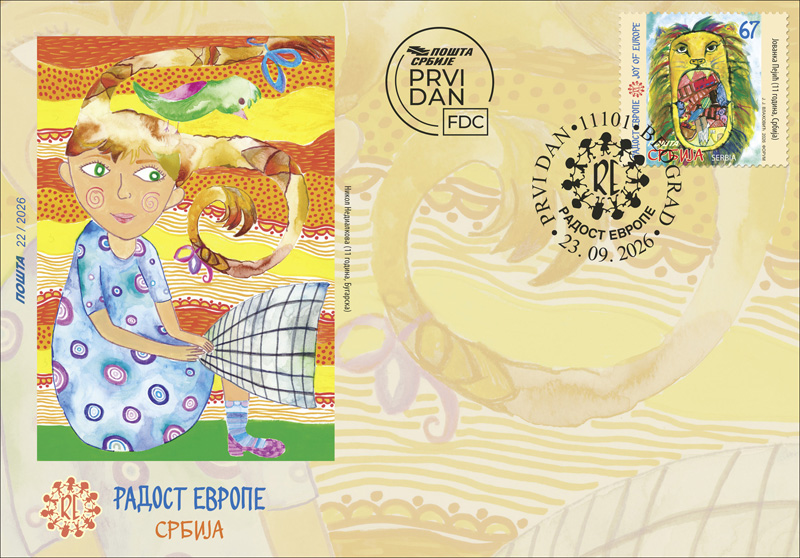

Exactly 28 years ago, in 1998, in Belgrade, as part of the then 25th jubilee meeting of the children of Europe - “Joy of Europe”, a new and significant programme content was introduced - the International Art Competition.
Since its inception, the competition has been open to children and young people, but also to preschool institutions, schools, children’s art studios, children’s centres, as well as other institutions and associations from all over the world. Participation is intended for children and young people aged 4 to 18, who present their creativity through various art techniques. This year, 2,700 works were sent to the Children’s Cultural Centre Belgrade, from cities all over Serbia, as well as from cities of Belarus, Bosnia and Herzegovina, Bulgaria, Montenegro, Egypt, Greece, India, Indonesia, Italy, China, Congo, Lithuania, Macedonia, Hungary, Mongolia, Namibia, Poland, Romania, Russia, Slovakia, Slovenia, Switzerland, Thailand, Taiwan, Turkey, Vietnam, Czech Republic and from Zimbabwe.
A special place among expertly selected works of art is occupied by those who every year get the opportunity to become part of the commemorative postage stamp “Joy of Europe”, which the Pošta Srbije L.L.C. traditionally issues at the end of September. Professionally selected art works represent, on the one hand, a significant document of the visual culture of childhood, and on the other, they represent a great incentive for young creators, as well as for art pedagogues and all those who support the purity of children’s expression, thoughts and creation.
This year’s theme is focused on the relationship of children and young people towards animals - that special, sincere and unbreakable bond that is born in early childhood. In animals, children recognize a whole world - a world of freedom, play, tenderness, trust and belonging.
The motif on the stamp is the work of Jovanka Pejić (age 11, Serbia). The authors of the works on the vignettes are as follows: Ali Akhtara (age 11, Indonesia), Tereza Kirilova (age 11, Bulgaria), Neda Marinković (age 8, Serbia), Eva Koreniha (age 8, Belarus), Ksenia Pokshina (age 6, Russia), Viktoria Encheva (age 11, Bulgaria), Vrunda Harshal Bhatt (age 12, India). The author of the work on the envelope is Nikol Nedyalkova (age 11, Bulgaria).
Expert collaboration: Lidija Seničar, editor of the International Art Competition “Joy of Europe”, Children’s Cultural Centre Belgrade.
Graphic realisation of the issue: MA Jakša Vlahović, academic graphic artist
Technical details
Date of issue: 22. 09. 2026.
Number of stamps in set: 1
Denomination:
1465: 67.00 RSD
Printrun: 15.000
FDC: 1
Sheet of: 8
Dimensions of stamp: 35 x 31,9 mm
Artistic realization: Jakša Vlahović
Subject: Joy of Europe
1465: Drawing by Jovanka Pejić (age 11, Serbia)
Perforations: 13 3/4
Printer: Forum Novi Sad
Museum exhibits
125 years of the Ethnographic Museum in Belgrade

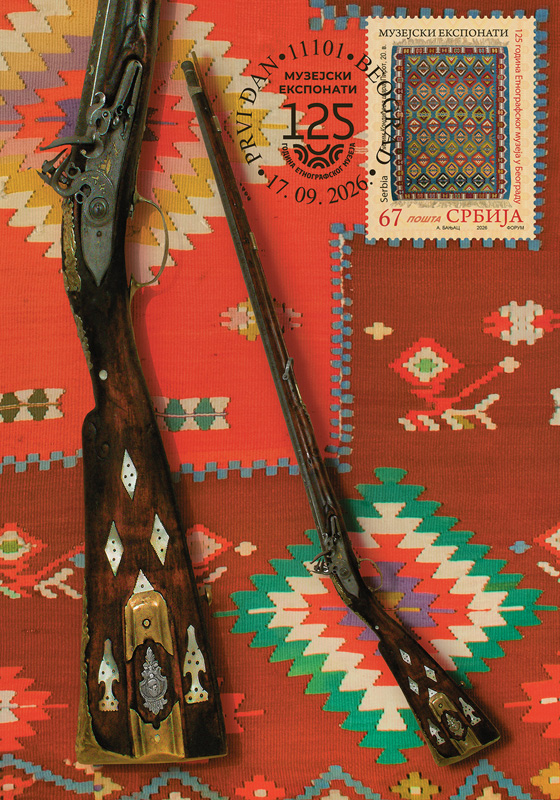
The Ethnographic Museum in Belgrade was founded in 1901 by separating the ethnographic department from the National Museum. Various ethnographic objects – earthenware and metal utensils, jewellery, amulets, glass and textile objects, weapons, tools, Easter eggs and other museum items were transferred to the Stevča Mihailović Foundation, which he bequeathed in his will for this very purpose. The objects were collected during field research in what was then Serbia and neighbouring countries where the Serbian people lived. The first permanent exhibition of the Museum was opened in 1904 on the occasion of the centennial celebration of the First Serbian Uprising.
Since 1953, the Ethnographic Museum in Belgrade has been located in the building of the former Belgrade Stock Exchange, on Students’ Square. The museum is engaged in researching the folk life and culture of the Serbian people and other peoples living with them and in their surroundings. The collections contain over 50 thousand objects and over 70 thousand museum exhibits of other types – photographs and photo negatives, archival materials and works of art that illustrate folk life. The Ethnographic Museum in Belgrade has a special library in the field of ethnology and anthropology with over 70 thousand library units. Since 1992, the Museum’s regular programme has also included the International Ethnological Film Festival, and since 2010, the Museum has also housed the Centre for the Intangible Cultural Heritage of Serbia.
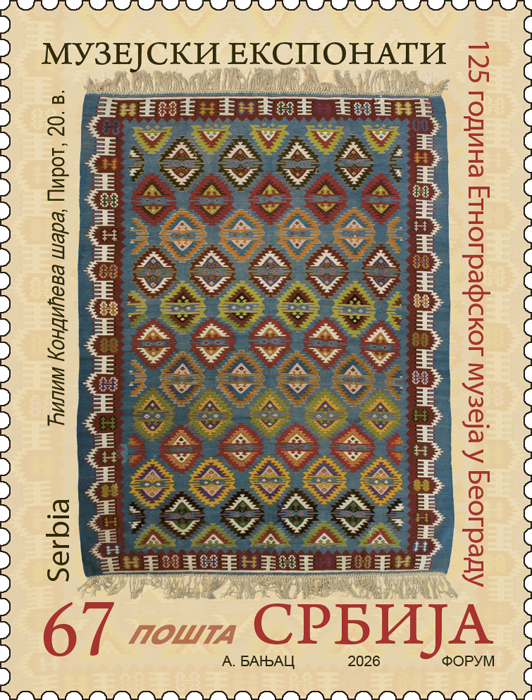
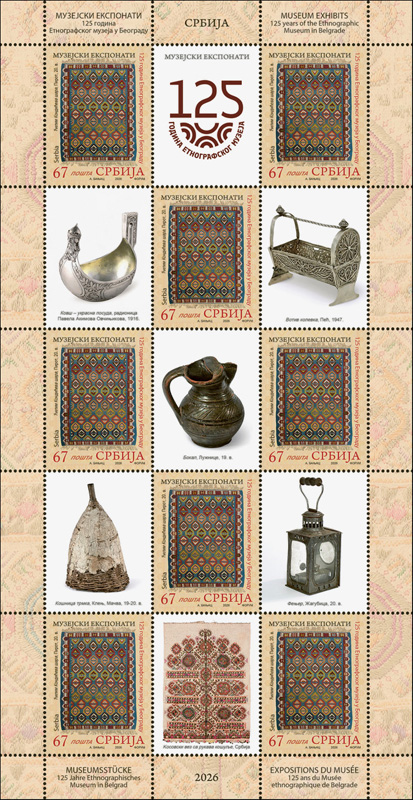
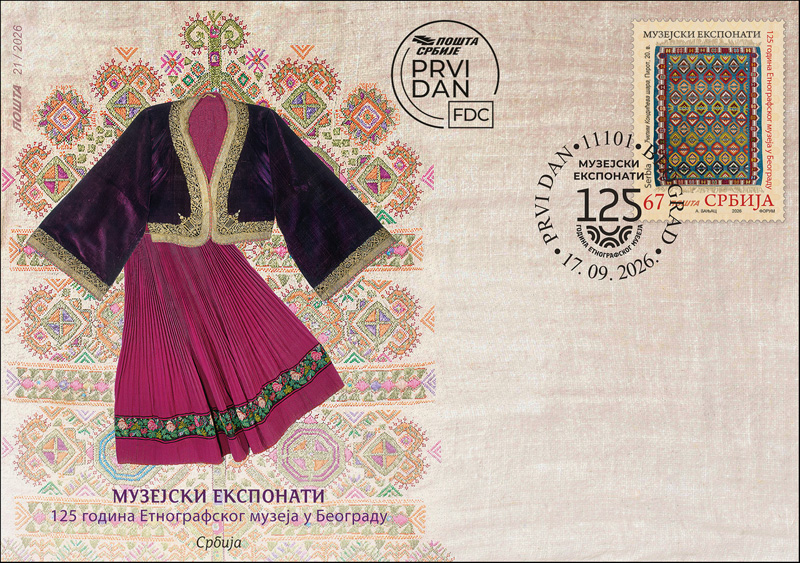
Stamp motif: Kilim “Kondić Pattern”, Pirot, Serbia, first half of the 20th century. For wall decoration or bed covering.
Motifs on the vignettes: Kovsh, decorative vessel, workshop of Pavel Akimov Ovchinnikov, 1916. Votive cradl e, Peć, 1947, blacksmith Marko Gaši. A votive is an offering given to shrines. Filigree cradles were offered by barren women who wanted a child. Jug, Lužnice, Kragujevac, mid-19th century. Made of clay, on a pedal operated pottery wheel, it was used for water and wine. Bee skep, Klenj, Mačva, 19th – 20th century. Dome-shaped, made of twigs and dung, with a handle on top for easier carrying. Lantern, Žagubica, early 20th century, metal and glass, with a wooden handle. Kosovo embroidery on a shirt sleeve, Serbia. Women’s wedding shirt – “đurđevojka”. The bride wore it on her wedding day.
FDC motif: Libade jacket, formal women’s jacket, Belgrade, 1831; Girl’s skirt, early 20th century, Šumadija.
CM motif: Flintlock rifle, with brass and mother-of-pearl decorations, Valjevo area. In the background: Kilim, Stragari, mid-19th century.
Professional cooperation on the issue: Ethnographic Museum in Belgrade
Graphic realization of the issue: MA Anamari Banjac, Academic painter
Technical details
Date of issue: 17. 09. 2026.
Number of stamps in set: 1
Denomination:
1464: 67.00 RSD
Printrun: 25.000
FDC: 1
Sheet of: 8
Dimensions of stamps: 31,9 x 42 mm
Artistic realization: Anamari Banjac
Subject: Museum Exhibits-125 years of the Ethnographic Museum in Belgrade
1464 – Kilim “Kondić Pattern”, Pirot, Serbia, first half of the 20th century. For wall decoration or bed covering.
Perforations: 13 ¾
Printer: Forum Novi Sad
Notable Serbs

Notable Serbs
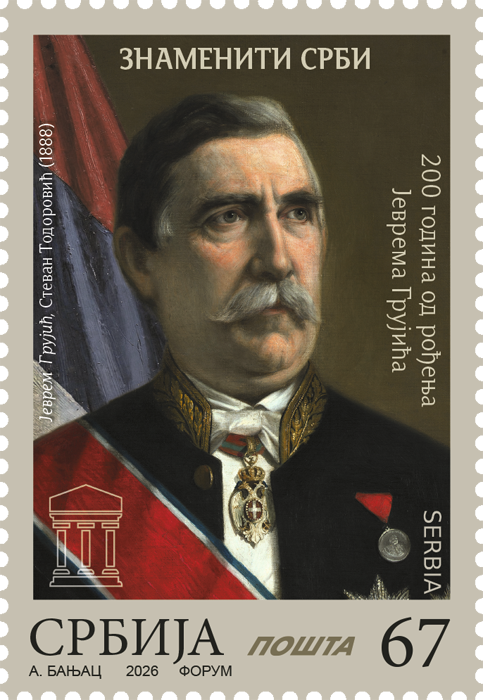
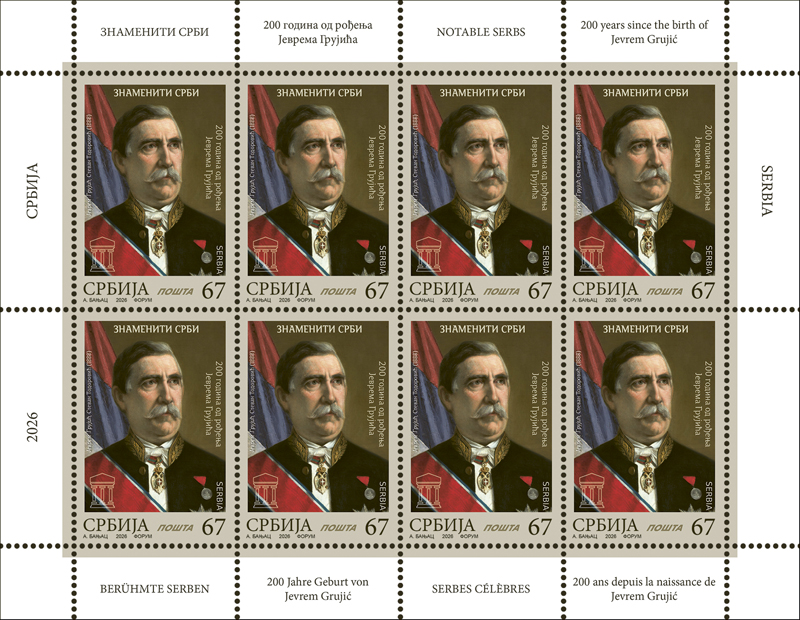
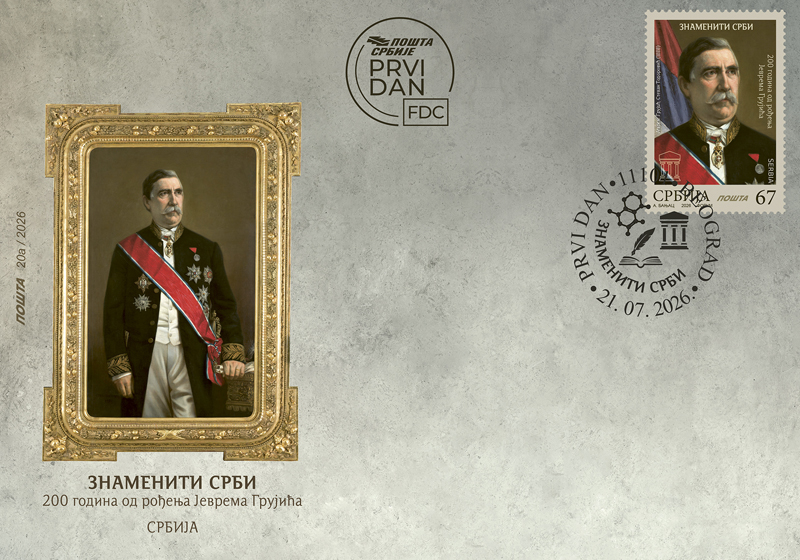
200 years since the birth of Jevrem Grujić
Jevrem Grujić (1826 – 1896) was a statesman and diplomat who was responsible for the adoption of the First Law on the National Assembly in 1858, the foundation of modern democracy. He was a central figure in the St. Andrew’s Assembly and the initiator of Serbian liberalism, who actively participated in decisive political events in Serbia.
He was among the first students sent by the state to study abroad, the so-called “Parisians”. He studied at the universities of Heidelberg and the Sorbonne, where he studied legal sciences. He graduated in law from the Sorbonne, and upon his return from Paris to Serbia, he brought new, liberal ideas and, with other liberal leaders, founded the Liberal Party. He was a generator of social change, a key factor in economic mobility and the foundation of new political principles, but also tastes and fashion, thus replacing the previous oriental customs with the cultural model of developed European capitals.
Jevrem Grujić was a member of several Serbian governments, a minister on multiple occasions, and a long-time Serbian ambassador to Constantinople, London, Paris, and Brussels. As one of the prominent ideologists of Serbian liberalism, he often came into conflict with the absolutist regime of Prince Mihailo, which is why his service was often called into question.
For his merits, he was awarded the highest order of the time – the Cross of Takovo, I class, and towards the end of his diplomatic service and political career, the Order of the White Eagle, II class.
He was a member of the Serbian Learned Society, for which he wrote his biography “Životopis” in five books and “Etnografski zapisi” (Ethnographic Records).
Stamp motif: Portrait of Jevrem Grujić (detail), Stevan Todorović, oil on canvas, 1888, Belgrade, Šećerović Conić Collection – House of Jevrem Grujić
Professional cooperation: House of Jevrem Grujić, Belgrade
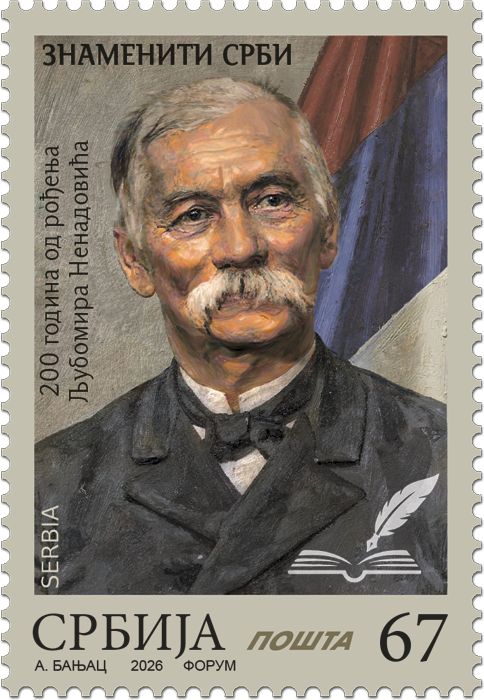
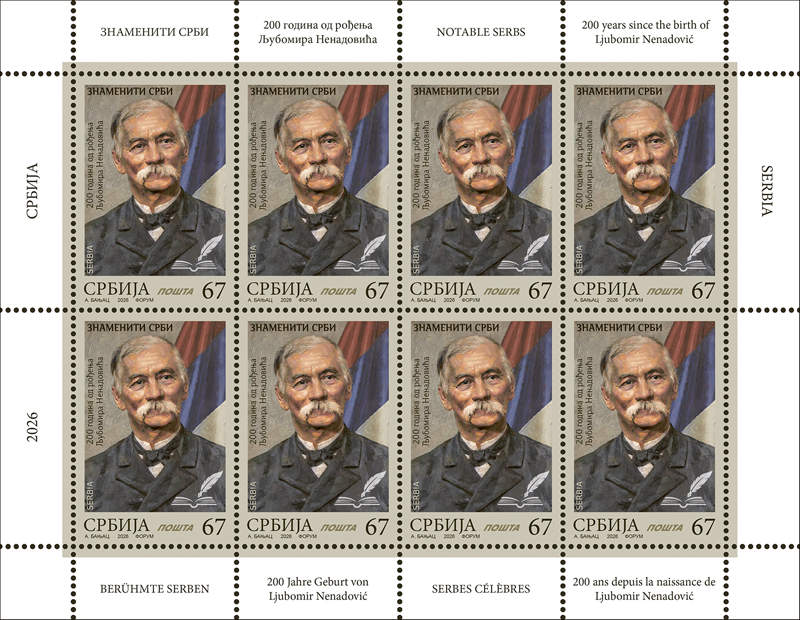
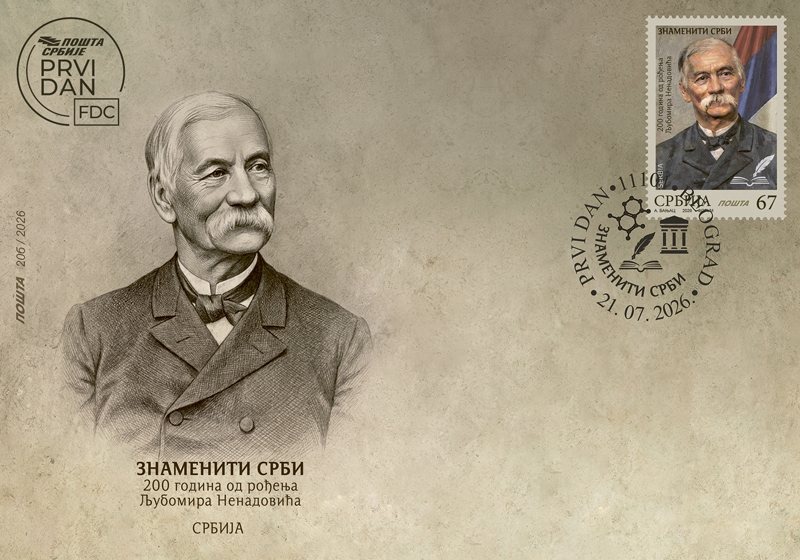
200 years since the birth of Ljubomir Nenadović
Ljubomir Nenadović (1826–1895) stems from the famous Nenadović lineage from Brankovina near Valjevo. He was the son of Prota Mateja, the uprising leader and writer of Memoirs, the nephew of Jakov Nenadović and the grandson of the Senior Chief Aleksa, who was executed by the renegade Janissary officers in the Slaughter of the Knezes in early 1804. He was educated in Prague, Berlin, Heidelberg, Geneva and Paris, and then became a high-ranking state official of the Principality of Serbia.
He held positions in the Ministry of Education, including as head and then minister. He was president of the Serbian Literary Society. In 1858, he was appointed secretary of the Serbian agency in Constantinople. As a storyteller and poet, as a humourist, satirist and essayist, as a children’s writer, and especially as a travel writer, he was one of the most popular Serbian writers of the Romantic era.
Since 1887, he has been a full member of the Serbian Royal Academy. He edited the newspaper Šumadinka (1850–1857), published Pesme (Poems) and the poem Slavenska vila (Slavic Fairy) (1849), as well as numerous travelogues: Jedan dan iz putovanja mog po Srbiji 1845. godine (One day from my trip to Serbia in 1845) and Putovanja po Prajskom primorju i po ostrvu Rigenu (Travels along the Prussian coast and on the island of Rügen) (1850), Pisma iz Švajcarske (Letters from Switzerland) (1852; 1855), Vladika crnogorski u Italiji or Pisma iz Italije (The Prince-Bishop of Montenegro in Italy or Letters from Italy) or Pisma iz Italije (The Prince-Bishop of Montenegro in Italy or Letters from Italy) (written in 1851; published in 1868–1869), Pisma iz Nemačke (Letters from Germany) (1870), O Crnogorcima or Pisma sa Cetinja 1878. (On the Montenegrins or Letters from Cetinje in 1878 (published in 1889). He died in his native Brankovina in early 1895, where he was buried in the yard of the Church of the Holy Archangels, a Nenadović endowment.
Professional cooperation: “Ljubomir Nenadović” Main Library, Valjevo
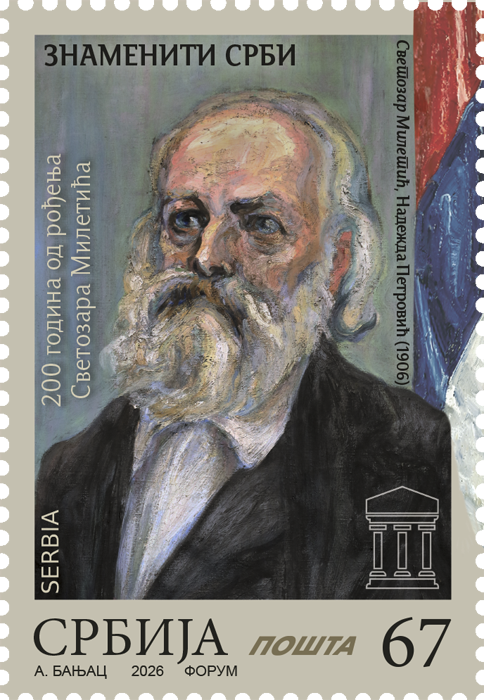
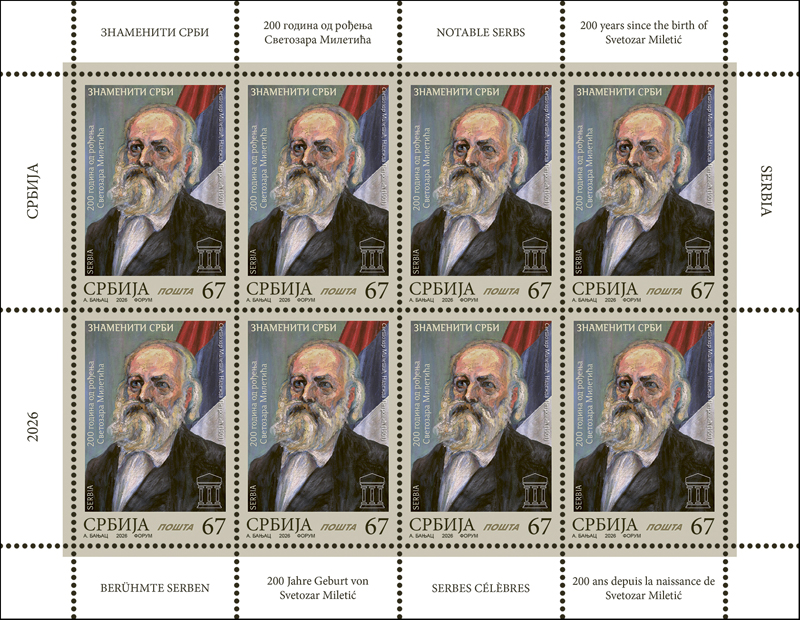
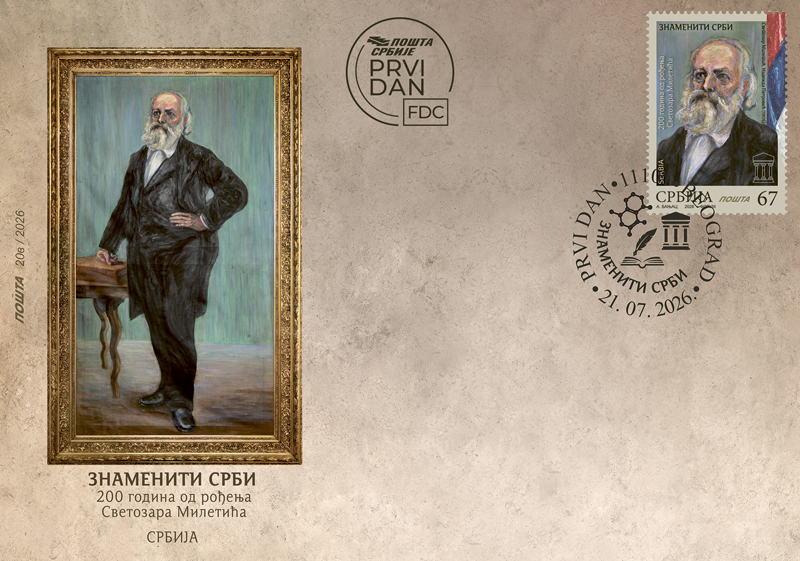
200 years since the birth of Svetozar Miletić
Dr. Svetozar Miletić (1826–1901) was one of the most significant figures in Serbian history of the 19th century – a politician, lawyer, journalist, mayor of Novi Sad and a tireless fighter for national rights, culture and education. He was born in Mošorin, educated in Novi Sad, Pressburg and Pest, and in 1854 he earned the title of Doctor of Juridical Science at the University of Vienna, thus becoming one of the most educated Serbs of his time.
Believing that the progress of a nation is based on knowledge, culture, and free public speech, Miletić dedicated his political and social work to strengthening Serbian institutions. As mayor of Novi Sad, he advocated for the modernization of the city and its positioning as the cultural and spiritual centre of Serbs in the Habsburg Monarchy.
His contribution to cultural development was immeasurable. He was one of the leaders of the reform of the Matica Srpska and strongly contributed to its relocation from Pest to Novi Sad in 1864. He renewed the work of the Serbian Reading Room, which became a centre for gathering intellectuals and public life. It was within its framework that the Serbian National Theatre, the first professional theatre among Serbs, was founded in 1861. Thanks to these undertakings, Novi Sad consolidated its reputation and earned the name “Serbian Athens”.
As the founder and editor of the newspaper Zastava, Miletić spread the ideas of freedom, equality and political responsibility. He was arrested and persecuted several times for his views, but he did not give up the fight for the rights of his people. His work still testifies to the power of education, culture and public speech in shaping society and national identity.
Motif on the stamp and first-day cover: Portrait of Svetozar Miletić (oil on canvas, 1906), a work by the painter Nadežda Petrović created after Miletić’s death, is one of the first Impressionist portraits in Serbian art.
Professional cooperation: Severina Miletić, archivist at the Archives of Vojvodina, photographer Vladimir Mučibabić, Archives of Vojvodina
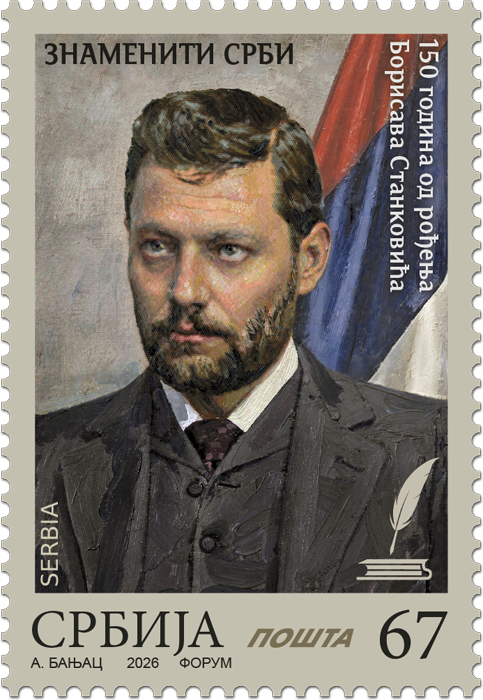
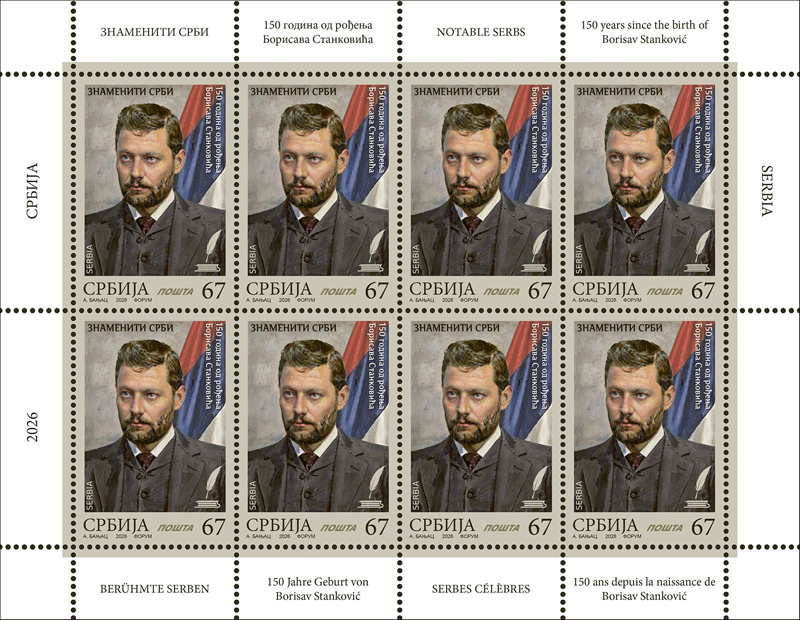
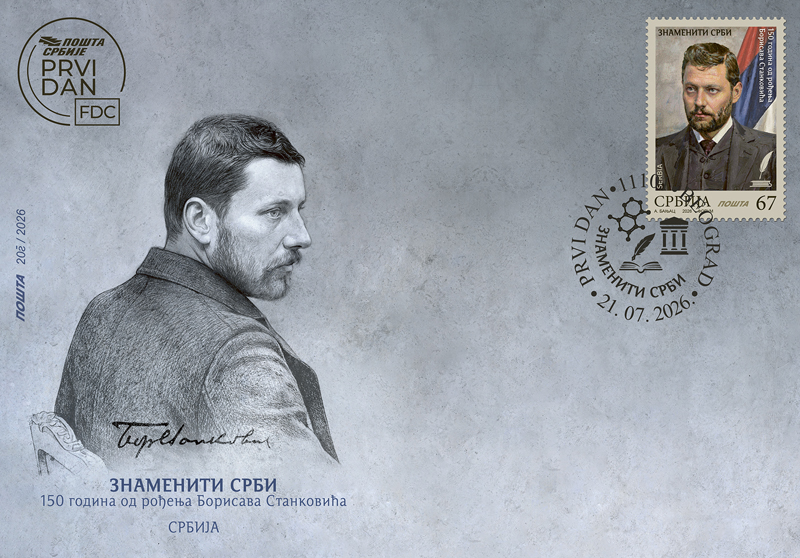
150 years since the birth of Borisav Stanković
Borisav Stanković, one of the few iconic writers of Serbian literature, was born in Vranje on March 22/23, 1876. Creating at the turn of the century, unmatched and unique, without contemporary successors, he was the founder of our modern literature. He died in Belgrade on October 22, 1927.
His entire body of work, novels, short stories and plays, having repeatedly withstood the test of time, as a constantly open text, still represents a permanent challenge not only to contemporary readers but also to academic interpreters. His inner dictate, stylistically and linguistically, and even thematically unique, gave rise to works such as (Bad Blood), Gazda Mladen (Master Mladen), Božji ljudi (God’s People), Stari dani (Old Days), Koštana, etc.…
By setting the action of his works in a small town in the south of central Serbia, in the space of a microcosm, a microworld with its own specific mentality, language, music, specific philosophy of life and accentuated emotions, he miraculously managed to illuminate the deeply hidden and complex inner world of its inhabitants and elevate it to the impressive heights of universal values. In this way, Borisav Stanković brought our literature to the very top of European literature. Numerous translations into many foreign languages testify to this.
In Vranje, the traditional Bora’s Week has been organized in his honour for six decades, and the Literary Society “Borisav Stanković”, which is responsible for the implementation of this international literary event and the constant affirmation of the value of his work, has established and has been awarding the literary award bearing the same name for 35 years. The high school, library and theatre, which organizes Bora’s Theatre Days, also bear his name, and his birthplace has been converted into a memorial museum since 1967.
Professional cooperation: Literary Society “Borisav Stanković” from Vranje
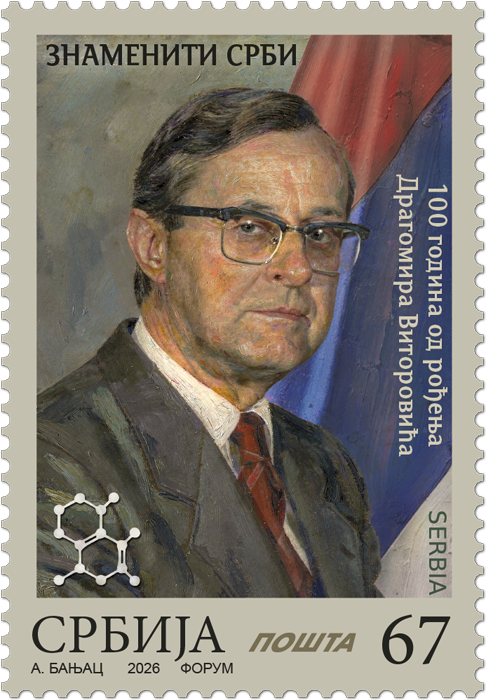
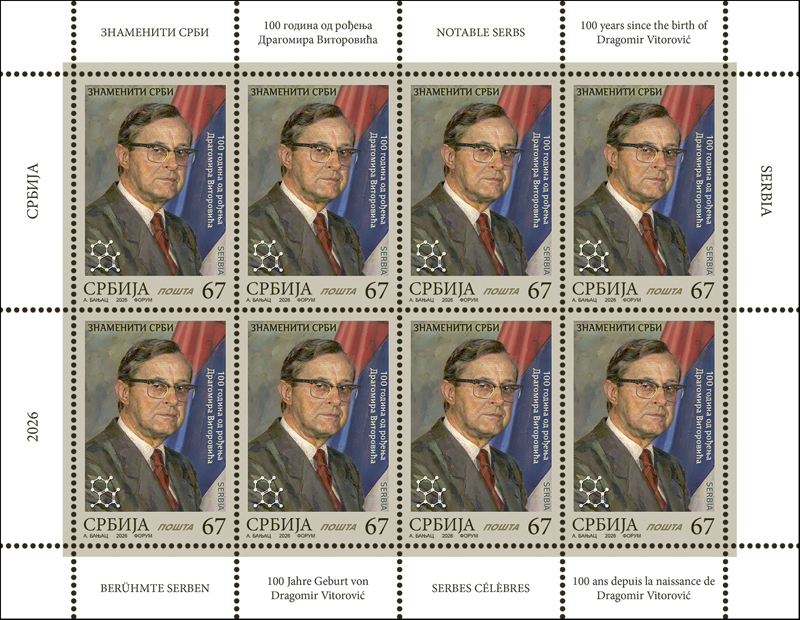
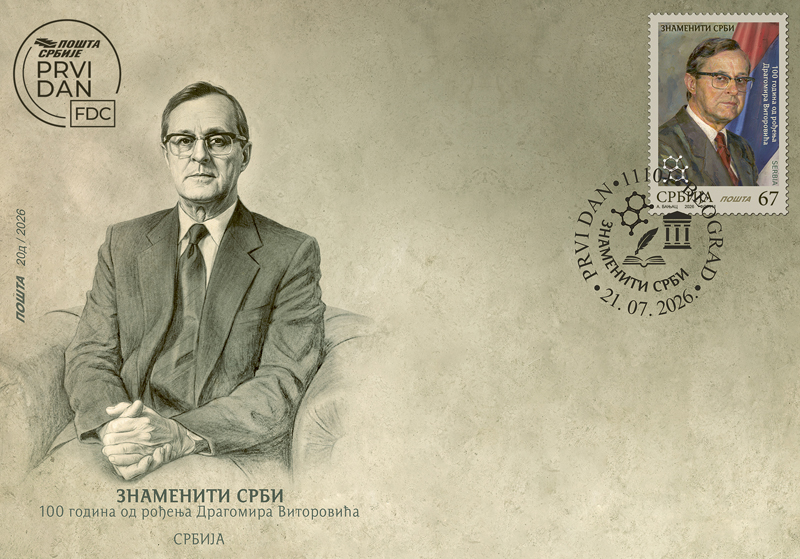
100 years since the birth of Dragomir Vitorović
Academician Dragomir Vitorović (Belgrade, September 17, 1926 – Belgrade, July 23, 2015) was one of the most prominent Serbian chemists of the 20th century and one of the founders of modern Serbian organic geochemistry. As a long-time full professor at the Faculty of Natural Sciences and Mathematics in Belgrade, he trained generations of young experts and passed on to them his passion for research. He was engaged in scientific research at the Department for Chemistry of the Institute of Chemistry, Technology and Metallurgy, studying the complex secrets of the chemistry of oil, coal and bituminous shale. His pioneering work in the field of organic geochemistry and his great contribution to the development of science was crowned by membership in the Serbian Academy of Sciences and Arts, where he was elected a corresponding member in 1981 and a full member in 1991. At the Serbian Academy of Sciences and Arts, he was active in the Committee for Chemistry, the Committee for Geochemistry, as well as in the committees for evaluating intellectual creativity and studying the lives of our scientists.
Professor Vitorović is the author of numerous papers published in leading international and domestic scientific journals and monographs, which still serve as indispensable reference literature for new generations of researchers. For his decades of dedicated work, scientific achievements and encouragement of international cooperation, he was awarded the Belgrade October Prize (1972), the July 7th Prize (1988) and the Order of the Red Banner of Labour (1981).
Professional cooperation: Serbian Academy of Sciences and Arts, Belgrade
Artistic realization: Anamari Banjac, MА, Academic Painter
Technical details
Date of issue: 21. 07. 2026.
Number of stamps in set: 5
Denomination:
1459: 67.00 дин
1460: 67.00 дин
1461: 67.00 дин
1462: 67.00 дин
1463: 67.00 дин
Printrun: 15.000 x 5
FDC: 5
Sheet of: 8
Dimensions of stamps: 29 x 42 mm
Artistic realization: Anamari Banjac
Subject: Notable Serbs
1459 – Portrait of Jevrem Grujić (detail), Stevan Todorović, oil on canvas, 1888
1460 – Ljubomir Nenadović
1461 – Portrait of Svetozar Miletić (oil on canvas, 1906), a work by the painter Nadežda Petrović
1462 – Borisav Stanković
1463 – Academician Dragomir Vitorović
Perforations: 13 ¾
Printer: Forum Novi Sad
145 years of diplomatic relations between the Republic of Serbia and the United States of America
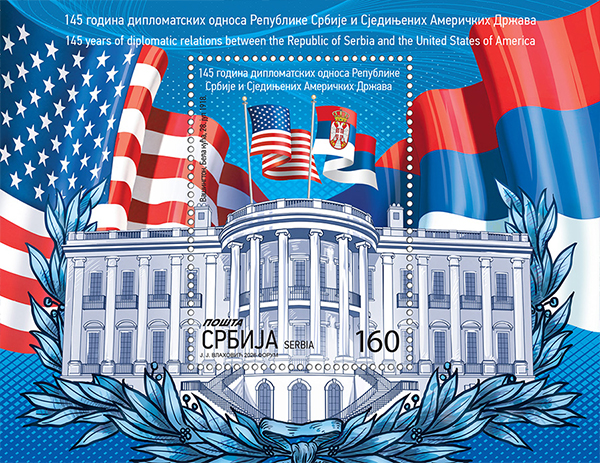

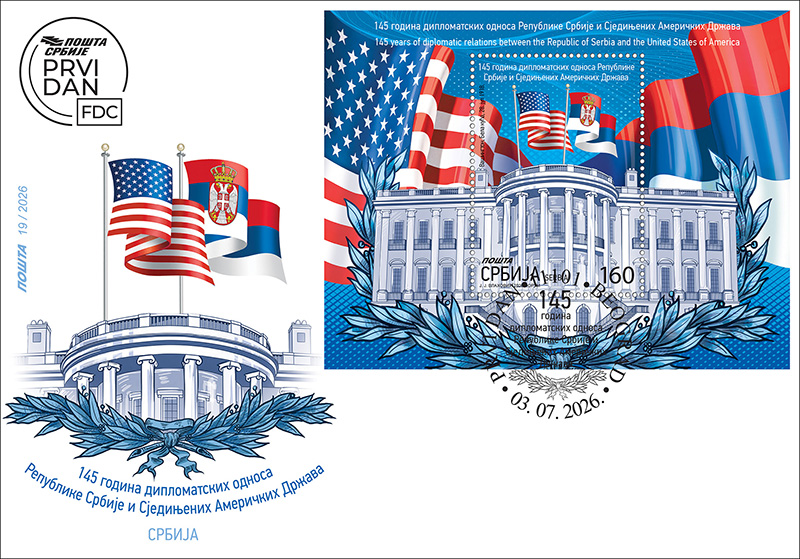
For almost a century and a half, relations between Serbia and the United States have been built on mutual respect, cooperation, and a shared ideal of freedom. This year, as we celebrate 145 years since the establishment of official diplomatic relations, we commemorate the pillars on which our relationship was built. In the year when we also mark the 250th anniversary of the US Declaration of Independence, this is an opportunity to recall our common, centuries-old struggle for freedom, as a value that our peoples especially cherish.
The same spirit from Philadelphia and Boston was present in Orašac and Takovo. All this time, the ideal of freedom inspired our soldiers to fight side by side for a better world, our scientists to enlighten and connect that world, our businessmen to enrich it, and our artists to make it more beautiful and noble.
Hoping that in the future we will be even more firmly bound in our common aspirations, we celebrate this important anniversary and remember the personalities, ideas, and places that symbolize our struggles for freedom.
President Woodrow Wilson ordered the Serbian flag to be raised above the White House on July 28, 1918, at the initiative of his friend Mihajlo Pupin. This was just one of many gestures of solidarity by Americans with the Serbian people during World War I, in which we fought side by side.
Expert collaboration: Ministry of Foreign Affairs of the Republic of Serbia.
Artistic realization: MA Jakša Vlahović, academic graphic artist
Technical details
Date of issue: 03. 07. 2026.
Number of stamps in set: block with 1 stamp
Denomination:
Block 118: 160.00 RSD
Printrun: 10.000
FDC: 1
Sheet of: block
Dimensions of block: 96 x 74 mm
Dimensions of stamp in block: 35 x 49.3 mm
Artistic realization: Jakša Vlahović
Subject: 145 years of diplomatic relations between the Republic of Serbia and the United States of America
118: White House in Washington, July 28, 1918, with flags of the United States of America and the Republic of Serbia
Perforations: 13 ¾
Printer: Forum Novi Sad
Protected animal species
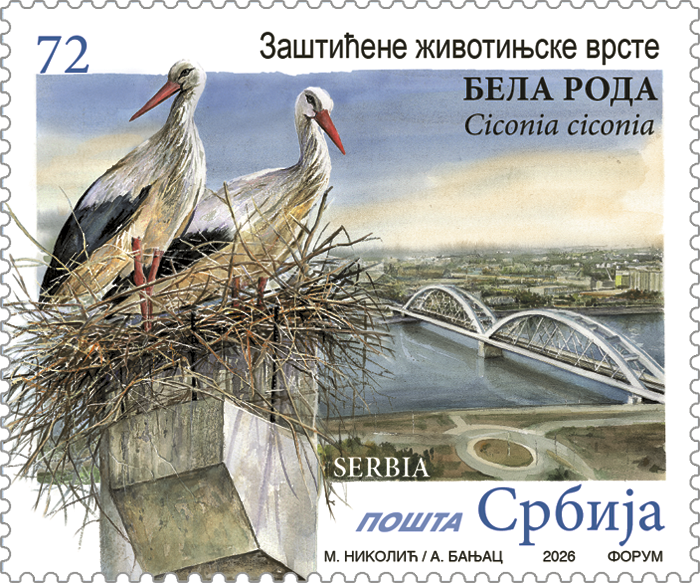
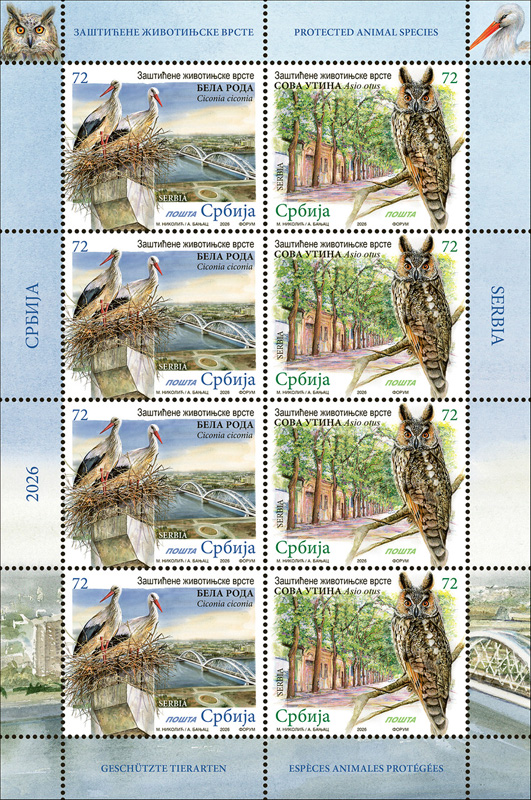
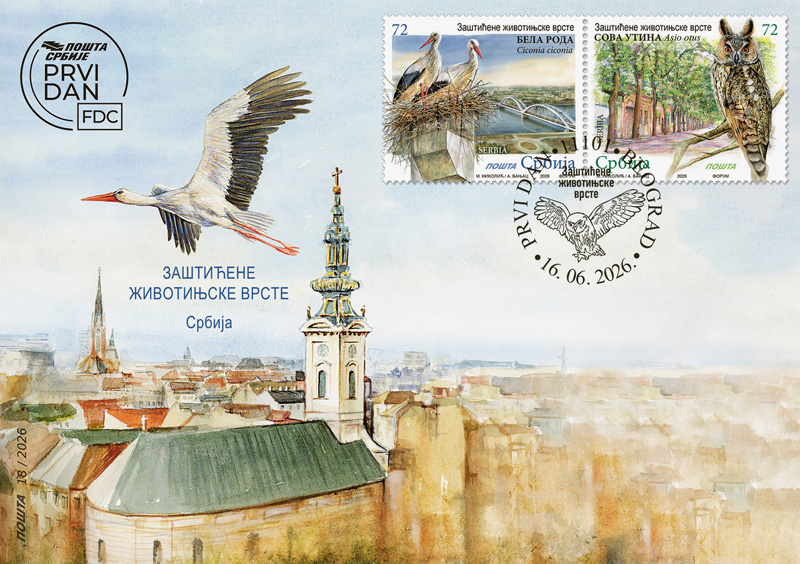

The white stork (Ciconia ciconia), the most famous migratory bird, nests in Europe and parts of Asia and Africa, while spending the winter in sub-Saharan Africa and India. It builds its nests near humans, on buildings and utility poles. It feeds on insects, amphibians, reptiles, fish, and small mammals. Its average lifespan is 15 years. The female lays 3–6 eggs, and both parents take turns incubating them for 34 days. The young set off on their journey to the wintering grounds – spanning about 12,000 km in one direction – in mid-August, while the parents follow in early September.
The journey is extremely dangerous: due to high mortality rates, only one out of ten storks manages to return home after three years. Consequently, they are now depleted or have completely disappeared in many parts of Europe. They are threatened by the loss of wetlands, poaching in the Middle East, and electrocution. However, the population in Serbia is strictly protected, showing a slight growth and counting between 1,900 and 2,000 pairs. More than half of them nest in Vojvodina, and Novi Sad boasts the largest stork colony in a single location in Europe.
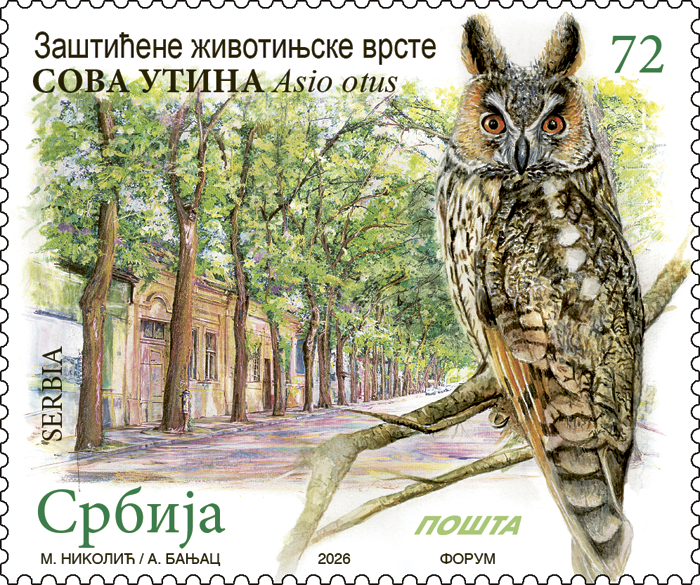
The long-eared owl (Asio otus) is a medium-sized owl, recognizable by its long feather tufts that look like ears. Females are larger than males. Males emit a quiet hooting sound, females make a whining call, and the young produce a very piercing sound resembling a squeaking swing. This species does not build nests, but steals them from other birds. From mid-March to late April, the female lays 3–5 eggs. The young hatch after 28 days, leave the nest after 25 days. When they are seven weeks old, they are fully capable of flying.
Long-eared owls are active at night, feeding on rodents and small mammals, while hiding in tree crowns during the day. In winter, they gather into roosts – ranging from a few to several hundred individuals – at traditional locations, often in inhabited areas. As natural regulators of rodent populations, long-eared owls are of immense importance to humans because they reduce the need for chemical poisons that pollute food and the environment. In Serbia, they are a strictly protected species, and in Vojvodina alone, there are around 450 owl roosting sites where about 30,000 individuals winter together. The town square in Kikinda is the largest winter habitat of long-eared owls on planet Earth.
Professional collaboration on the issue: Milan Ružić, Kalman Moldvai, Uroš Stojiljković, Bird Protection and Study Society of Serbia
Artistic realization of the issue: Miroslav Nikolić; Anamari Banjac, MA, Academic Painter
Technical details
Date of issue: 16. 06. 2026.
Number of stamps in set: 2
Denomination:
1456: 72.00 RSD
1457: 72.00 RSD
Printrun: 25.000
FDC: 1
Sheet of: 8
Dimensions of stamp: 42,05 x 35 mm
Artistic realization: Anamari Banjac
Subject: Protected animal species
1456: The white stork (Ciconia ciconia)
1457: The long-eared owl (Asio otus)
Perforations: 13 3/4
Printer: Forum Novi Sad
Joint issue Serbia – Slovenia
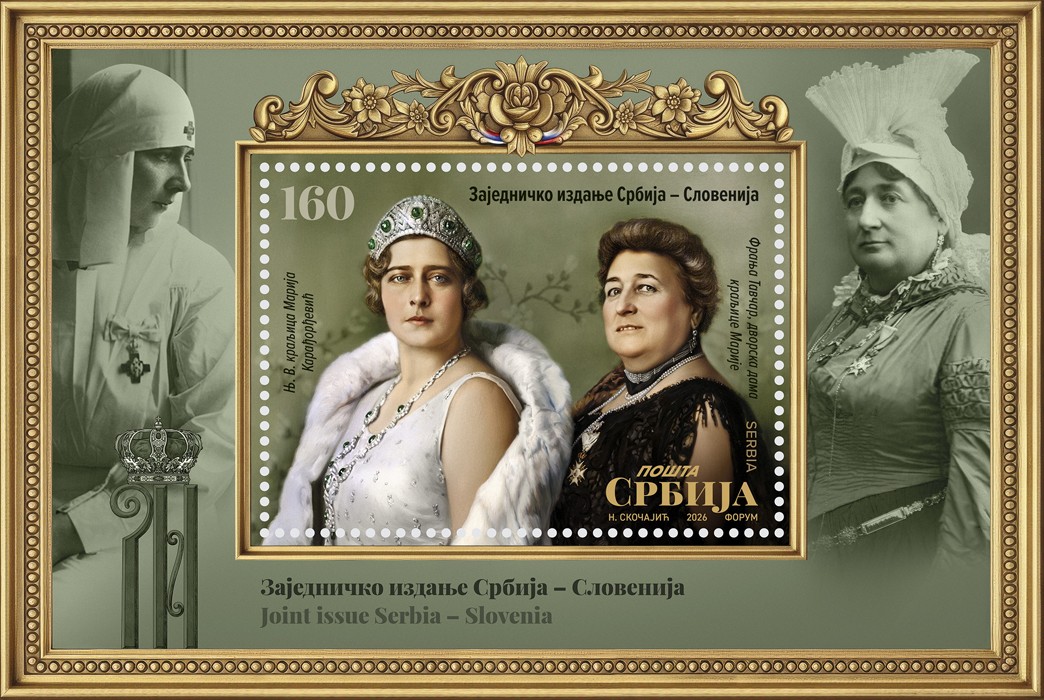

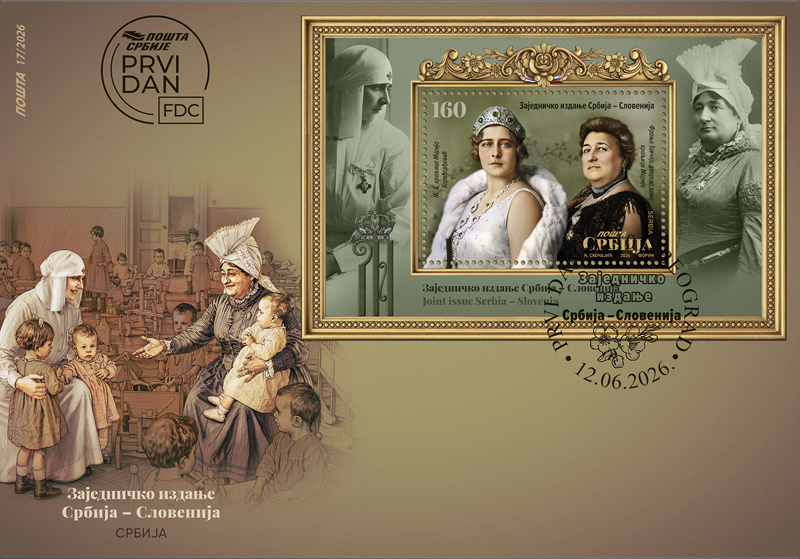
The joint issue of commemorative postage stamps issued by the Posts of Serbia and Slovenia dedicated to HM Queen Maria Karađorđević and her court lady Franja Tavčar pays tribute to two remarkable women whose lives and work connected two nations through humanity, friendship, and commitment to others.
Queen Maria was widely respected for her deep compassion and tireless humanitarian engagement. Through numerous charitable initiatives, particularly those aimed at helping women and children, the poor, war victims and orphans, she left a lasting legacy of kindness and responsibility throughout the former Kingdom, earning her the title of Queen Mother of all nations who lived in Yugoslavia.
Franja Tavčar, a devoted court lady, known for her dedication, loyalty, and humanitarian spirit, shared the Queen’s commitment to helping those in need, who need help the most. She initiated and supported charitable activities and embodied the values of solidarity and service to others.
Their personal bond symbolizes the historic ties between the Serbian and Slovenian peoples. Through their humanitarian work and shared ideals, Queen Maria and Franja Tavčar are, even today, a bridge of friendship between the two nations, reminding us that compassion and kindness transcend borders and generations.
Expert cooperation: Uroš Parezanović, Head of Public Relations and Protocol of the Royal Palace; Biljana Ristić, Senior History Curator, Škofja Loka Museum
Artistic realization of the issue: Nadežda Skočajić, academic graphic artist
Technical details
Date of issue: 12. 06. 2026.
Number of stamps in set: block with 1 stamp
Denomination:
Block 117: 160.00 RSD
Printrun: 10.000
FDC: 1
Sheet of: block
Dimensions of block: 100 x 67 mm
Dimensions of stamp in block: 49.3 x 35 mm
Artistic realization: Nadežda Skočajić
Subject: Joint issue Serbia – Slovenia
117: Portraits of HM Queen Maria Karađorđević and her court lady Franja Tavčar
Perforations: 13 ¾
Printer: Forum Novi Sad
85 years of diplomatic relations between the Republic of Serbia and Canada
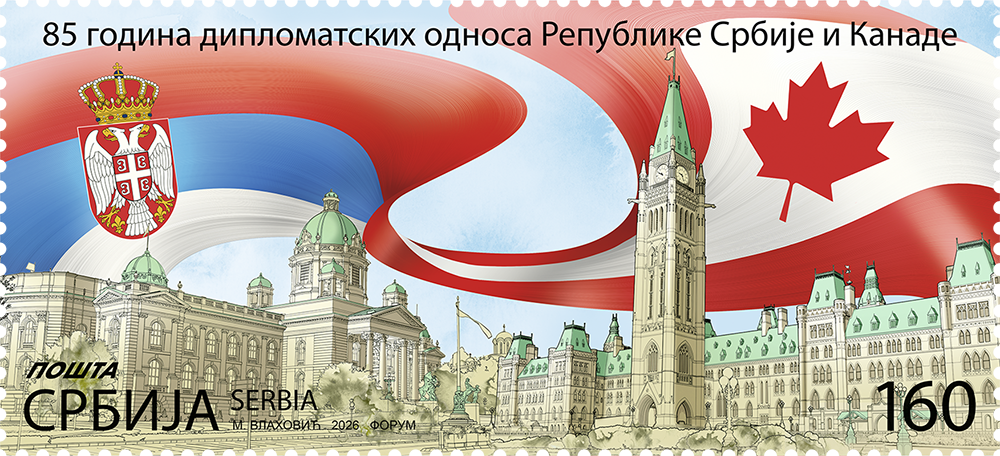

The celebration of the 85th anniversary of the establishment of diplomatic relations between Serbia and Canada confirms the long continuity and stability of relations between the two countries, but also their ability to develop and adapt to the modern international context. This anniversary is an opportunity to highlight the historical foundations of our ties, but also the areas in which cooperation is deepening today – political dialogue, economy, culture, science and education.
Contemporary relations between Serbia and Canada are marked by concrete institutional and practical steps, including the formation of parliamentary friendship groups in the parliaments of both countries, as well as the establishment of a direct Belgrade–Toronto air route in May 2026, the first in 34 years, which significantly contributes to connecting citizens and intensifying economic activities.
This anniversary year also carries a strong symbolic dimension through the celebration of the 170th anniversary of the birth of Nikola Tesla, a figure who connects Serbia and North America in a recognizable and lasting way, as well as through preparations for the Specialized Exhibition EXPO 2027 Belgrade, which opens up new opportunities for international cooperation and partnerships for Serbia.
Professional cooperation: Ministry of Foreign Affairs, North and South America Department
Artistic realization: Marija Vlahović, Academic Graphic Artist
Technical details
Date of issue: 29. 05. 2026.
Number of stamps in set: 1
Denomination:
1454: 160.00 RSD
Printrun: 15.000
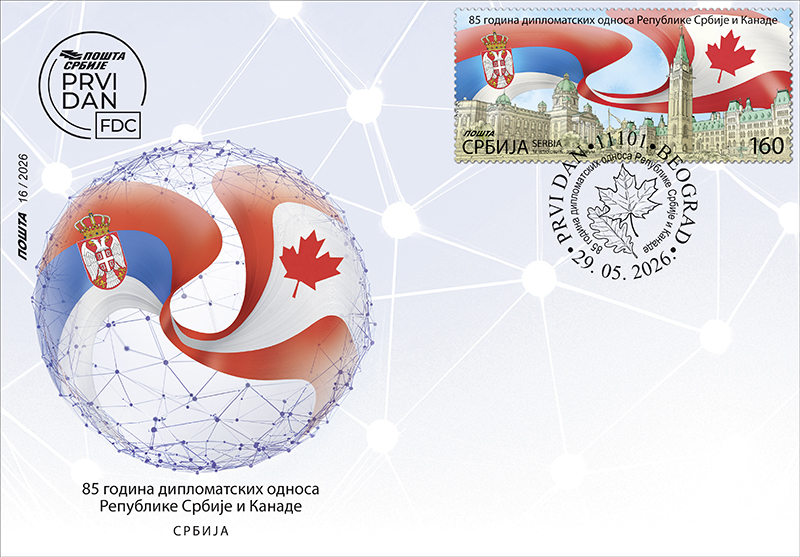
FDC: 1
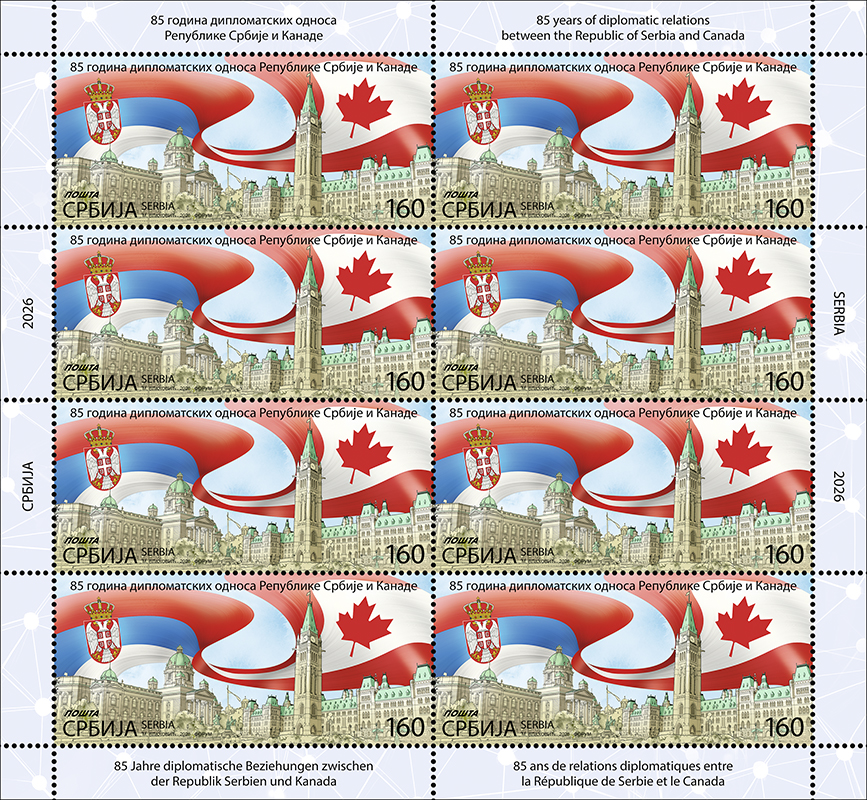
Sheet of: 8
Dimensions of stamp: 70 x 31,9 mm
Artistic realization: Marija Vlahović
Subject: Stamp Day - 75th Anniversary of the First National Philatelic Exhibition
1454: the buildings of the parliaments and flags of the Republic of Serbia and Canada
Perforations: 13 3/4
Printer: Forum Novi Sad
100 years of the International Philatelic Federation (FIP)
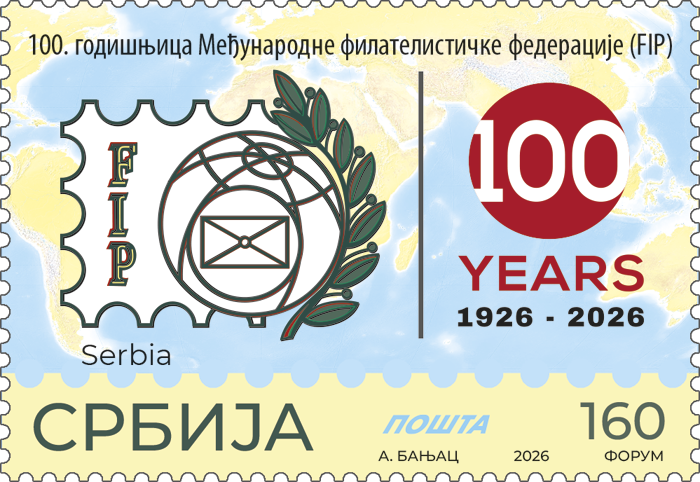
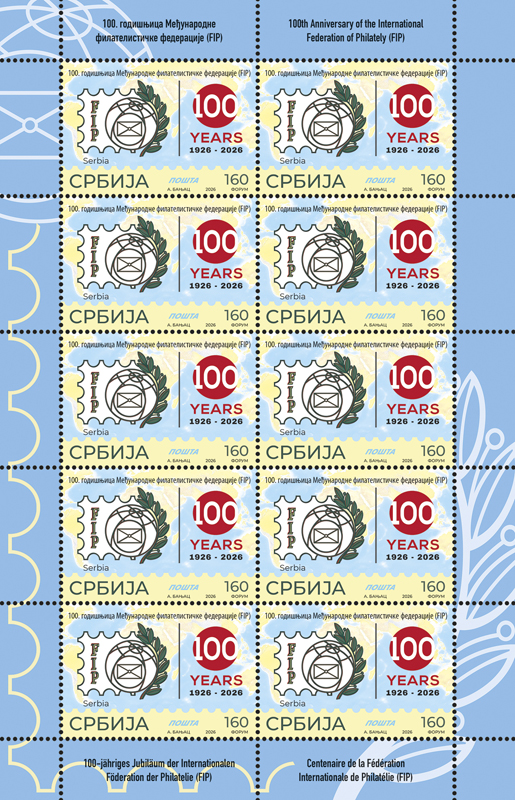
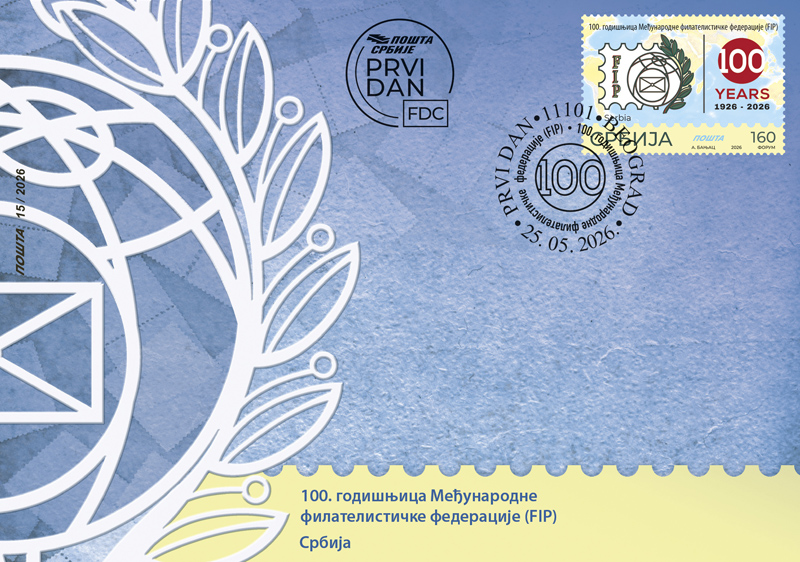

The International Philatelic Federation, i.e. Fédération Internationale de Philatélie (FIP) was founded in Paris on June 18, 1926. The association was created at the initiative of a group of European philatelic societies, who came together during the International Philatelic Exhibition in Paris and agreed to create a global umbrella organization for philatelists. From an organization that consisted of only a few European societies a hundred years ago, the International Philatelic Federation ˗ FIP has developed into a global network of more than 90 national philatelic societies and is today the supreme authority for defining standards in modern philately.
The headquarters of this organization are in Zurich, and the main goals of the FIP are the advancement of philately and stamp collecting, the development of friendly relations between nations, and cooperation with postal administrations. The FIP plays a special role in the development of exhibition activities, through the granting of patronage and recognition to international exhibitions, as well as through the work of specialized commissions covering various areas of philately.
World exhibitions are held under the auspices of the FIP, as the highest level of philatelic competition, the status and standards of which are determined by the FIP, defining the criteria for evaluating exhibits.
Based on the belief that postage stamps are “little ambassadors” of countries, the FIP positions philately as a lasting cultural value and a means of connecting nations and cultures. Union of Philatelists of Serbia, as a full member, actively participates in the work of the FIP and is present on the international exhibition scene.
Professional cooperation on the issue: Vladimir Milić, President of the Union of Philatelists of Serbia
Artistic realization of the issue: MA Anamari Banjac, academic painter
Technical details
Date of issue: 25. 05. 2026.
Number of stamps in set: 1
Denomination:
1453: 160.00 RSD
Printrun: 15.000
FDC: 1
Sheet of: 10
Dimensions of stamp: 42 x 29 mm
Artistic realization: Anamari Banjac
Subject: 100 years of the International Philatelic Federation (FIP)
1453: Jubileum logo of the International Philatelic Federation (FIP)
Perforations: 13 3/4
Printer: Forum Novi Sad
100 Years of the Archives of Vojvodina
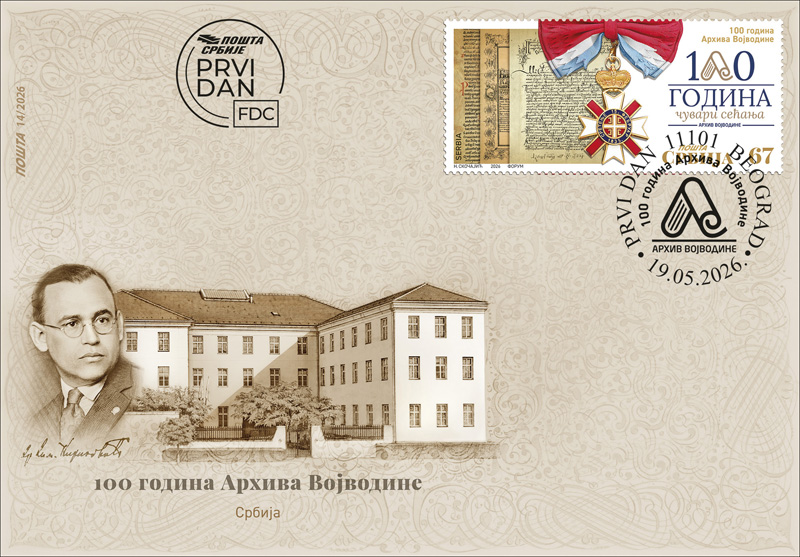

The Archives of Vojvodina was founded in 1926 as the State Archives in Novi Sad. Since 1989, the headquarters of the Archives have been placed in an adapted building of the former remand prison, built at the beginning of the 20th century according to the project of the architect Đula Vagner. The building was declared a cultural monument in 2007.
Dr. Dimitrije Kirilović (1894–1956) was the first archivist of the State Archives in Novi Sad from 1926 to 1932, and then its director from 1932 to 1941. With his dedicated work, he laid the foundations of an organized archival service and made a decisive contribution to the institutional development of archival activity, the systematic collection and protection of materials, as well as the formation of the original archival fund.
Today, the Archives of Vojvodina operates as a public institution, responsible for the protection of archival materials and documentary material created through the work of provincial authorities, institutions, organizations and prominent individuals in the area of today's AP Vojvodina. The materials kept in the Archives cover the period from the time of the Habsburg Monarchy to the modern era and represent authentic testimony to the political, socio-economic and cultural-historical circumstances in which its creators operated, and are used for public law, private law and scientific research purposes.
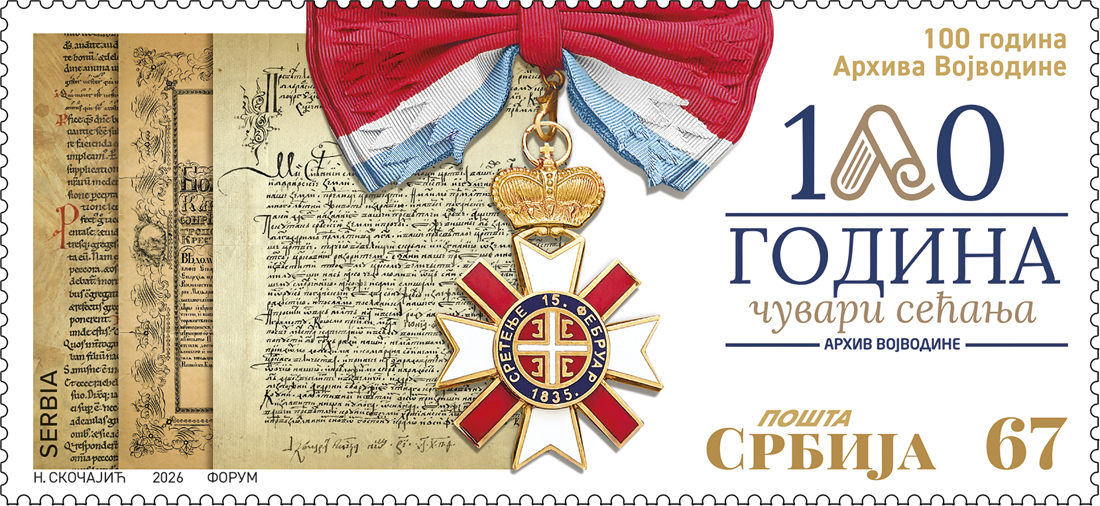
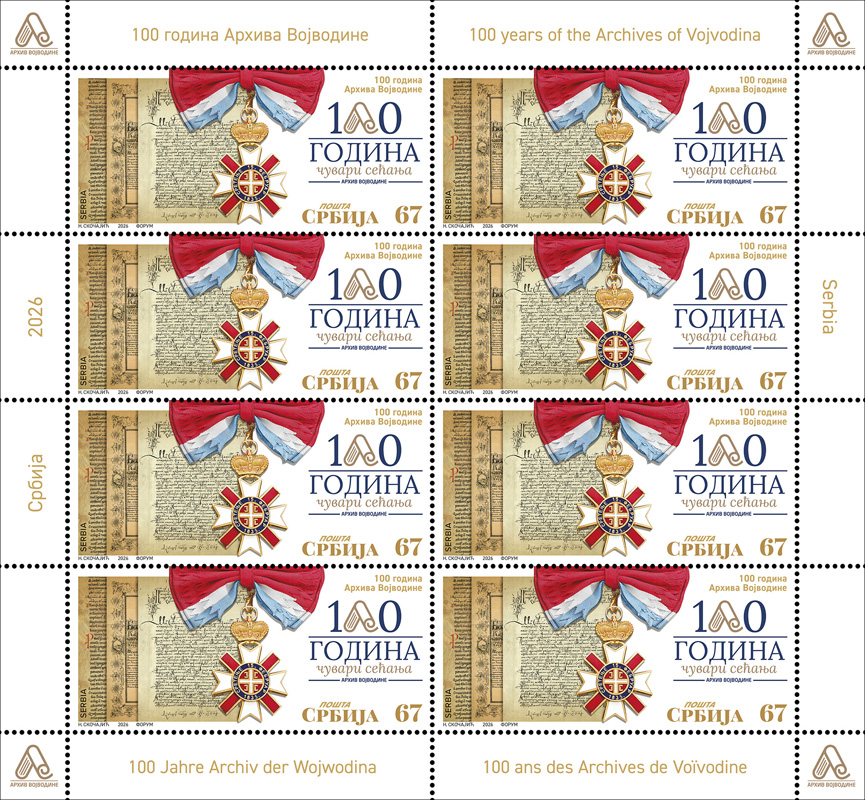
Motifs on the issue: fragment of a breviary on parchment (12th–13th century); Metropolitan Stefan Stratimirović announcing the appointment of Josif Rajačić as Bishop of Vrsac (1833); Letter of gratitude from Patriarch Arsenij III Crnojević to the Austrian Emperor Leopold I for the mercy shown to the refugee Serbian people (1690); The Sretenje Order of the First Degree, awarded to the Archives of Vojvodina on the occasion of its one hundred years of work, for special services to the Republic of Serbia and its citizens in preserving cultural and historical heritage.
Professional cooperation on the issue: Dunja Andrić, the Archives of Vojvodina
Artistic realization of the issue: MA Nadežda Skočajić, Academic Graphic Artist
Technical details
Date of issue: 19. 05. 2026.
Number of stamps in set: 1
Denomination:
1452: 67.00 RSD
Printrun: 25.000
FDC: 1
Sheet of: 8
Dimensions of stamp: 70 x 31,9 mm
Artistic realization: Nadežda Skočajić
Subject: 100 Years of the Archives of Vojvodina
1452: fragment of a breviary on parchment (12th–13th century); Metropolitan Stefan Stratimirović announcing the appointment of Josif Rajačić as Bishop of Vrsac (1833); Letter of gratitude from Patriarch Arsenij III Crnojević to the Austrian Emperor Leopold I for the mercy shown to the refugee Serbian people (1690); The Sretenje Order of the First Degree, awarded to the Archives of Vojvodina on the occasion of its one hundred years of work, for special services to the Republic of Serbia and its citizens in the preservation of cultural and historical heritage.
Perforations: 13 3/4
Printer: Forum Novi Sad
International Family Day
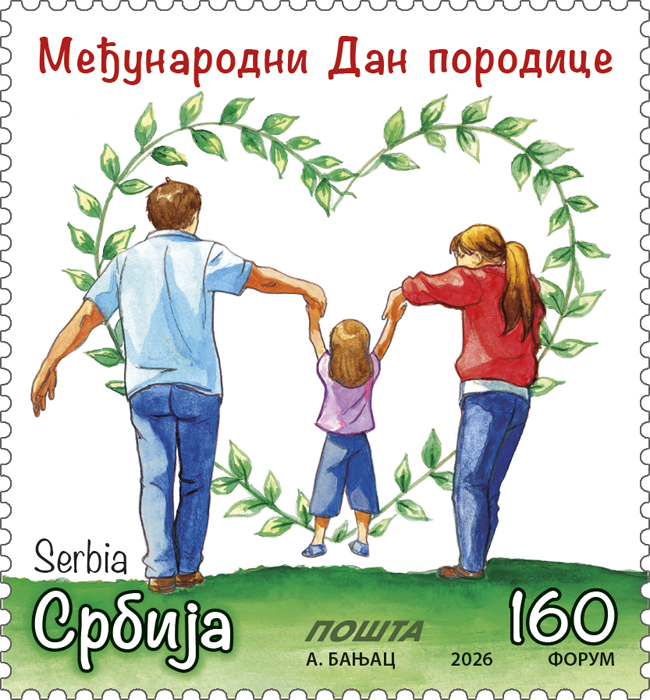
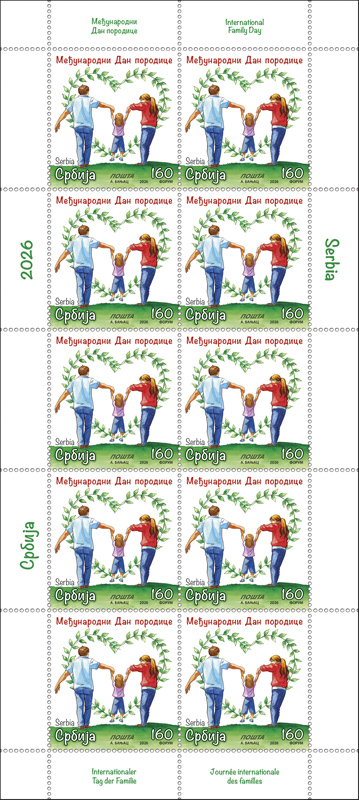
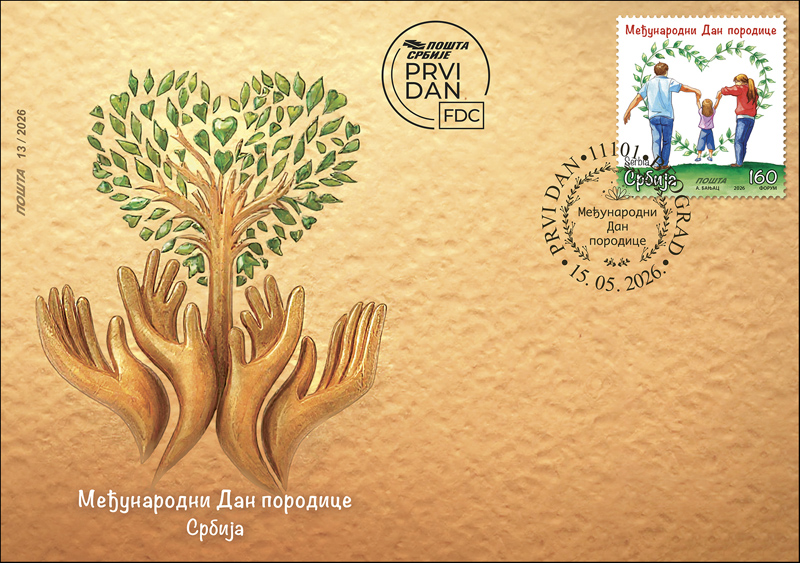

International Family Day is celebrated every year on May 15, in accordance with a resolution adopted by the United Nations General Assembly in 1993, and was first celebrated in 1994. This day was established with the aim of highlighting the importance of the family as the basic unit of society and raising awareness of the social, economic and demographic processes that affect the lives of families around the world.
The UN sets a theme for the celebration each year to highlight the current challenges facing families in the modern world. This year’s theme is ”Families, Inequalities and Child Wellbeing” and focuses on the impact of economic and social disparities on the position of families and the life chances of children.
The family is the foundation of social cohesion, intergenerational solidarity, and the preservation of cultural and moral values. It is in the family environment that the first knowledge is acquired, life attitudes are shaped, and relationships of trust, respect, and responsibility are built.
Contemporary global challenges, such as growing economic inequalities and unequal access to education, healthcare and basic services, significantly impact families and can deepen intergenerational cycles of poverty. Therefore, special attention is paid to the development of family-centred protection systems that help households remain stable and ensure that all children have equal opportunities for healthy and happy development.
According to the results of the 2022 Population Census*, there are more than 1.9 million families living in the Republic of Serbia, of which about 1.3 million have children. The Government of Serbia and the Ministry of Family Welfare and Demography are committed to preserving and improving the institution of the family through measures to support parenthood, developing community services, and improving conditions for quality family life.
** The census did not include data for the AP of Kosovo and Metohija
Professional cooperation: Ministry of Family Welfare and Demography
Artistic realization of the issue: MA Anamari Banjac, academic painter
Technical details
Date of issue: 15. 05. 2026.
Number of stamps in set: 1
Denomination:
1451: 160.00 RSD
Printrun: 15.000
FDC: 1
Sheet of: 10
Dimensions of stamp: 35 x 37,7 mm
Artistic realization: Anamari Banjac
Subject: International Family Day
1451: Scene of parents with child
Perforations: 13 3/4
Printer: Forum Novi Sad
STAMP DAY
75th Anniversary of the First National Philatelic Exhibition
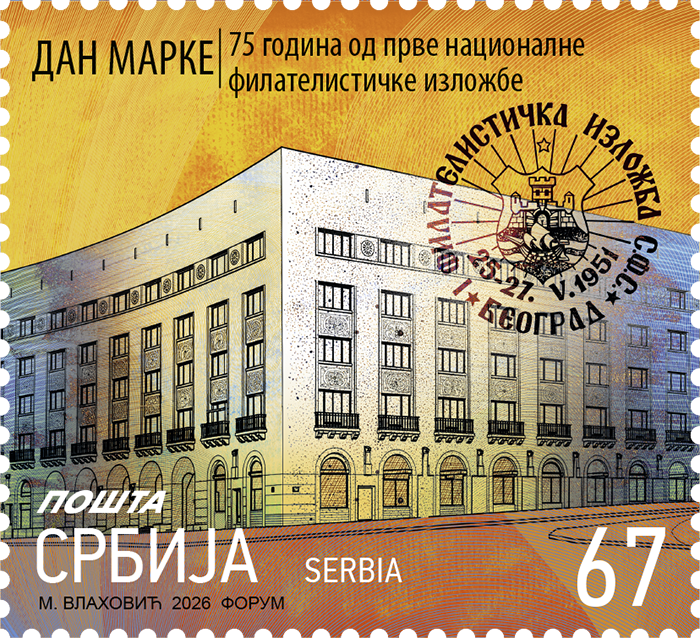
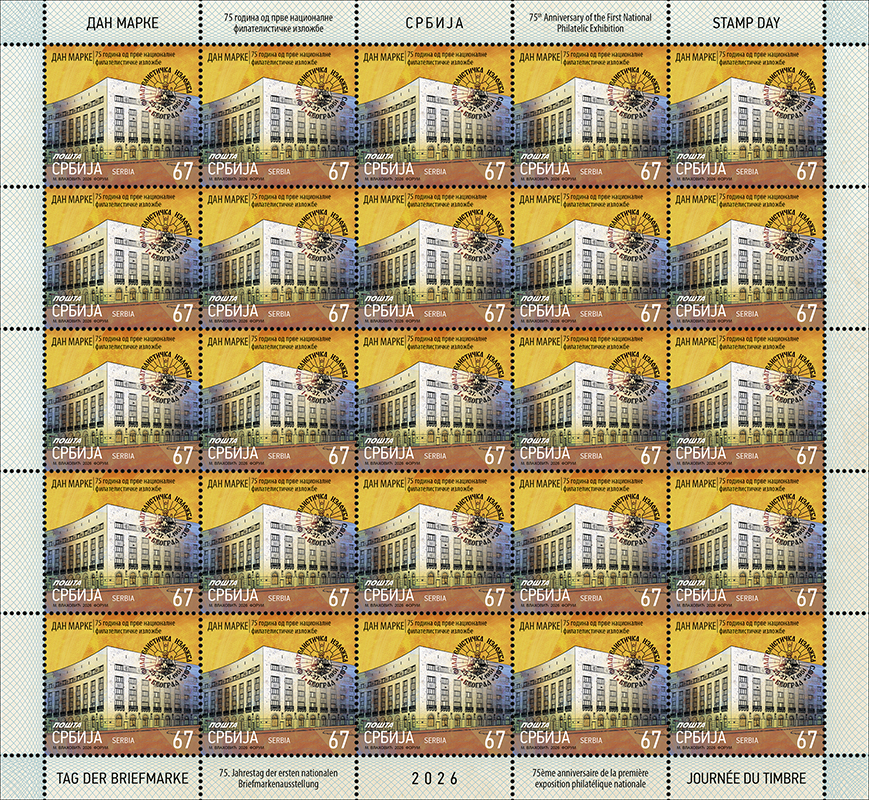
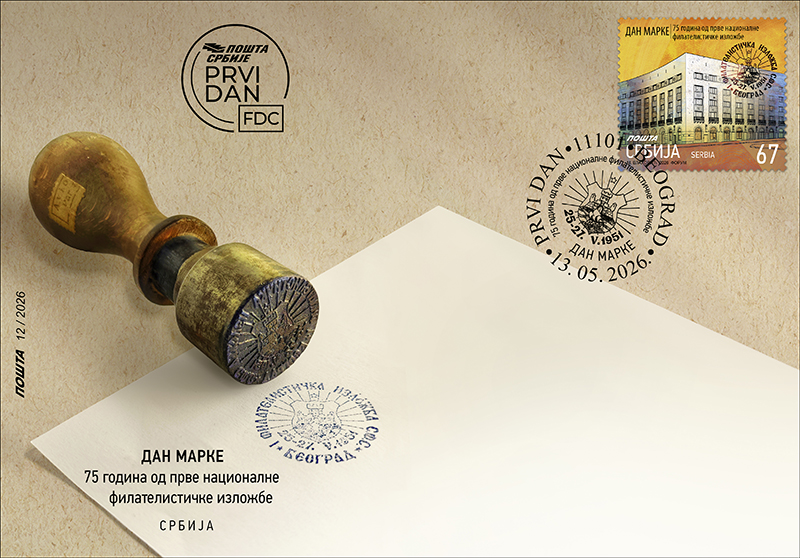

The first national philatelic exhibition was held in Belgrade from May 25 to 30, 1951, organized by the Union of Philatelists of Serbia, in the building of the Home for War Invalids on Savska Street.
Continuing the pre-war tradition, the exhibition marked the renewal of philatelic life after the interruption during World War II and represented the first major post-war philately review in Serbia.
The opening ceremony was attended by representatives of the PTT administration, the People’s Front and the diplomatic corps, as well as numerous guests. The exhibition featured 130 display cases, and due to the great interest of visitors, the duration of the exhibition was extended by three days. The exhibited material included pre-war and contemporary philately with a pronounced thematic character.
This historical event founded modern Serbian philately, and five decades later this exhibition, organized by the Union of Philatelists of Serbia, grew into a national philatelic exhibition – SRBIJAFILA.
Professional cooperation: Vladimir Milić, President of the Union of Philatelists of Serbia
Artistic realisation of the issue: MA Marija Vlahovic, Academic Graphic Artist
Technical details
Date of issue: 13. 05. 2026.
Number of stamps in set: 1
Denomination:
1450: 67.00 RSD
Printrun: 25.000
FDC: 1
Sheet of: 25
Dimensions of stamp: 35 x 31,9 mm
Artistic realization: Marija Vlahović
Subject: Stamp Day - 75th Anniversary of the First National Philatelic Exhibition
1450: the building of the Home for War Invalids on Savska Street and stamp of the first national philatelic exhibition
Perforations: 13 3/4
Printer: Forum Novi Sad
World Red Cross Day
150 years of the Red Cross of Serbia
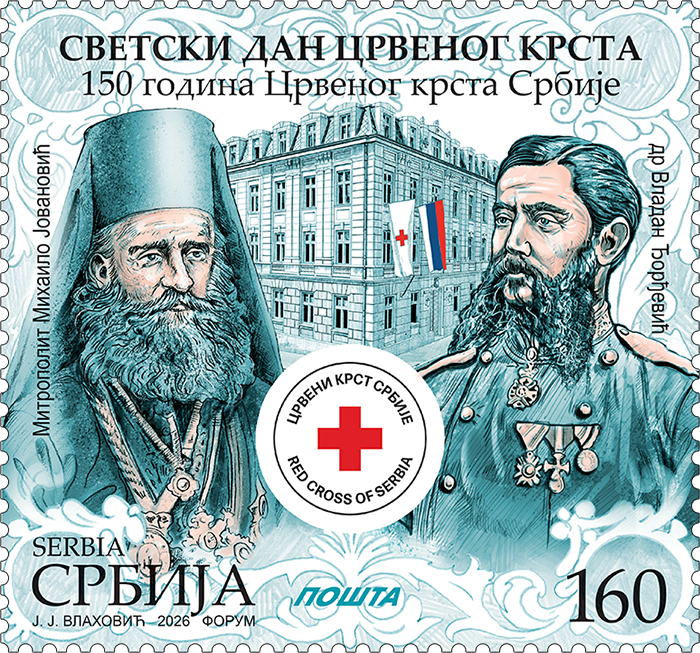
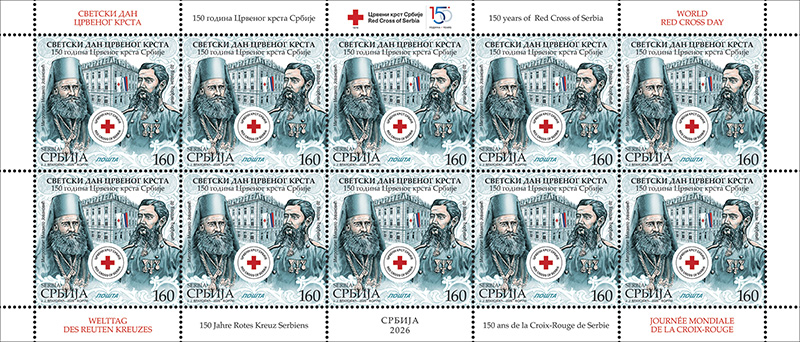
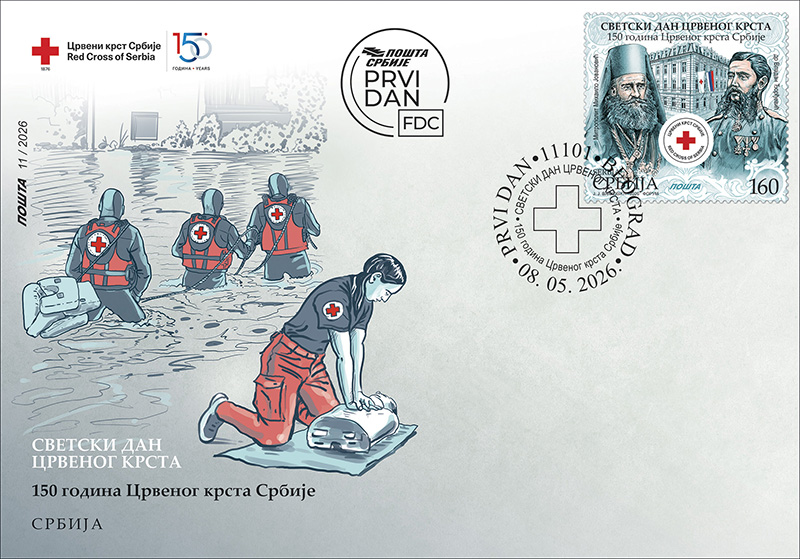

World Red Cross and Red Crescent Day is celebrated on May 8, the birthday of its founder, Henri Dunant. Faced with the horrors of the Battle of Solferino (1859), Dunant initiated the creation of a humanitarian organization to aid the wounded and protect medical personnel. Today, it is the International Red Cross and Red Crescent Movement, the largest global humanitarian network, providing assistance in wars, natural disasters and health crises, protecting human dignity without discrimination and alleviating suffering wherever it occurs.
This year we are also celebrating a great anniversary – 150 years of the Red Cross of Serbia. Founded in 1876 on the initiative of Dr Vladan Đorđević, the first Serbian trained surgeon, it is one of the oldest national societies in the world. The first president was Metropolitan Mihailo, while Princess (later Queen) Natalia donated land for the construction of the Society’s headquarters, which was designed by the prominent architect Aleksandar Bugarski.
Since its beginnings, the Red Cross of Serbia has played a crucial role in caring for victims during the Serbian-Turkish, Balkan, and World Wars I and II. Between the two world wars, the organization’s activities expanded to include social protection and health education.
Today, the Red Cross of Serbia consists of 183 organizations in cities and municipalities, along with two provincial organizations. As part of the International Movement, the Red Cross of Serbia implements programmes of voluntary blood donation, social assistance, first aid, emergency response, and education in various fields of work, remaining unwaveringly faithful to its humanitarian principles.
Expert collaboration: the Red Cross of Serbia.
Artistic realization: MA Jakša Vlahović, academic graphic artist
Technical details
Date of issue: 08. 05. 2026.
Number of stamps in set: 1
Denomination:
1449: 160.00 RSD
Printrun: 15.000
FDC: 1
Sheet of: 10
Dimensions of stamp: 42 x 39,15 mm
Artistic realization: Jakša Vlahović
Subject: World Red Cross Day - 150 years of the Red Cross of Serbia
1449: Metropolitan Mihailo Jovanović, first president of the Red Cross of Serbia; Dr. Vladan Đorđević, founder of the Red Cross of Serbia; new building of the headquarters of the Red Cross of Serbia in Belgrade.
Perforations: 13 ¾
Printer: Forum Novi Sad
EUROPA
70 years of EUROPA stamps

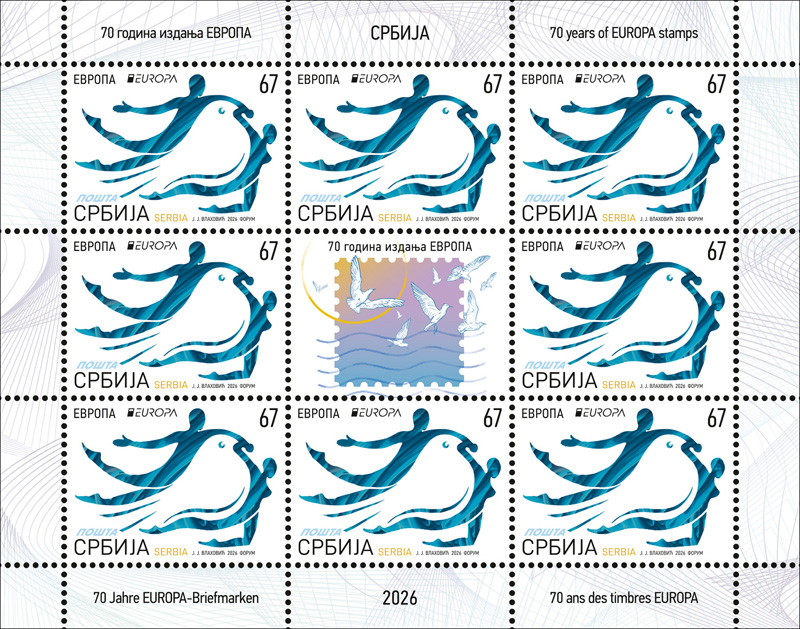
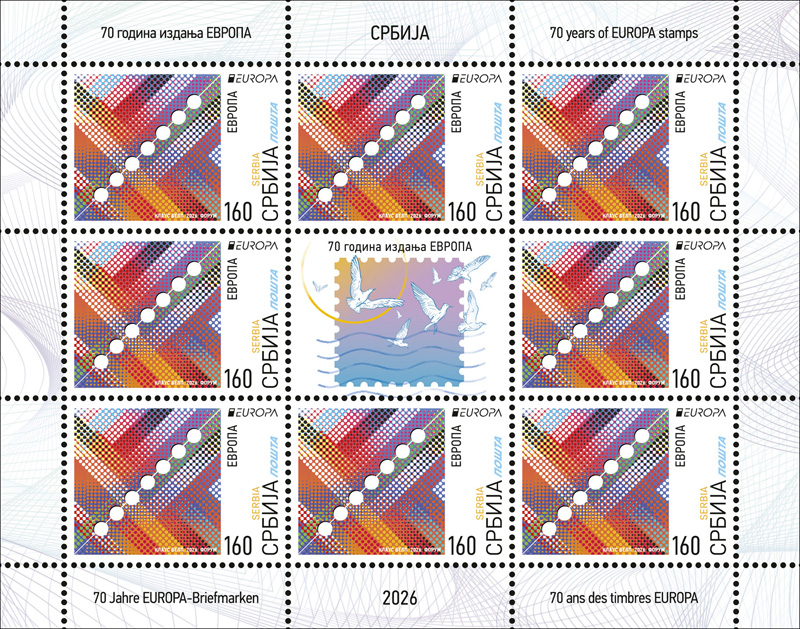
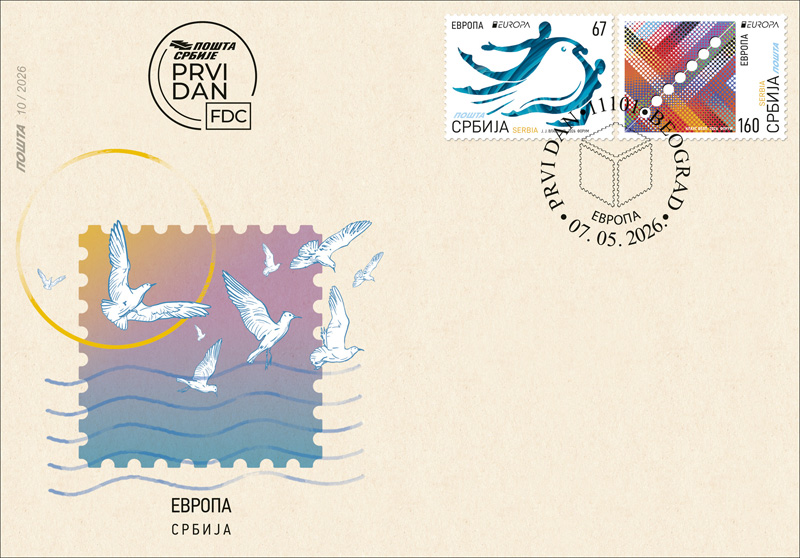
The Association of Public Postal Operators “PostEurop” is celebrating a significant anniversary in 2026 – seven decades since the first issue of postage stamps of the EUROPA series. Launched in 1956, this philatelic initiative has grown into one of the most recognizable symbols of European togetherness, promoting peace, cooperation and the richness of our continent’s diversity over the decades.
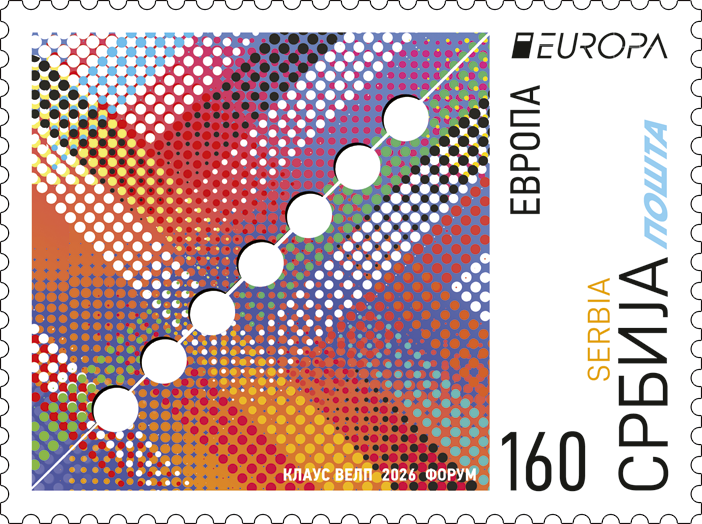
The grand jubilee is crowned by a joint motif that celebrates cooperation, innovation and unity. A special competition was held for the artistic solution of the motif of the joint stamp, with the topic “70 years of the EUROPA issue. United in...”, in which the proposal of the Finnish postal administration, authored by Klaus Welp, won.
The winning design, through abstract and symbolic motifs, artistically summarizes seven decades of cooperation between European postal operators, but also represents a call for the new generation of artists to visually shape the future of the community through their own creative expression.
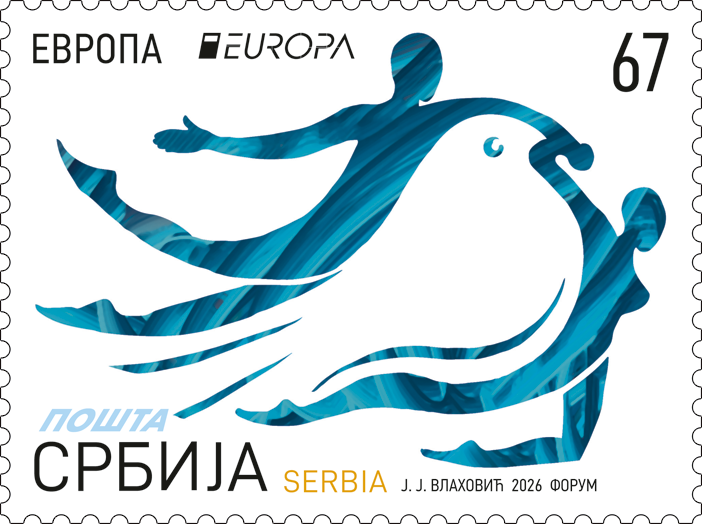
Post of Serbia complements this anniversary issue with an additional stamp by Jakša Vlahović. His design marks the PostEurop anniversary through a symbolic representation of harmonious cooperation between European nations, aimed at the peace and prosperity of mankind.
In this way, a small piece of paper reaffirms its role as an “ambassador of culture” and a bridge connecting nations. The EUROPA 2026 issue remains a permanent reminder of the power of cooperation that has built stronger relationships and preserved the idea of a united and peaceful Europe for seven decades.
Artistic realization:
Klaus Welp, Graphic Designer (Finland) – stamp with a face value of 160 RSD.
Jakša Vlahović, Academic Graphic Artist (Serbia) – stamp with a face value of 67 RSD.
Technical details
Date of issue: 07. 05. 2026.
Number of stamps in set: 2
Denomination:
1447: 67.00 RSD
1448: 160.00 RSD
Printrun: 15.000
FDC: 1
Sheet of: 8
Dimensions of stamp: 35 x 26,1 mm
Artistic realization: Jakša Vlahović – stamp 67 RSD, Klaus Welp – stamp 160 RSD.
Subject: Europa
1447: Symbolic depiction of a man and a woman, whose shapes form the silhouette of a dove – a messenger, a bearer of words and peace.
1448: The selected design of the Finnish Postal Administration, in honor of the anniversary of "PostEurop" in 2026, which has been printed as a motif on stamps of all member countries.
Perforations: 13 ¾
Printer: Forum Novi Sad
Sacral Architecture
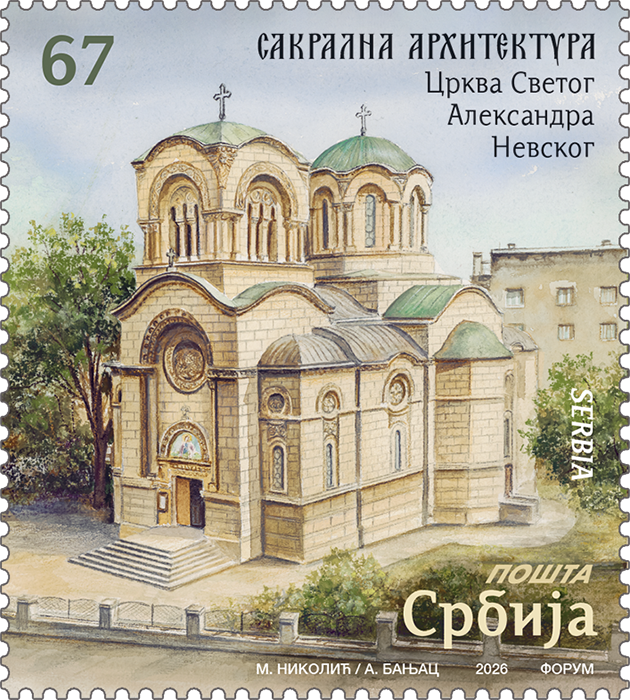

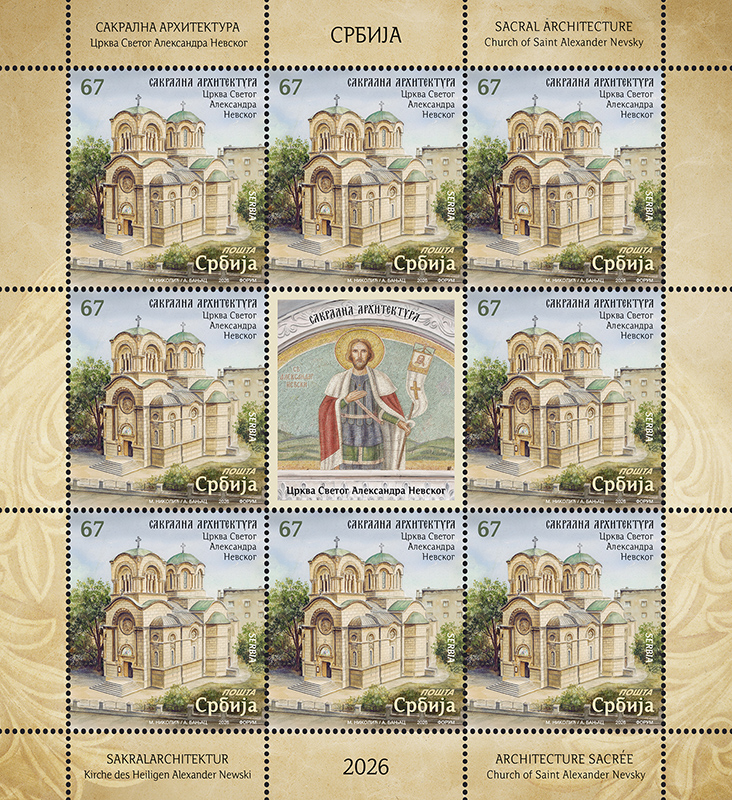
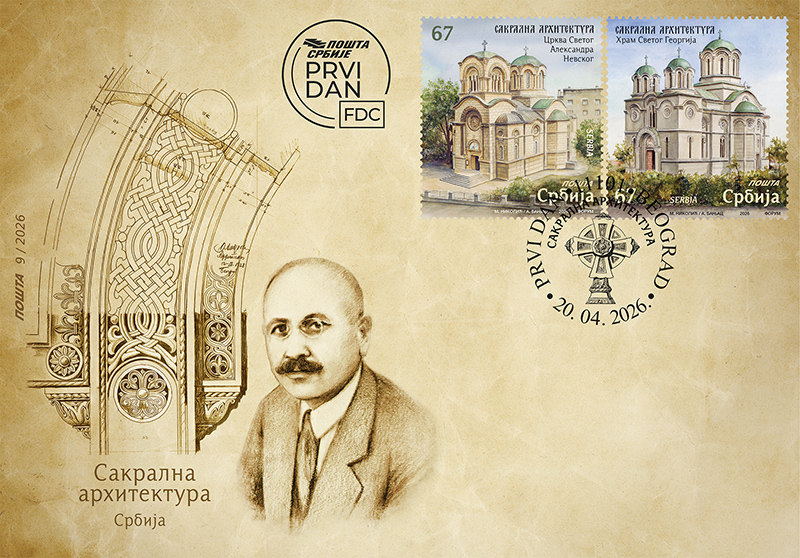
The Church of St. Alexander Nevsky was built as a parish church in Dorćol, but also as a permanent monument to the members of the Moravian Army, among whom were numerous Russian volunteers who fought for the liberation of Serbia. Built in the Serbian-Byzantine style, this triconch-domed building with a base in the shape of an inscribed cross, crowned by a central dome and adorned with rich stone decorations on the facade, is a contemporary but consistent interpretation of the original Moravian style. The original construction, which began in 1912 according to the design of architect Jelisaveta Načić, continued in 1927 and was completed in 1930, according to the architectural design of Vasily Mikhailovich Androsov (1872–1944), who designed and completed the temple. The newly built temple was the first interwar temple, and thus at one point the most modern solution in the sacral architecture of the capital.
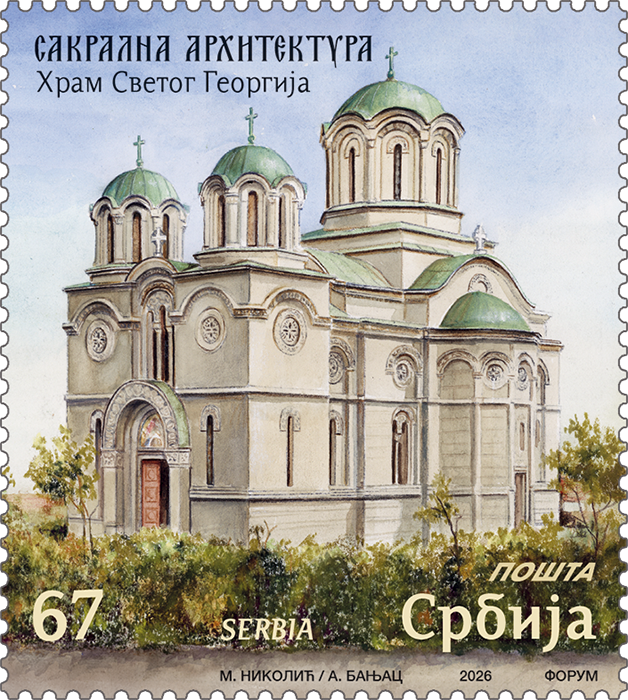
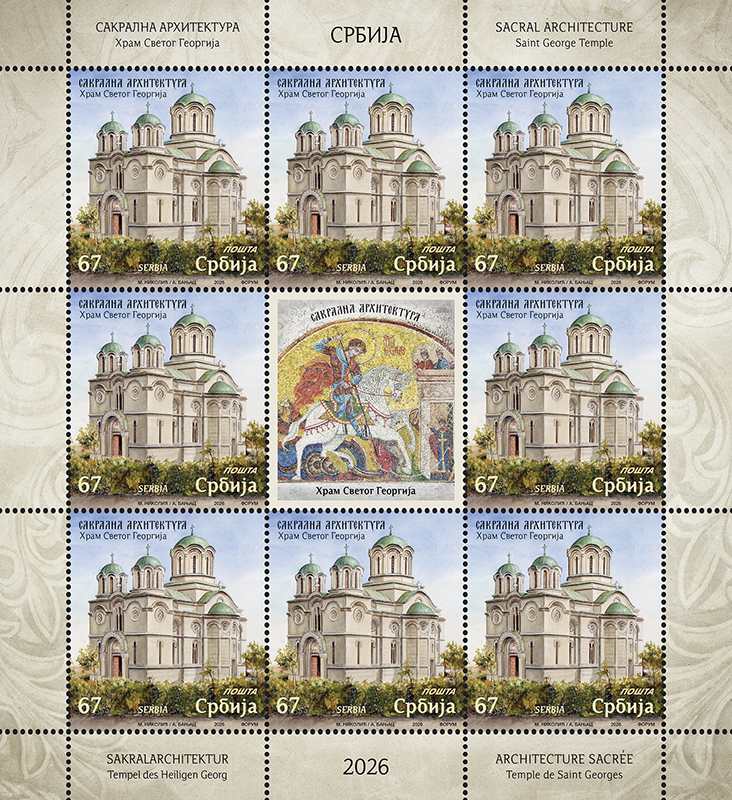
The Saint George Temple in Čukarica was designed by Vasily Mikhailovich Androsov in co-authorship with architect Dragutin Maslać. Dimitrije Mitar Jovanović donated his land in Čukarica to the Belgrade Municipality for the construction of a church, the construction of which began in June 1928 and lasted until 1932, when it was completed and consecrated. Built in the traditional Serbian-Byzantine style, with a base of an inscribed cross and three domes, the church’s architecture is reminiscent of medieval endowments, while the white stone facade and harmonious proportions of the church provide a sense of peace and spiritual stability in the midst of the urban environment. With its specific location, on a hill that dominates the panorama of Čukarica, the Saint George Temple still emphasizes the cultural as well as urban and spatial values of this part of Belgrade today.
With his rich architectural oeuvre, Androsov left a permanent mark on Serbian sacral architecture through the churches of St. Alexander Nevsky and St. George in Čukarica, sublimating national tradition and Byzantine roots into a unique architectural expression.
Professional cooperation: Serbian Orthodox Church; Stevan Mićić, architect,
Director of the Heraldic Club Belgrade
Artistic realization: Miroslav Nikolić; MA Anamari Banjac, Academic Painter
Technical details
Датум издања: 20. 04. 2026.
Број марака: 2
1445: 67.00 дин
1446: 67.00 дин
Тираж: 25.000
Коверат првог дана (FDC) са жигом: 1
Табак: 8
Димензије марке: 37,7 x 42 mm
Штампа: вишебојни офсет
Зупчање: чешљасто 13 ¾
Штампарија: Форум Нови Сад
Уметничка реализација: Мирослав Николић, Анамари Бањац
Subject: 110 years of the Australian medical mission in Serbia
1445 – Црква Светог Александра Невског
1446 – Храм Светог Ђорђа
Easter

Easter is the most important Christian holiday that Christians celebrate in memory of the resurrection of the Lord Jesus Christ on the third day after his death on the cross and burial. It symbolizes the victory of life over death, light over darkness, good over evil. It is a moveable holiday, but it always falls on a Sunday. Since the Orthodox Church calculates time according to the Julian calendar, this means that this holiday can fall between March 22 and April 25. It is celebrated after the Jewish Passover, on the first Sunday after the full moon. Easter is preceded by a special preparation and feat of fasting, with which Christians prepare for its celebration for seven weeks. It is celebrated for seven days, and in worship service until the feast of Pentecost – the Descent of the Holy Spirit on the Apostles, until when the faithful people greet each other with “Christ is risen!”, and in return respond “Indeed He is risen!”.
Among the Serbian people, in addition to “Uskrs” and “Vaskrs” (Easter), this holiday is also called “Veligdan”, or “Velik-dan” (Great Day), because it represents “the holiday of holidays and the feast of feasts”, a day of eternal joy, because Christ, “by the power of His divinity”, defeated death, after his voluntary sacrifice by crucifixion on the cross, for the salvation of the humankind.
The most famous Easter custom in the entire Christian world, which is directly related to the symbolism of Christ’s resurrection itself, is the painting of eggs. Easter is celebrated at the beginning of spring and the reawakening of nature, which is why various plants are used when painting the eggs, in order to depict the birth of a new life in nature. Among Orthodox Serbs, eggs are dyed on the Great Friday. The first egg, which is kept throughout the entire year, is painted red. It is called the “Housekeeper”.
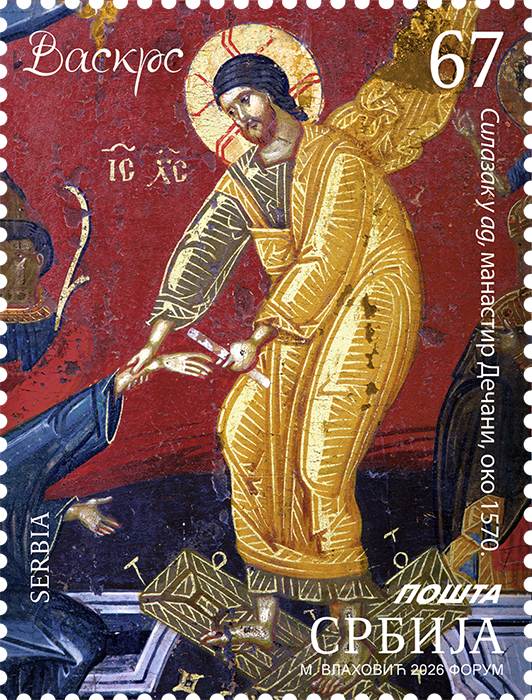
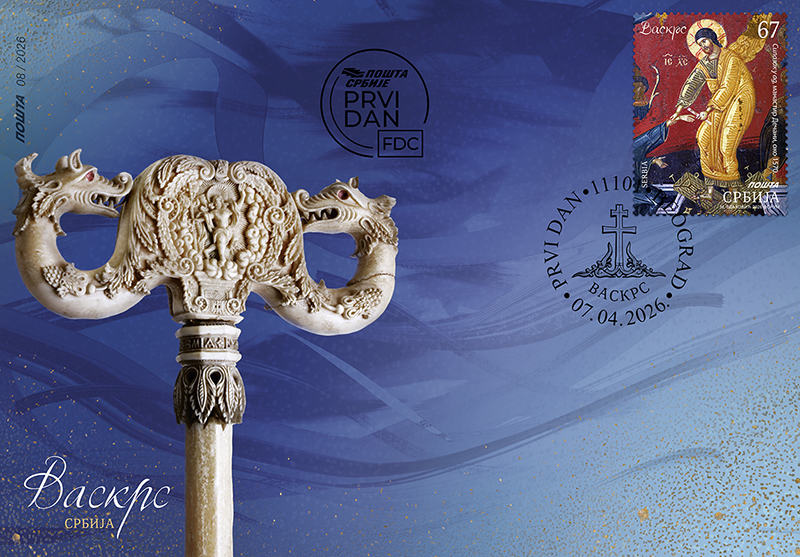
Motif on the stamp: Harrowing of Hell, 44 x 30.1 x 2.6 cm, tempera on panel, Dečani, treasury, iconographer Longinus, around 1570. Motif on the envelope: Archbishop’s sceptre of Serbian Patriarch Arsenije IV Jovanović Šakabenta, carved ivory, dimensions 165 x 18 cm, originally from the Šišatovac Monastery, unknown author, 1725–1748, Serbian Orthodox Church Museum.
Professional cooperation: Serbian Orthodox Church Museum
Artistic realisation of the issue: MA Marija Vlahovic, Academic Graphic Artist
Technical details
Date of issue: 07. 04. 2026.
Number of stamps in set: 1
Denomination:
1444: 67.00 RSD
Printrun: 25.000
FDC: 1
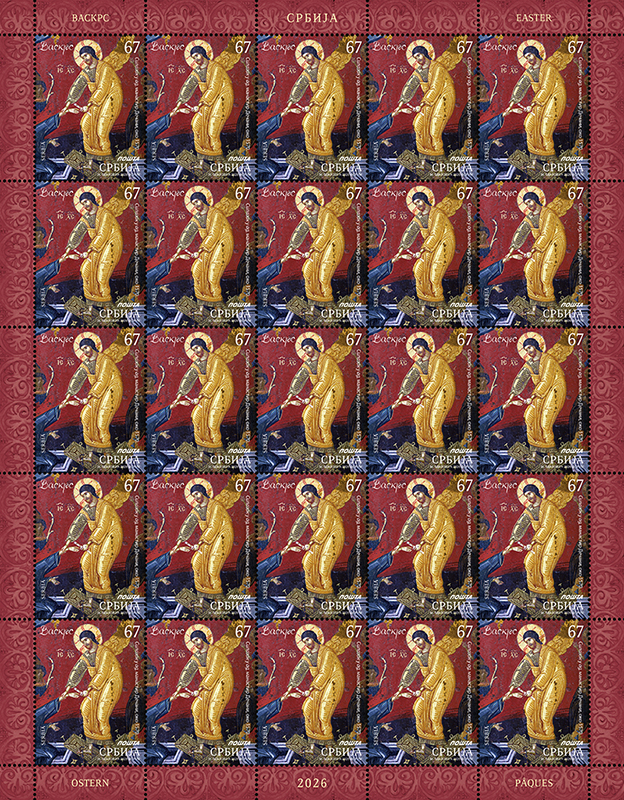
Sheet of: 25
Dimensions of stamp: 31,9 x 42 mm
Artistic realization: Marija Vlahović
Subject: Easter
1444: Harrowing of Hell, Dečani, around 1570.
Perforations: 13 3/4
Printer: Forum Novi Sad
European nature protection
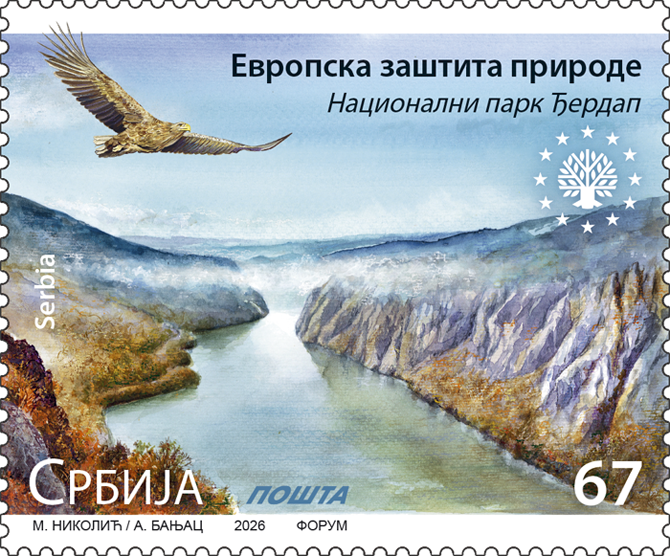

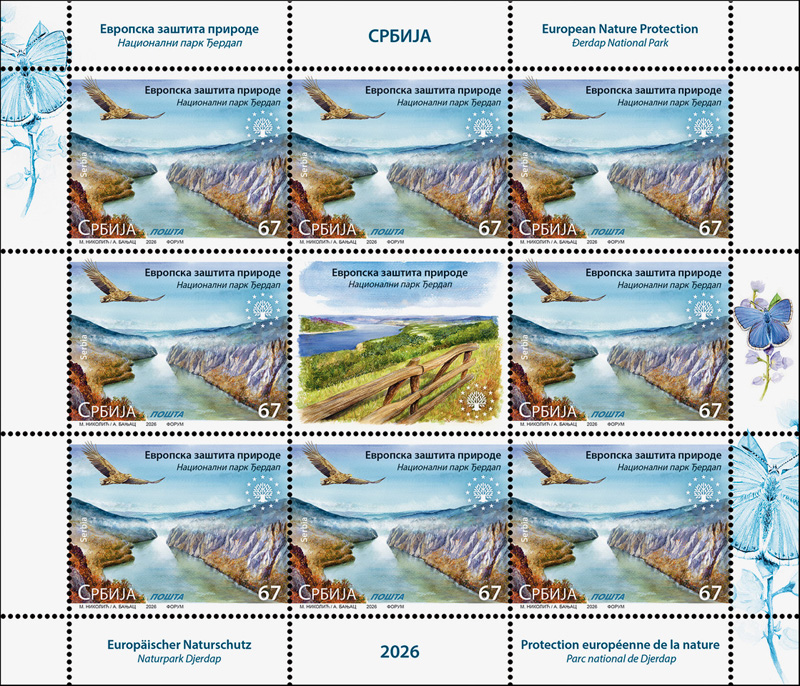
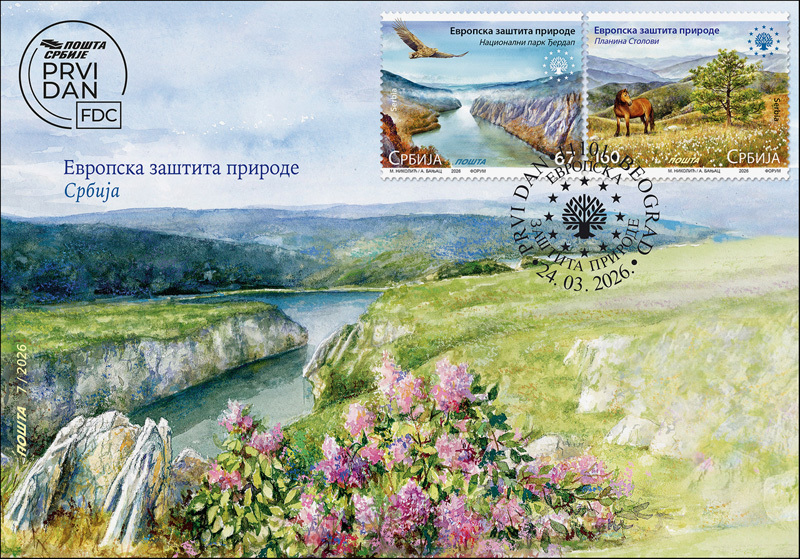
Đerdap National Park covers part of the Đerdap Gorge in the middle reaches of the Danube, covering an area of 63,786.48 ha. The longest breakthrough gorge in Europe is located in this section of the river, with the southern side belonging to Serbia and the northern side to Romania. In the area of the Mali Kazan Gorge, the Danube has the smallest width of 150–180 m, and the greatest depth of about 90 m.
The Đerdap National Park is home to more than 1,100 plant species, is a habitat for about 250 bird species, and the mammal fauna is also diverse and numerous, with the lynx (Lynx lynx) and the chamois (Rupicapra rupicapra)particularly standing out.
The presence of natural features of exceptional geological and biological diversity and a rich cultural and historical heritage (Lepenski Vir, Golubac Castle, Trajan’s Tablet, etc.) make the Đerdap Gorge an area of outstanding interaction between significant natural and cultural values. The Đerdap National Park was declared a Category I protected area of exceptional importance in 1974, and in 2020 it was included in the UNESCO Global Geoparks Network.
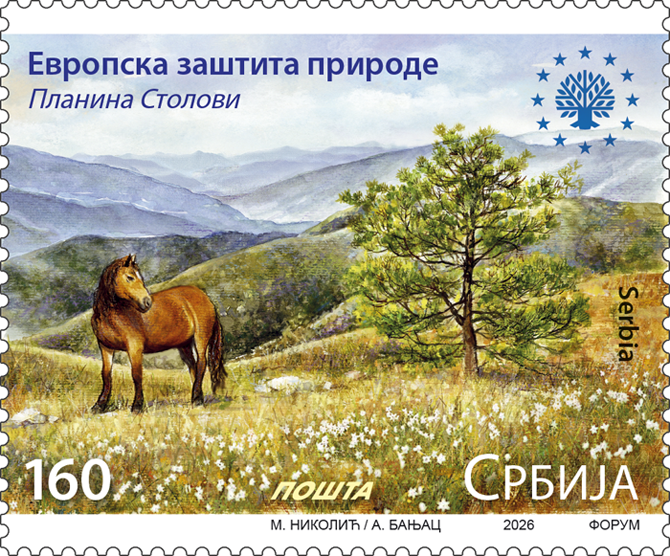
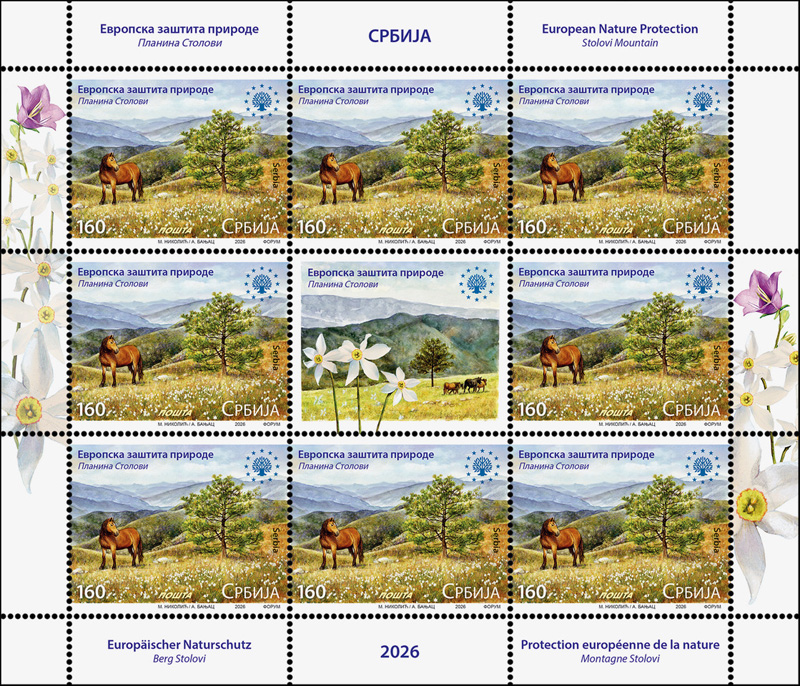
The area of exceptional features “Stolovi”, a mountain range belonging to the Inner Dinarides belt, located in the Ibar-Kopaonik region, along the right bank of the river Ibar, extends over 9,932.1 ha. It was placed under protection in order to preserve hydrographic phenomena and two vegetation belts – oak and beech.
Stolovi Mountain is known for its wild daffodils (Narcissus radiiflorus), diverse flora and fauna, the presence of chamois (Rupicapra rupicapra), and a large number of rare and endangered bird species nest in its area, including the golden eagle (Aquila chrysaetos) and the rock partridge (Alectoris graeca). The trademark of Stolovi is also the owner’s horses that stay on the mountain all year round.
Stolovi, on the right bank of the Ibar River, is also home to a Cultural Monument of Exceptional Importance, the medieval town of Maglič. The Government of the Republic of Serbia declared Stolovi a protected area in 2022.
Professional cooperation on the issue: Institute for Nature Conservation of Serbia and “National Park Đerdap” L.L.C.
Artistic realization of the issue: Miroslav Nikolić, MA Anamari Banjac, academic painter
Technical details
Датум издања: 24. 03. 2026.
Број марака: 2
1442: 67.00 дин
1443: 160.00 дин
Тираж: 25.000
Коверат првог дана (FDC) са жигом: 1
Табак: 8
Димензије марке: 42 x 34,8 mm
Штампа: вишебојни офсет
Зупчање: чешљасто 13 3/4
Штампарија: Форум Нови Сад
Уметничка реализација: Анамари Бањац
Subject: 110 years of the Australian medical mission in Serbia
1442 – Национални парк „Ђердап”
1443 – Планина Столови
125 years of organized mountaineering in Serbia
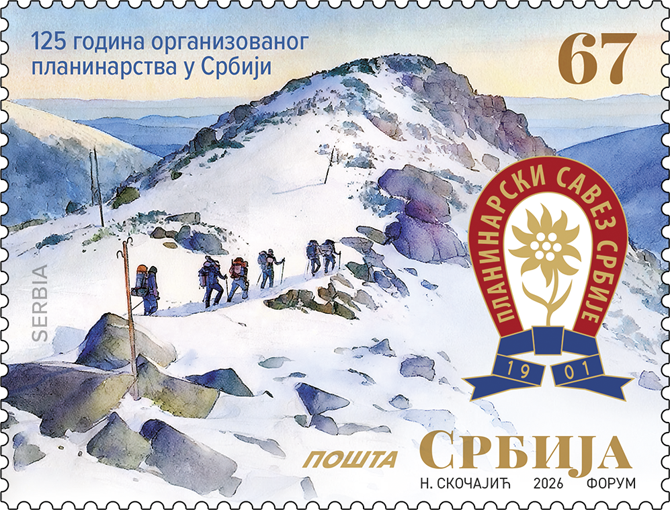
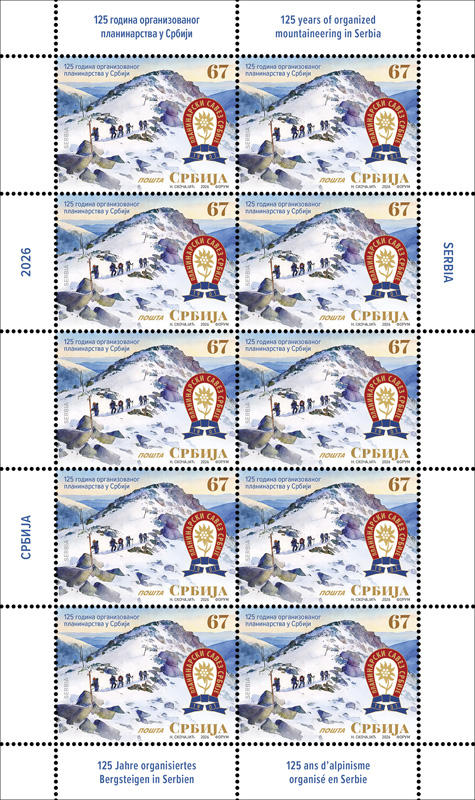
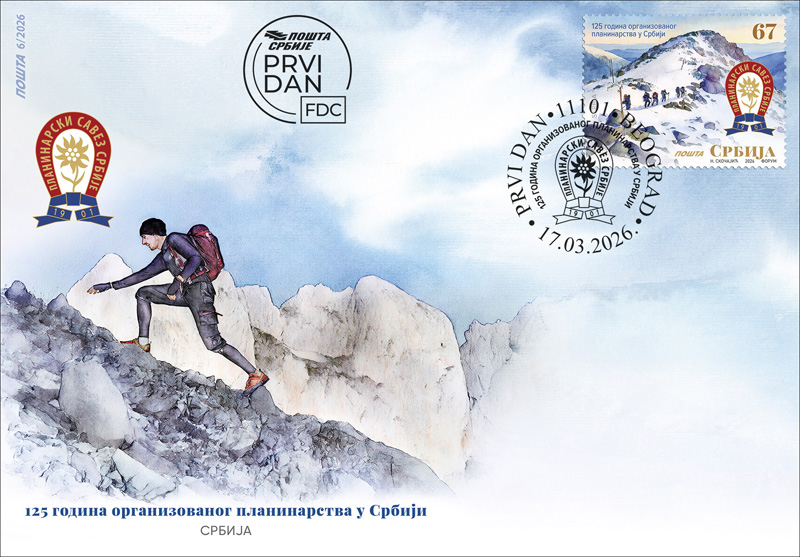

The first mountaineering organization in Serbia, the Serbian Mountaineering Society, was founded on June 9, 1901 in Belgrade. In our country and among our people, there were already trips to the mountains to enjoy nature, get to know it and study it. The first mountaineering steps in our country belong to Ljubomir Nenadović, Milan Milićević, Dositej Obradović and the pharmacist from Svilajnac, Julije Draškoci.
The founders of the Serbian Mountaineering Society were inspired by a man who loved the mountains as part of his scientific and life mission – Josif Pančić. He and his students organized the first group trips to the Serbian mountains in the mid-19th century, laying the foundations of what would later become a movement. Among the founders of the Serbian Mountaineering Society were the most intelligent people of their time – academics, professors, and prominent citizens. The first president was Jovan Žujović, the founder of geological science in Serbia.
In the period before World War II, there were four mountaineering societies in Serbia: the Serbian Mountaineering Society – Belgrade, Fruška Gora – Novi Sad, the Association of Mountaineering Students – Belgrade, and Morava – Niš, which had several dozen branches in the areas from Peć to Subotica and from Užice to Žagubica.
After World War II, in 1948, the Mountaineering Association of Serbia was founded. Since then, mountaineering organizations have no longer operated independently, but have been united in the Association as a community with a unified membership and programme tasks. Today, the Association has over 20,000 members who are united in more than 200 basic organizations – clubs and societies.
In 1997, the Mountaineering Association became a member of the Sports Association of Serbia, which emphasized the sporting character of the organization. Our mountaineers have conquered the peaks of the world, from the Balkans to the highest peaks of all continents, and have competed in competitions where they have won numerous medals and awards.
Professional cooperation on the issue: Mountaineering Association of Serbia
Artistic realization of the issue: MA Nadežda Skočajić, Academic Graphic Artist
Technical details
Date of issue: 17. 03. 2026.
Number of stamps in set: 1
Denomination:
1436: 67.00 RSD
Printrun: 25.000
FDC: 1
Sheet of: 10
Dimensions of stamp: 42 x 31,9 mm
Artistic realization: Nadežda Skočajić
Subject: 125 years of organized mountaineering in Serbia
1436: Mountaineers and logo of Mountaineering Association of Serbia
Perforations: 13 3/4
Printer: Forum Novi Sad
150 years since the first telephone conversation
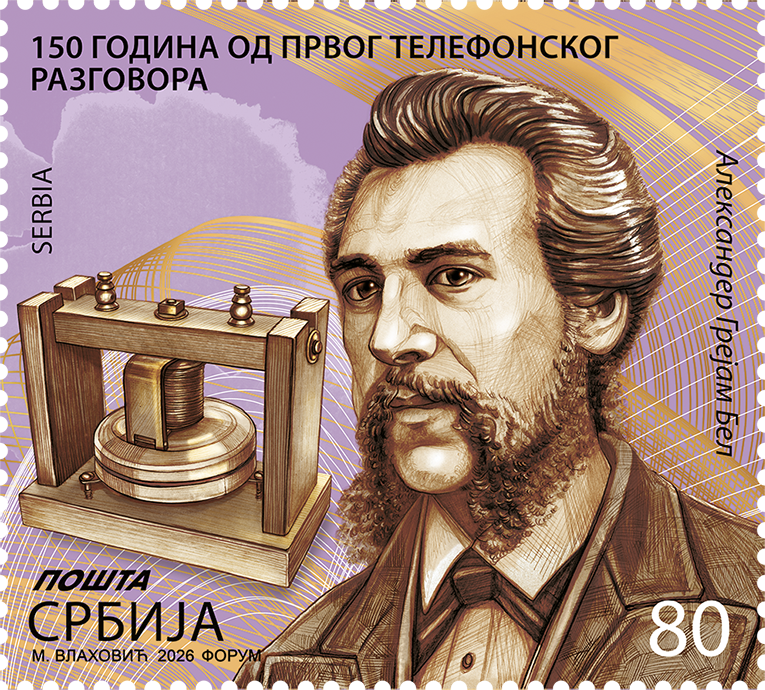
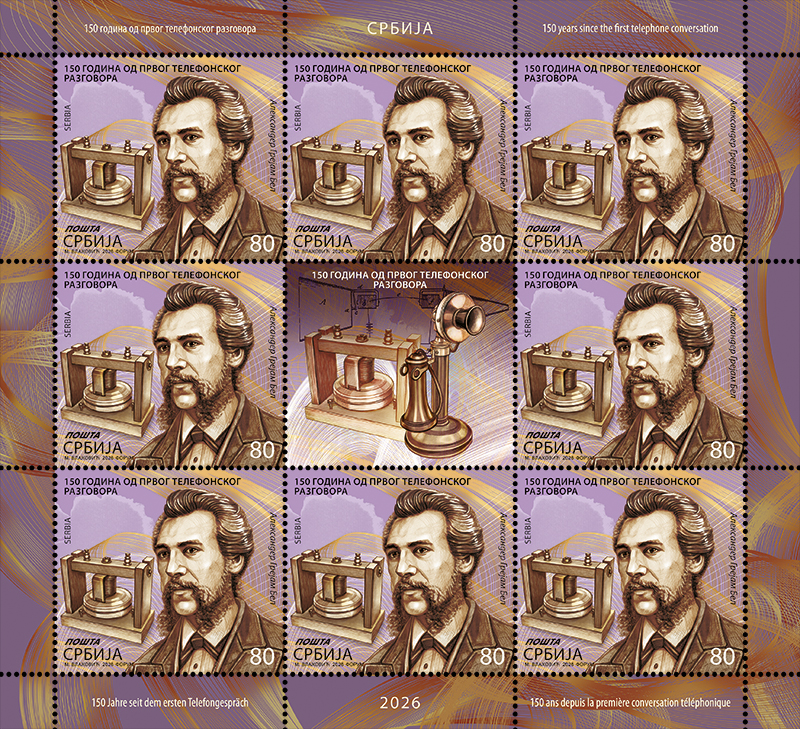
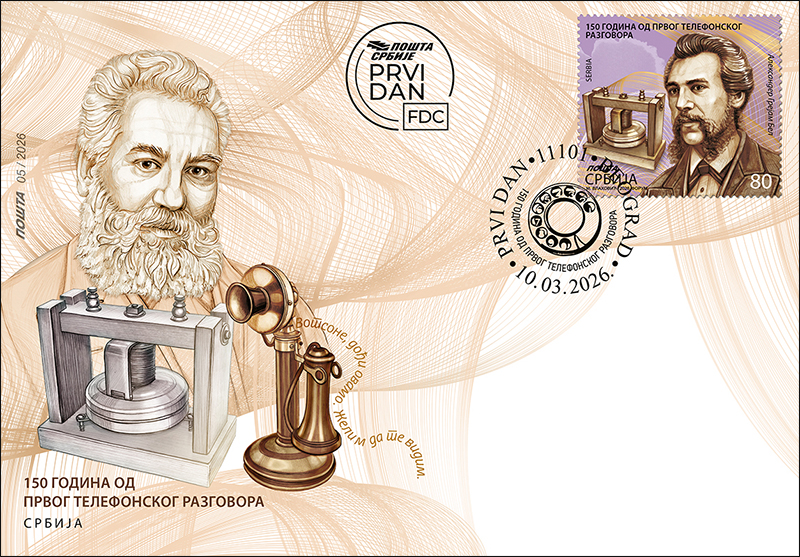

Alexander Graham Bell was born on March 3, 1847, in Edinburgh, into a family involved in research into articulatory phonetics. His father, Alexander Melville Bell, was the creator of the Visible Speech system, which was used to help deaf people learn to speak. Bell’s mother, Eliza, was hard of hearing, which inspired the young Bell to take on great scientific challenges. The Bell family moved from Scotland to Canada, and then to America.
In Boston, from 1871 to 1873, Graham Bell worked at a school for the deaf and mute, where he came up with the idea of creating a new device – the telephone. He filed his patent with the Western Union office, and on March 10, 1876, Bell made the first successful telephone conversation with his assistant, electrician Thomas Watson, uttering the famous words: “Watson, come here. I want to see you.” The conversation took place over a 12-meter wire that connected the telephone to the laboratory in the attic. After this, Bell continued to promote his telephone at various events, and just a year later the Bell Telephone Society was founded, in which Bell worked on improving his invention.
In January 1915, Bell established a transcontinental telephone connection between New York and San Francisco. In addition to the telephone, his scientific contributions include other revolutionary discoveries such as the photophone, metal detectors, and ailerons. Alexander Graham Bell was one of the founders of the National Geographic Society. He dedicated his entire life to the empowerment and integration of deaf people into society. In recognition of his overall work, the World Health Organization designated March 3 as World Hearing Day, the birthday of this remarkable man. He died on August 2, 1922, in Baddeck, Nova Scotia, Canada.
Professional cooperation: PTT Museum Belgrade
Artistic realisation of the issue: MA Marija Vlahovic, Academic Graphic Artist
Technical details
Date of issue: 10. 03. 2026.
Number of stamps in set: 1
Denomination:
1433: 80.00 RSD
Printrun: 25.000
FDC: 1
Sheet of: 8
Dimensions of stamp: 42 x 37,7 mm
Artistic realization: Marija Vlahović
Subject: 150 years since the first telephone conversation
1433: Alexander Graham Bell and the first prototype of telephone device
Perforations: 13 3/4
Printer: Forum Novi Sad
200 година Матице српске
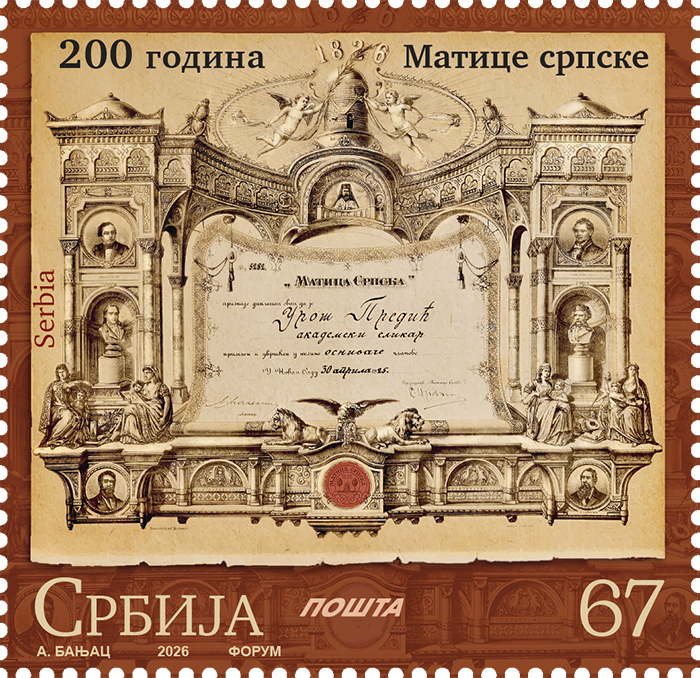
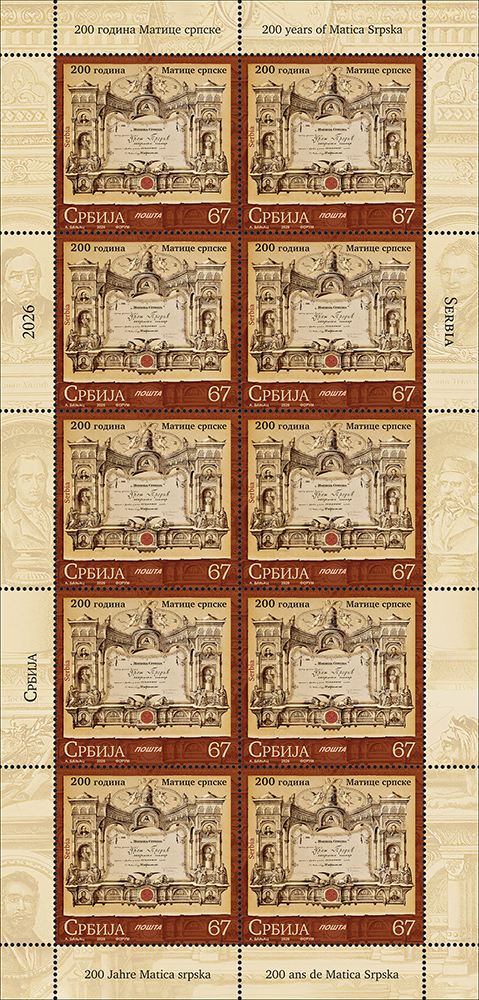
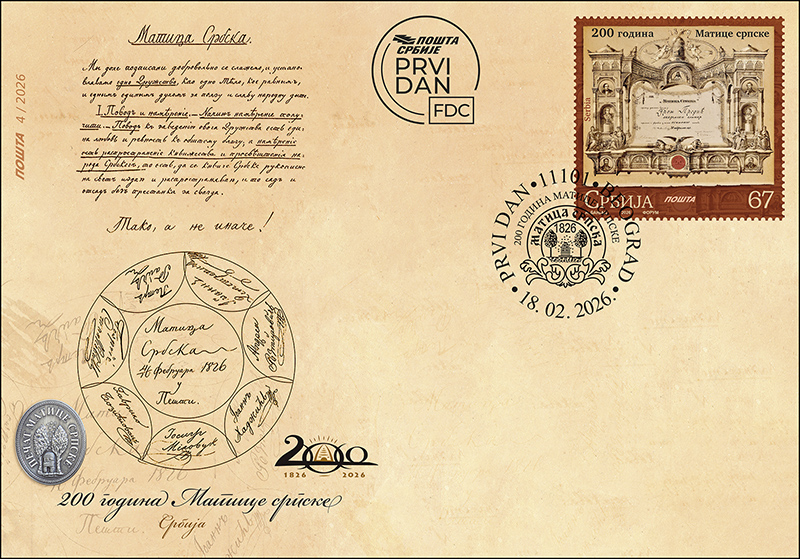
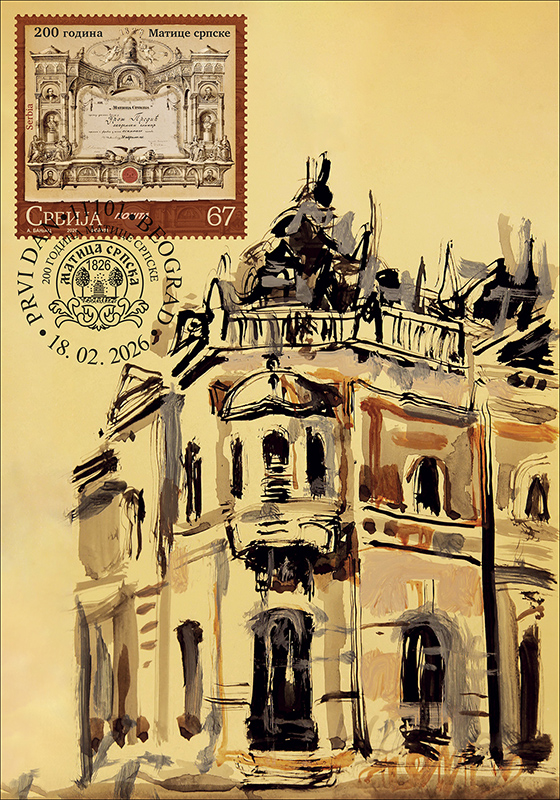

MATICA SRPSKA is the oldest Serbian literary, scientific and cultural society, founded in 1826 in Pest. Its foundation was preceded by the launch of the Letopis Matice srpske (Matica Srpska Chronicle) in 1824. From the very beginning, its activities were aimed at presenting Serbian culture in Europe, and on the other hand, at educating the people. In 1864, Matica Srpska moved to Novi Sad, but its field of activity has always been in all areas where Serbs live, “now, and henceforth, forever and ever”. Many contributors and benefactors have supported the work of Matica Srpska as a central cultural institution throughout its two-hundred-year history. The scholarships of the Matica Srpska endowment have produced a large number of prominent Serbian scientists, cultural workers and artists.
Today, Matica Srpska has around 3,000 associates. They are involved in dozens of scientific and development projects, within the Department of Literature and Language, the Lexicographic Department, the Department of Social Sciences, the Department of Natural Sciences, the Department of Fine Arts, the Department of Performing Arts and Music, and the Manuscript Department. Associates prepare contributions for ten of Matica’s scientific journals and work on the preparation of publications of capital importance for Serbian culture and science, such as the Serbian Encyclopaedia, the Serbian Biographical Dictionary, the Dictionary of the Serbian Language, The Serbian Language Orthography, and others. Matica awards a large number of awards, one of the most significant of which is the “Zmaj Award” for poetry in the Serbian language. Matica Srpska, with the institutions it founded: the Matica Srpska Library, the Gallery of Matica Srpska, and the Matica Srpska Publishing Centre, forms a complex system that uniquely works on the idea of knowledge, enlightenment, and science as the foundation of all kinds of progress of the Serbian people.
Professional cooperation on the issue: Jelena Veselinov, PhD, Manager of Affairs of Matica Srpska; Danilo Vuksanović, PhD, Assistant Director of the Gallery of Matica Srpska
Artistic realization of the issue: MA Anamari Banjac, academic painter
Technical details
Датум издања: 18. 02. 2026.
Број марака: 1
1432: 67.00 дин
Тираж: 25.000
Коверат првог дана (FDC) са жигом: 1
Максимум карта: 1
Табак: 10
Димензије марке: 46,5 x 42 mm
Штампа: вишебојни офсет
Зупчање: чешљасто 13 3/4
Штампарија: Форум Нови Сад
Уметничка реализација: Анамари Бањац
Нацрт:
1432 – Диплома Матице српске академском сликару Урошу Предићу
CHINESE TRADITION
Lunar horoscope – Year of the Horse

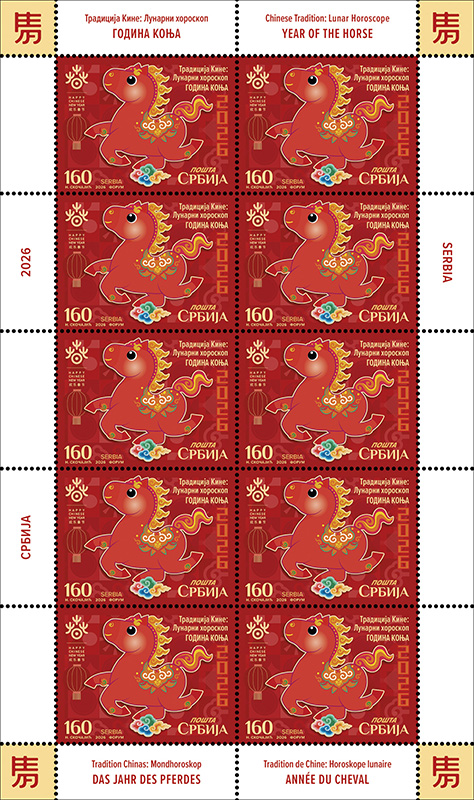
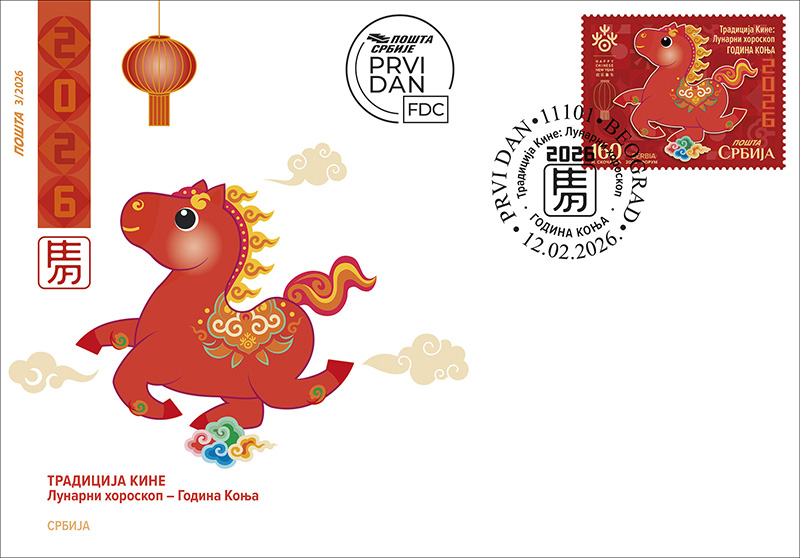

Chinese culture, thousands of years old, has bestowed humanity with a valuable cultural heritage and spiritual wealth. The Chinese horoscope is one of the oldest known horoscopes and includes twelve animals: Rat, Ox, Tiger, Rabbit, Dragon, Snake, Horse, Goat, Monkey, Rooster, Dog and Pig. They correspond to twelve astrological branches, with a twelve-year cycle. In addition, the following elements: metal, wood, water, fire and earth are also very important in the Chinese horoscope. The personality traits are often closely related to the characteristics of the Chinese horoscope related to the year in which the person was born.
The year 2026 will be the year of the Fire Horse. Traditionally, the horse is considered a symbol of freedom and vitality, strong will and passion. The Year of the Fire Horse heralds significant changes, new beginnings, bold breakthroughs and unstoppable momentum. The Chinese Lunar Year of the Fire Horse begins on February 17, 2026, marking the beginning of the fifteen-day Spring Festival celebrated by Chinese people around the world.
The material for the realization of the commemorative postage stamp was provided by the Ministry of Culture and Tourism of the People's Republic of China.
Professional cooperation: Chinese Cultural Centre in Belgrade.
Graphic realization: Nadežda Skočajić, MA Academic Graphic Artist
Qin Shuo, PhD in Visual Communications
Technical details
Датум издања: 12. 02. 2026.
Број марака: 1
1431: 160.00 дин
Тираж: 25.000
Коверат првог дана (FDC) са жигом: 1
Sheet of: 10
Димензије марке: 42 x 31,9 mm
Штампа: вишебојни офсет
Зупчање: чешљасто 13 3/4
Штампарија: Форум Нови Сад
Уметничка реализација: Надежда Скочајић
Subject: 110 years of the Australian medical mission in Serbia
1431 – Коњ, кинески знак зодијака 2026. године
150 years of the General Staff
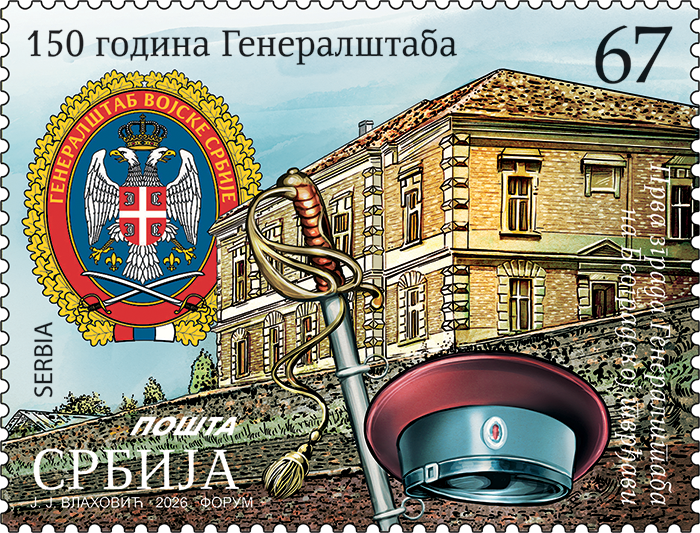
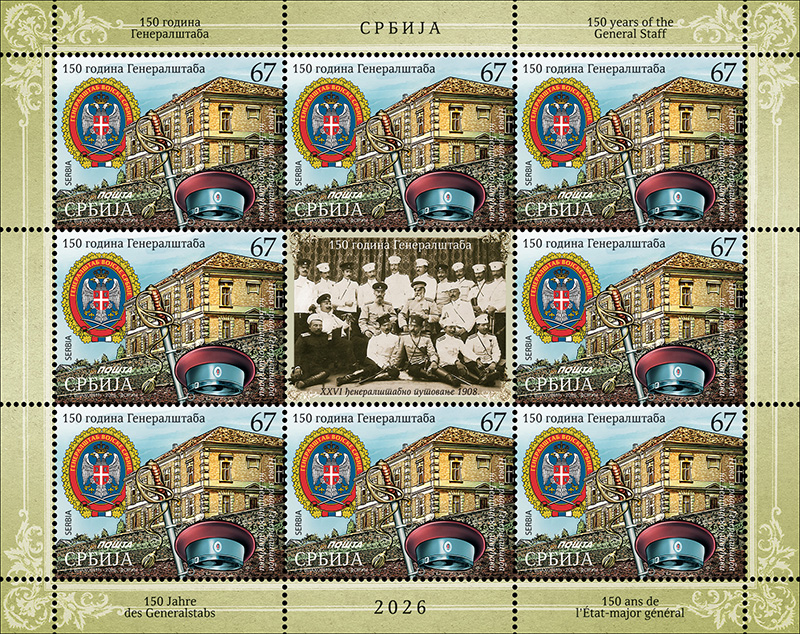
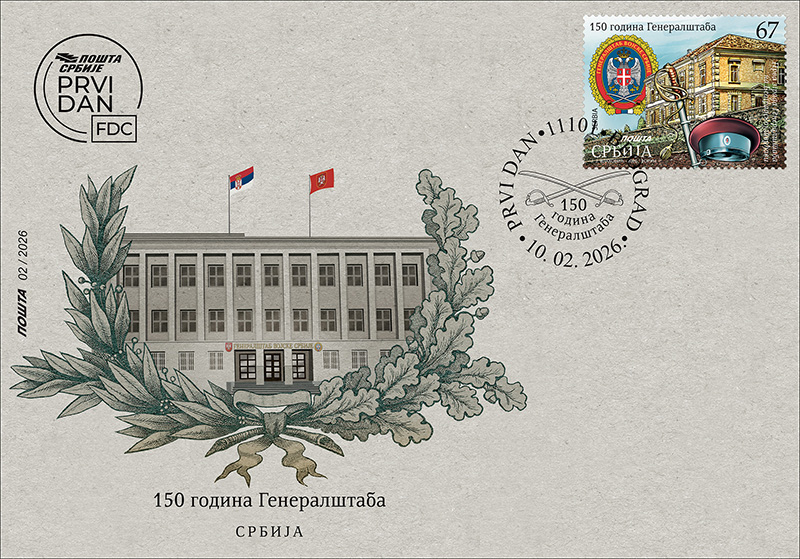

As a military institution, the General Staff originated in the early 19th century in Prussia, when it was first formed as part of reforms aimed at adapting the military organization to changes in warfare brought about by the emergence of large national armies and the rapid development of military technology. Since that time, it has participated in the creation and development of the concept of defence for the entire country, drawing up war plans, conceiving and developing military doctrine and strategy, planning the development, organization and structure of the defence system and mobilization readiness, organizing war planning, and coordinating the development of infrastructure and the arrangement of the state territory for waging war.
In the Serbian Armed Forces, the Main General Staff was formed on February 5, 1876. Its first chief was General František Aleksandr Zach, and over the course of 150 years, the General Staff was headed by some of the most significant figures in Serbian military history – General Jovan Mišković, Dukes Radomir Putnik, Živojin Mišić and Petar Bojović, Colonel Generals and National Heroes of Yugoslavia Arso Jovanović, Koča Popović, Peko Dapčević, Ljubo Vučković and Rade Hamović.
The General Staff played a special role in preparing the defence of the Federal Republic of Yugoslavia against NATO aggression in 1999.
The General Staff of the Serbian Armed Forces is the highest expert and staff body for the preparation and use of the army in times of peace, emergency and war. It proposes and operationalizes decisions for the preparation and use of the Serbian Armed Forces within the competence of the President of the Republic of Serbia and the Chief of the General Staff of the Serbian Armed Forces. Today, the General Staff of the Serbian Armed Forces is a military institution formed on modern foundations in the service of the defence of the Republic of Serbia and its citizens.
Professional cooperation: Colonel Prof. Dalibor Denda, PhD, Strategic Research Institute, University of Defence. Artistic realization: MA Jakša Vlahović, Academic Graphic Artist
Technical details
Датум издања: 10. 02. 2026.
Број марака: 1
1430: 67.00 дин
Тираж: 25.000
Коверат првог дана (FDC) са жигом: 1
Табак: 8
Димензије марке: 42 x 31,9 mm
Штампа: вишебојни офсет
Зупчање: чешљасто 13 3/4
Штампарија: Форум Нови Сад
Artistic realization: Jakša Vlahović
Subject: 110 years of the Australian medical mission in Serbia
1430 – Прва зграда Генералштаба на Београдској тврђави, грб Генералштаба, делови официрске униформе
150 years of the Military Geographical Institute – “General Stevan Bošković”
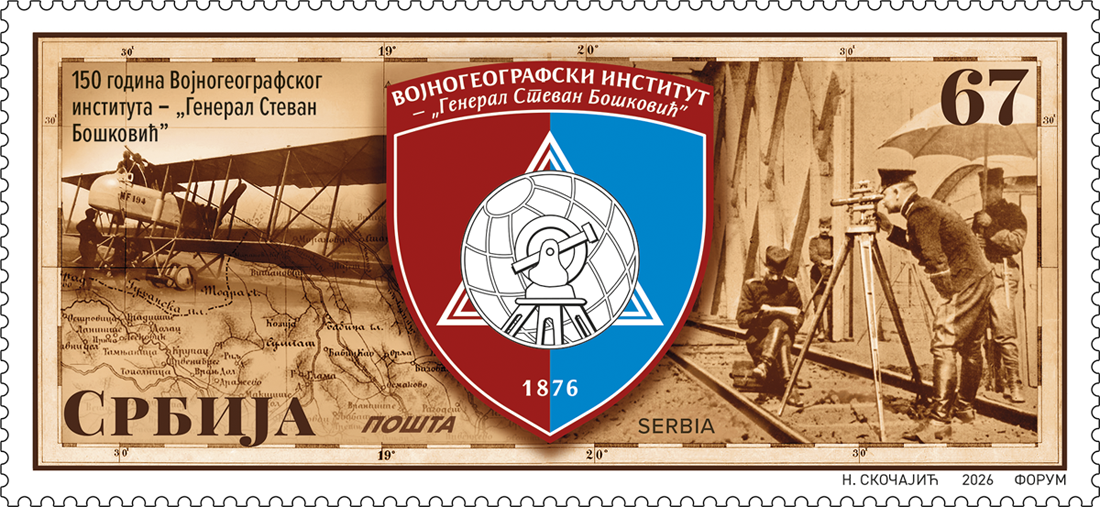
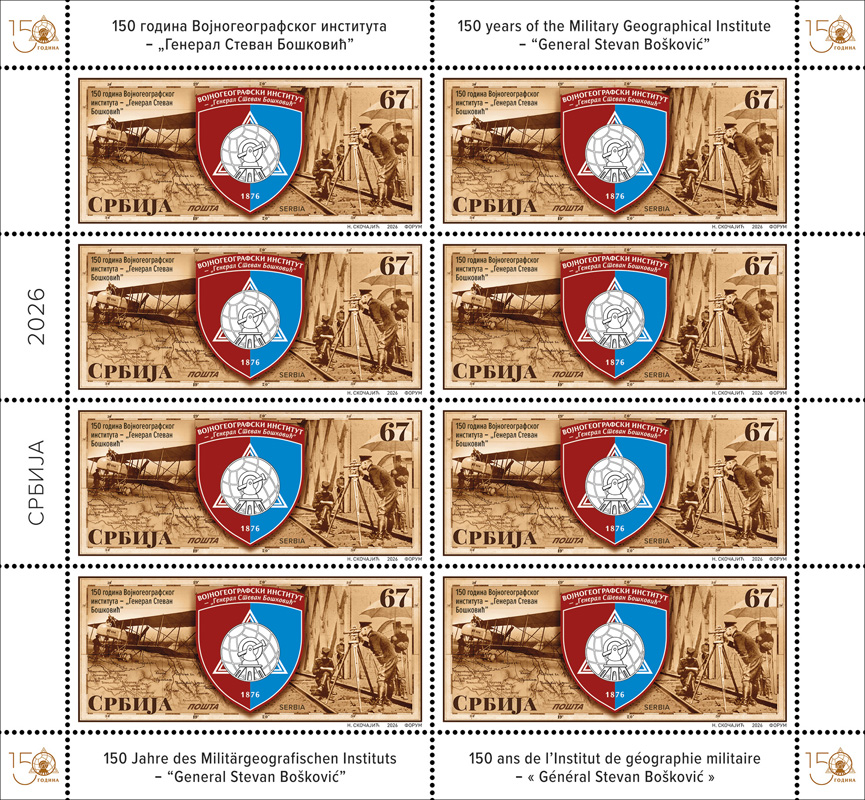
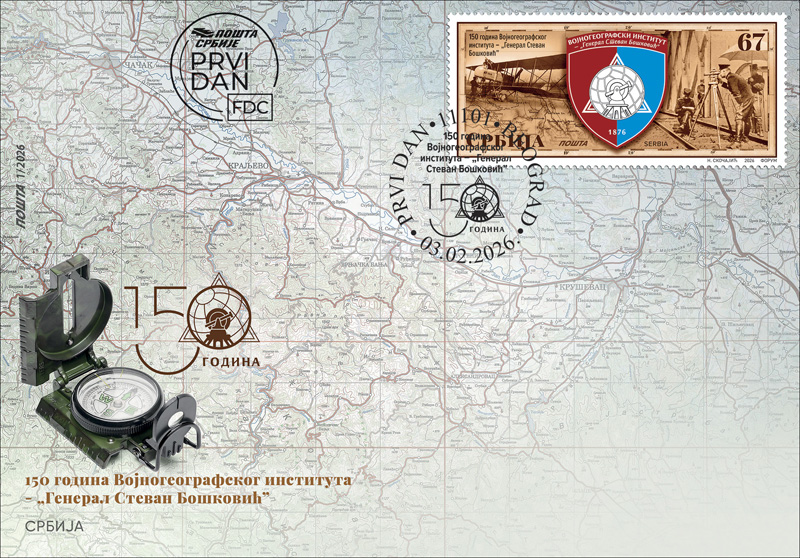

The Military Geographical Institute is one of the oldest institutions of our army. It celebrates its day on February 5, the day when Prince Milan M. Obrenović signed a document on the Establishment of the General Staff in 1876, whereby the Second Department was formed with the task of “carrying out tasks related to the military survey of Serbia, compiling maps necessary for military needs, recording and drawing up various military plans, observing and studying our own and neighbouring countries in terms of geography, topography, statistics, etc.”
In 1920, the Department became the Geographical Institute (in 1923, the Military Geographical Institute), the first military institution to bear the name of an institute. Since its foundation, the Institute has not changed its basic activity – the production of maps for military needs, and has played a very important role in the development of Serbian geodesy, cartography and photogrammetry. It has implemented a number of projects of national importance, such as the design and establishment of the first state trigonometric, levelling, gravimetric and GPS networks. One of the most important tasks of the Institute is the first systematic topographic survey of the entire state territory, on the basis of which numerous topographic maps have been produced.
Today, the Military Geographical Institute is a scientific, research, production and technical institution of the Serbian Armed Forces, which carries out its activities in the fields of geodesy, photogrammetry, cartography, geographic information systems, cartographic reproduction, metrology and other geodisciplines. Inheriting its long-standing tradition, the Military Geographical Institute continues its pioneering work in this century, which is reflected today in the application of the most modern information technologies for the production of topographic maps.
Professional cooperation: Military Geographical Institute – “General Stevan Bošković” Artistic realization: MA Nadežda Skočajić, Academic Graphic Artist
Technical details
Датум издања: 03. 02. 2026.
Број марака: 1
1429: 67.00 дин
Printrun: 25.000
Коверат првог дана (FDC) са жигом: 1
Табак: 8
Димензија марке: 70 x 31,9 mm
Штампа: вишебојни офсет
Зупчање: чешљасто 13 3/4
Штампарија: Форум Нови Сад
Уметничка реализација: Надежда Скочајић
Нацрт: 1429 – амблем Војногеографског института “Генерал Стеван Бошковић“, у позадини фотографија старог премера на којој је генерал Бошковић и фотографија старог авиона, обе из архиве.

