
European nature protection
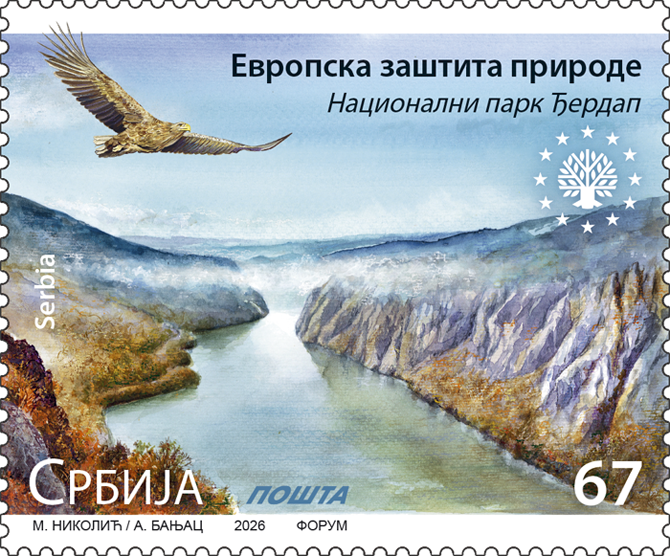

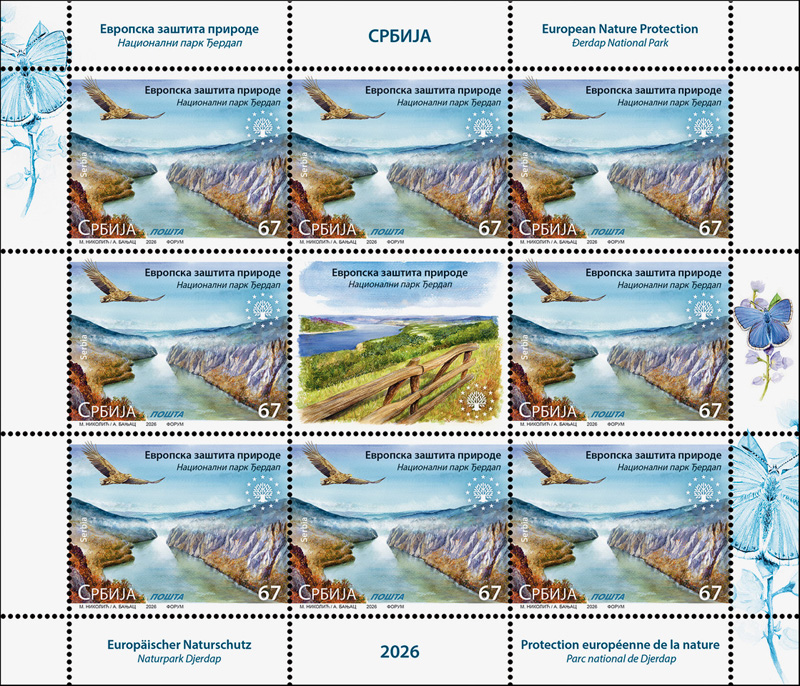
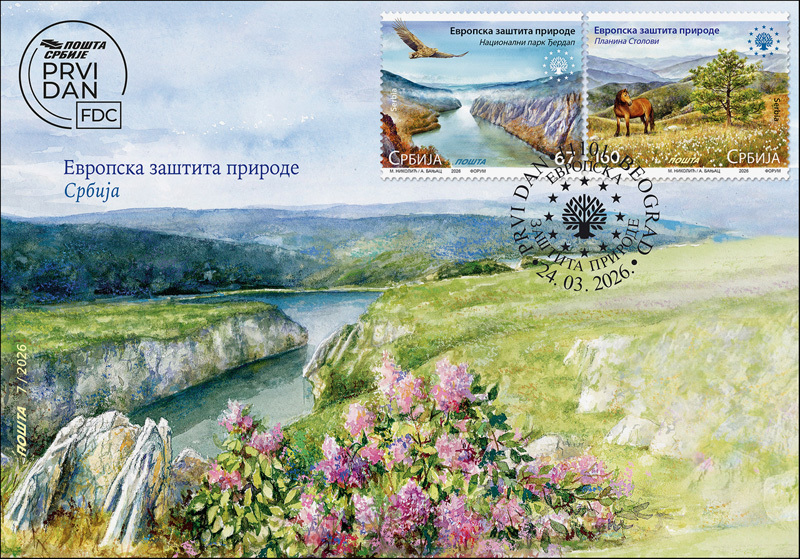
Đerdap National Park covers part of the Đerdap Gorge in the middle reaches of the Danube, covering an area of 63,786.48 ha. The longest breakthrough gorge in Europe is located in this section of the river, with the southern side belonging to Serbia and the northern side to Romania. In the area of the Mali Kazan Gorge, the Danube has the smallest width of 150–180 m, and the greatest depth of about 90 m.
The Đerdap National Park is home to more than 1,100 plant species, is a habitat for about 250 bird species, and the mammal fauna is also diverse and numerous, with the lynx (Lynx lynx) and the chamois (Rupicapra rupicapra)particularly standing out.
The presence of natural features of exceptional geological and biological diversity and a rich cultural and historical heritage (Lepenski Vir, Golubac Castle, Trajan’s Tablet, etc.) make the Đerdap Gorge an area of outstanding interaction between significant natural and cultural values. The Đerdap National Park was declared a Category I protected area of exceptional importance in 1974, and in 2020 it was included in the UNESCO Global Geoparks Network.
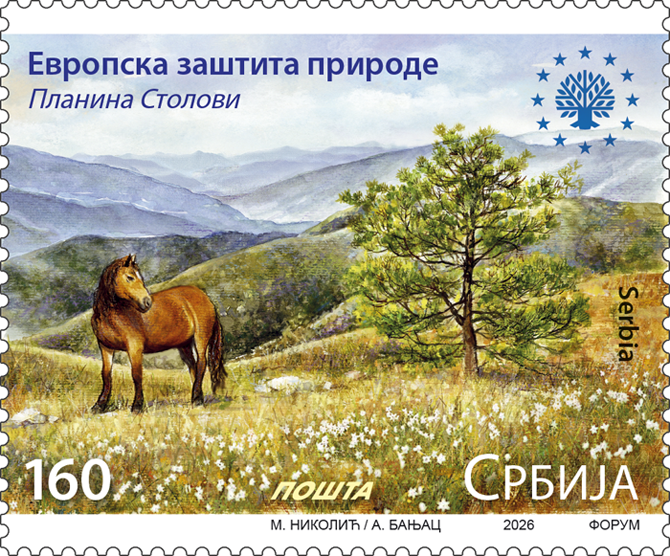
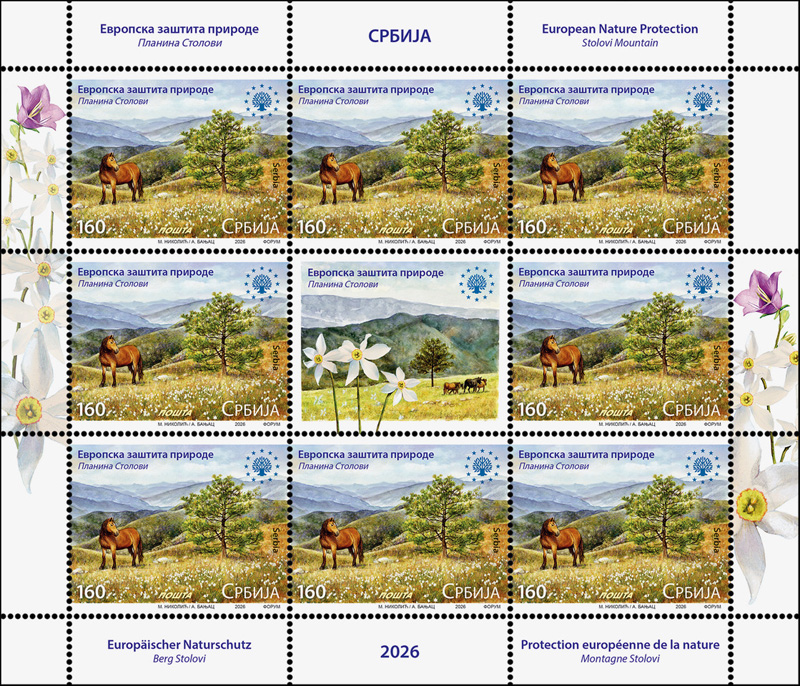
The area of exceptional features “Stolovi”, a mountain range belonging to the Inner Dinarides belt, located in the Ibar-Kopaonik region, along the right bank of the river Ibar, extends over 9,932.1 ha. It was placed under protection in order to preserve hydrographic phenomena and two vegetation belts – oak and beech.
Stolovi Mountain is known for its wild daffodils (Narcissus radiiflorus), diverse flora and fauna, the presence of chamois (Rupicapra rupicapra), and a large number of rare and endangered bird species nest in its area, including the golden eagle (Aquila chrysaetos) and the rock partridge (Alectoris graeca). The trademark of Stolovi is also the owner’s horses that stay on the mountain all year round.
Stolovi, on the right bank of the Ibar River, is also home to a Cultural Monument of Exceptional Importance, the medieval town of Maglič. The Government of the Republic of Serbia declared Stolovi a protected area in 2022.
Professional cooperation on the issue: Institute for Nature Conservation of Serbia and “National Park Đerdap” L.L.C.
Artistic realization of the issue: Miroslav Nikolić, MA Anamari Banjac, academic painter
Technical details
Датум издања: 24. 03. 2026.
Број марака: 2
1442: 67.00 дин
1443: 160.00 дин
Тираж: 25.000
Коверат првог дана (FDC) са жигом: 1
Табак: 8
Димензије марке: 42 x 34,8 mm
Штампа: вишебојни офсет
Зупчање: чешљасто 13 3/4
Штампарија: Форум Нови Сад
Уметничка реализација: Анамари Бањац
Subject: 110 years of the Australian medical mission in Serbia
1442 – Национални парк „Ђердап”
1443 – Планина Столови
125 years of organized mountaineering in Serbia
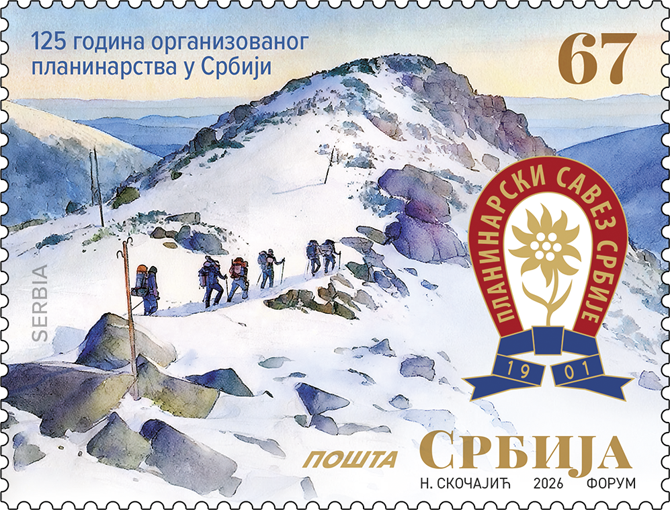
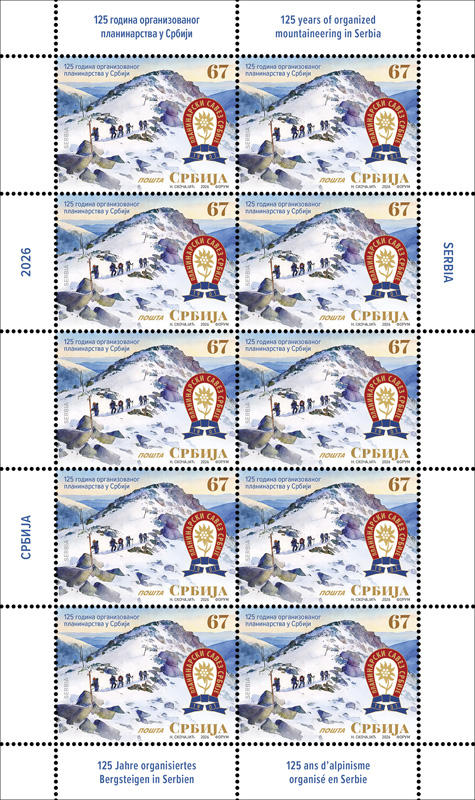
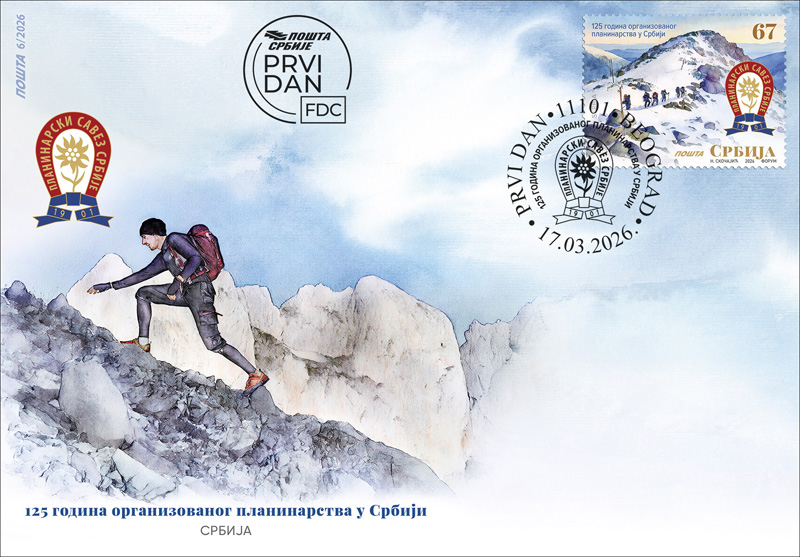

The first mountaineering organization in Serbia, the Serbian Mountaineering Society, was founded on June 9, 1901 in Belgrade. In our country and among our people, there were already trips to the mountains to enjoy nature, get to know it and study it. The first mountaineering steps in our country belong to Ljubomir Nenadović, Milan Milićević, Dositej Obradović and the pharmacist from Svilajnac, Julije Draškoci.
The founders of the Serbian Mountaineering Society were inspired by a man who loved the mountains as part of his scientific and life mission – Josif Pančić. He and his students organized the first group trips to the Serbian mountains in the mid-19th century, laying the foundations of what would later become a movement. Among the founders of the Serbian Mountaineering Society were the most intelligent people of their time – academics, professors, and prominent citizens. The first president was Jovan Žujović, the founder of geological science in Serbia.
In the period before World War II, there were four mountaineering societies in Serbia: the Serbian Mountaineering Society – Belgrade, Fruška Gora – Novi Sad, the Association of Mountaineering Students – Belgrade, and Morava – Niš, which had several dozen branches in the areas from Peć to Subotica and from Užice to Žagubica.
After World War II, in 1948, the Mountaineering Association of Serbia was founded. Since then, mountaineering organizations have no longer operated independently, but have been united in the Association as a community with a unified membership and programme tasks. Today, the Association has over 20,000 members who are united in more than 200 basic organizations – clubs and societies.
In 1997, the Mountaineering Association became a member of the Sports Association of Serbia, which emphasized the sporting character of the organization. Our mountaineers have conquered the peaks of the world, from the Balkans to the highest peaks of all continents, and have competed in competitions where they have won numerous medals and awards.
Professional cooperation on the issue: Mountaineering Association of Serbia
Artistic realization of the issue: MA Nadežda Skočajić, Academic Graphic Artist
Technical details
Date of issue: 17. 03. 2026.
Number of stamps in set: 1
Denomination:
1436: 67.00 RSD
Printrun: 25.000
FDC: 1
Sheet of: 10
Dimensions of stamp: 42 x 31,9 mm
Artistic realization: Nadežda Skočajić
Subject: 125 years of organized mountaineering in Serbia
1436: Mountaineers and logo of Mountaineering Association of Serbia
Perforations: 13 3/4
Printer: Forum Novi Sad
150 years since the first telephone conversation
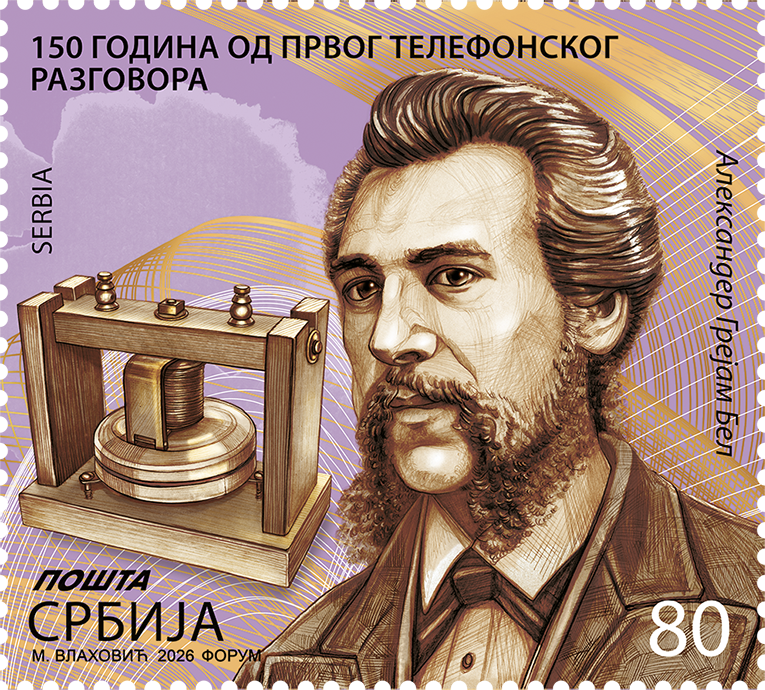
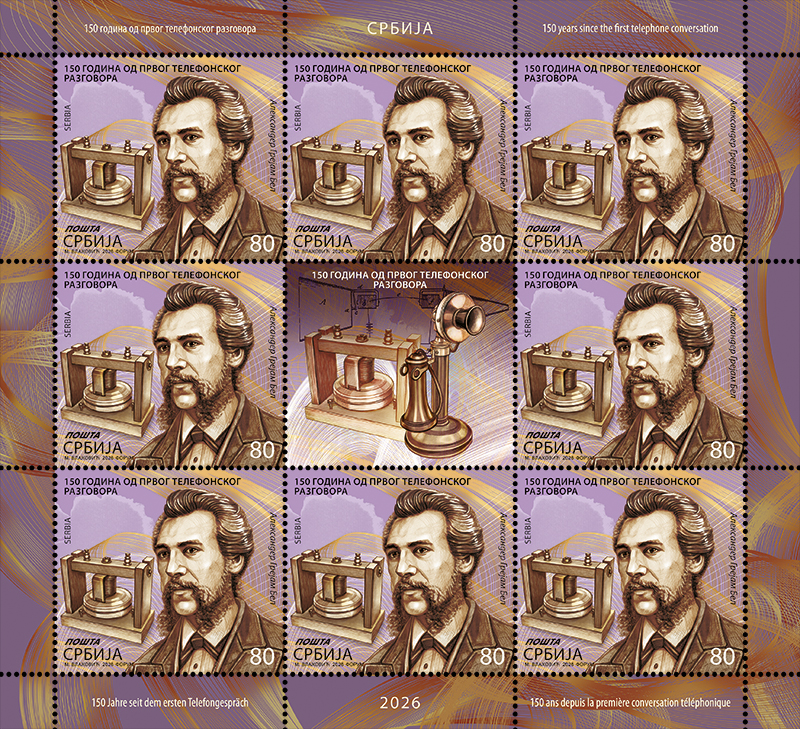
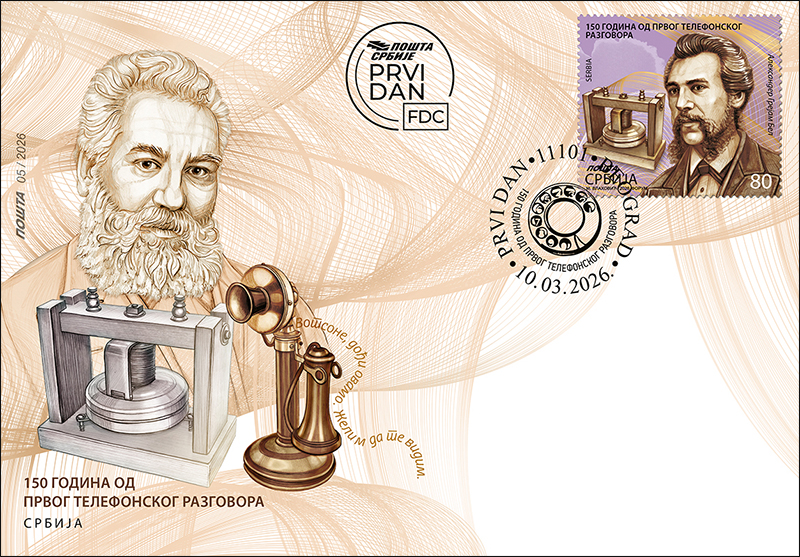

Alexander Graham Bell was born on March 3, 1847, in Edinburgh, into a family involved in research into articulatory phonetics. His father, Alexander Melville Bell, was the creator of the Visible Speech system, which was used to help deaf people learn to speak. Bell’s mother, Eliza, was hard of hearing, which inspired the young Bell to take on great scientific challenges. The Bell family moved from Scotland to Canada, and then to America.
In Boston, from 1871 to 1873, Graham Bell worked at a school for the deaf and mute, where he came up with the idea of creating a new device – the telephone. He filed his patent with the Western Union office, and on March 10, 1876, Bell made the first successful telephone conversation with his assistant, electrician Thomas Watson, uttering the famous words: “Watson, come here. I want to see you.” The conversation took place over a 12-meter wire that connected the telephone to the laboratory in the attic. After this, Bell continued to promote his telephone at various events, and just a year later the Bell Telephone Society was founded, in which Bell worked on improving his invention.
In January 1915, Bell established a transcontinental telephone connection between New York and San Francisco. In addition to the telephone, his scientific contributions include other revolutionary discoveries such as the photophone, metal detectors, and ailerons. Alexander Graham Bell was one of the founders of the National Geographic Society. He dedicated his entire life to the empowerment and integration of deaf people into society. In recognition of his overall work, the World Health Organization designated March 3 as World Hearing Day, the birthday of this remarkable man. He died on August 2, 1922, in Baddeck, Nova Scotia, Canada.
Professional cooperation: PTT Museum Belgrade
Artistic realisation of the issue: MA Marija Vlahovic, Academic Graphic Artist
Technical details
Date of issue: 10. 03. 2026.
Number of stamps in set: 1
Denomination:
1433: 80.00 RSD
Printrun: 25.000
FDC: 1
Sheet of: 8
Dimensions of stamp: 42 x 37,7 mm
Artistic realization: Marija Vlahović
Subject: 150 years since the first telephone conversation
1433: Alexander Graham Bell and the first prototype of telephone device
Perforations: 13 3/4
Printer: Forum Novi Sad
200 година Матице српске
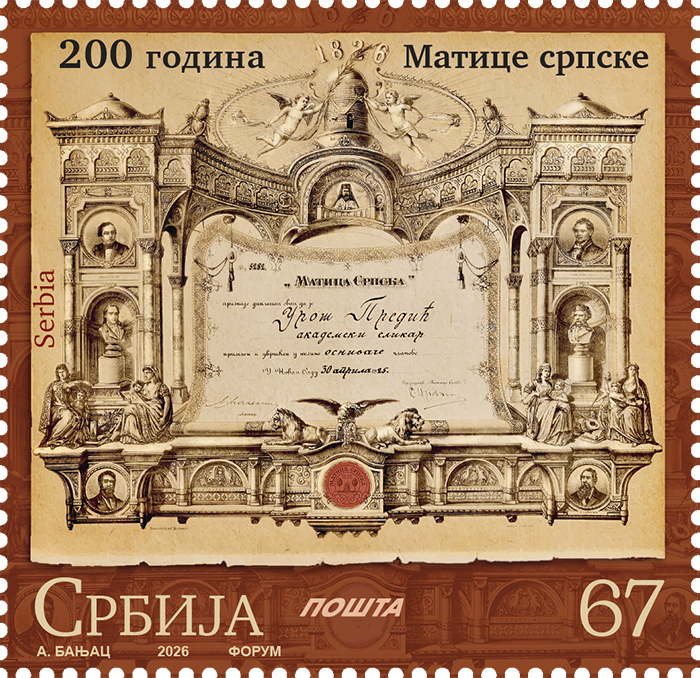
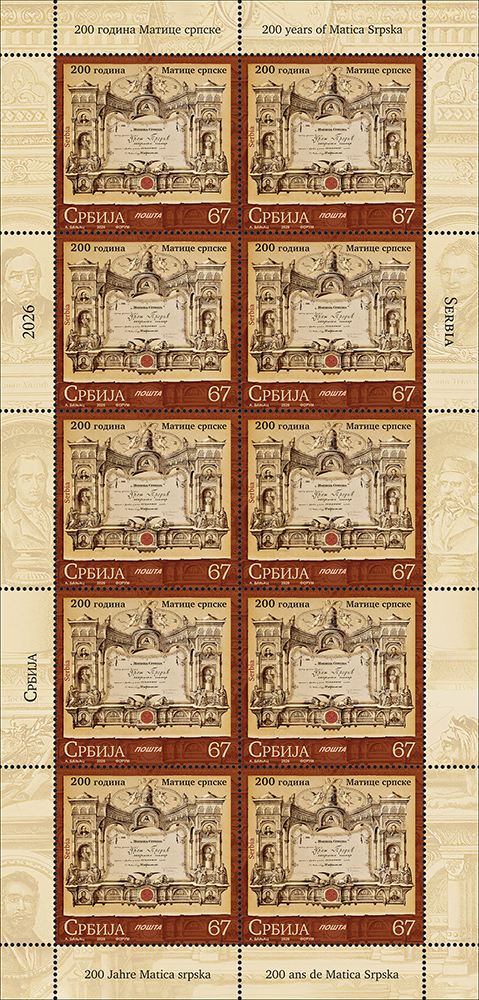
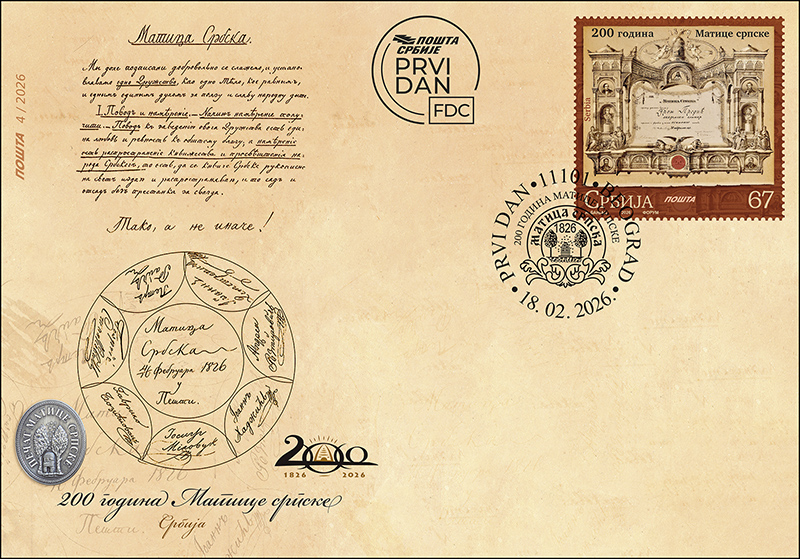
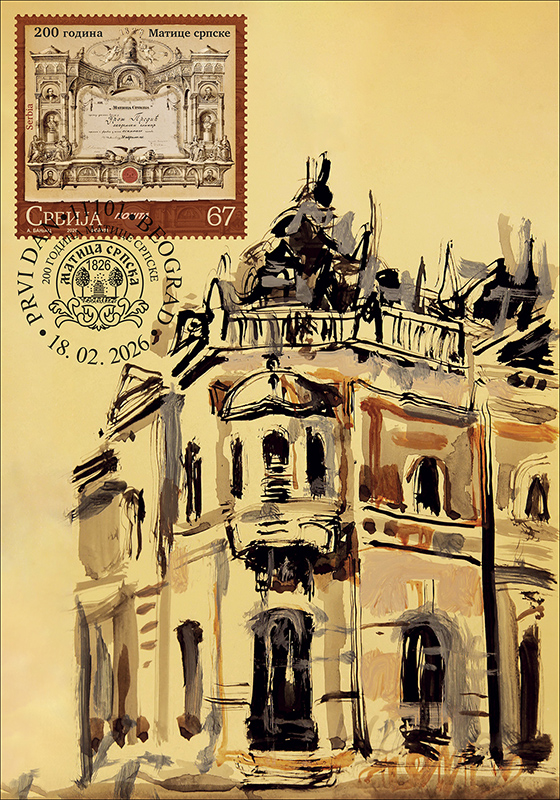

MATICA SRPSKA is the oldest Serbian literary, scientific and cultural society, founded in 1826 in Pest. Its foundation was preceded by the launch of the Letopis Matice srpske (Matica Srpska Chronicle) in 1824. From the very beginning, its activities were aimed at presenting Serbian culture in Europe, and on the other hand, at educating the people. In 1864, Matica Srpska moved to Novi Sad, but its field of activity has always been in all areas where Serbs live, “now, and henceforth, forever and ever”. Many contributors and benefactors have supported the work of Matica Srpska as a central cultural institution throughout its two-hundred-year history. The scholarships of the Matica Srpska endowment have produced a large number of prominent Serbian scientists, cultural workers and artists.
Today, Matica Srpska has around 3,000 associates. They are involved in dozens of scientific and development projects, within the Department of Literature and Language, the Lexicographic Department, the Department of Social Sciences, the Department of Natural Sciences, the Department of Fine Arts, the Department of Performing Arts and Music, and the Manuscript Department. Associates prepare contributions for ten of Matica’s scientific journals and work on the preparation of publications of capital importance for Serbian culture and science, such as the Serbian Encyclopaedia, the Serbian Biographical Dictionary, the Dictionary of the Serbian Language, The Serbian Language Orthography, and others. Matica awards a large number of awards, one of the most significant of which is the “Zmaj Award” for poetry in the Serbian language. Matica Srpska, with the institutions it founded: the Matica Srpska Library, the Gallery of Matica Srpska, and the Matica Srpska Publishing Centre, forms a complex system that uniquely works on the idea of knowledge, enlightenment, and science as the foundation of all kinds of progress of the Serbian people.
Professional cooperation on the issue: Jelena Veselinov, PhD, Manager of Affairs of Matica Srpska; Danilo Vuksanović, PhD, Assistant Director of the Gallery of Matica Srpska
Artistic realization of the issue: MA Anamari Banjac, academic painter
Technical details
Датум издања: 18. 02. 2026.
Број марака: 1
1432: 67.00 дин
Тираж: 25.000
Коверат првог дана (FDC) са жигом: 1
Максимум карта: 1
Табак: 10
Димензије марке: 46,5 x 42 mm
Штампа: вишебојни офсет
Зупчање: чешљасто 13 3/4
Штампарија: Форум Нови Сад
Уметничка реализација: Анамари Бањац
Нацрт:
1432 – Диплома Матице српске академском сликару Урошу Предићу
CHINESE TRADITION
Lunar horoscope – Year of the Horse

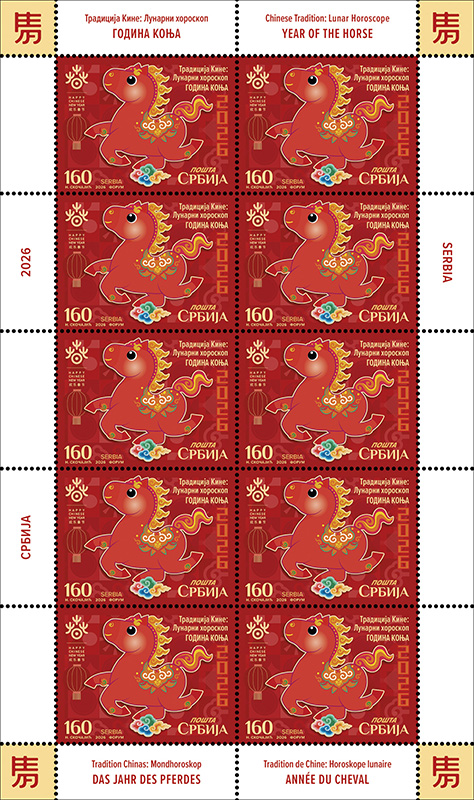


Chinese culture, thousands of years old, has bestowed humanity with a valuable cultural heritage and spiritual wealth. The Chinese horoscope is one of the oldest known horoscopes and includes twelve animals: Rat, Ox, Tiger, Rabbit, Dragon, Snake, Horse, Goat, Monkey, Rooster, Dog and Pig. They correspond to twelve astrological branches, with a twelve-year cycle. In addition, the following elements: metal, wood, water, fire and earth are also very important in the Chinese horoscope. The personality traits are often closely related to the characteristics of the Chinese horoscope related to the year in which the person was born.
The year 2026 will be the year of the Fire Horse. Traditionally, the horse is considered a symbol of freedom and vitality, strong will and passion. The Year of the Fire Horse heralds significant changes, new beginnings, bold breakthroughs and unstoppable momentum. The Chinese Lunar Year of the Fire Horse begins on February 17, 2026, marking the beginning of the fifteen-day Spring Festival celebrated by Chinese people around the world.
The material for the realization of the commemorative postage stamp was provided by the Ministry of Culture and Tourism of the People's Republic of China.
Professional cooperation: Chinese Cultural Centre in Belgrade.
Graphic realization: Nadežda Skočajić, MA Academic Graphic Artist
Qin Shuo, PhD in Visual Communications
Technical details
Датум издања: 12. 02. 2026.
Број марака: 1
1431: 160.00 дин
Тираж: 25.000
Коверат првог дана (FDC) са жигом: 1
Sheet of: 10
Димензије марке: 42 x 31,9 mm
Штампа: вишебојни офсет
Зупчање: чешљасто 13 3/4
Штампарија: Форум Нови Сад
Уметничка реализација: Надежда Скочајић
Subject: 110 years of the Australian medical mission in Serbia
1431 – Коњ, кинески знак зодијака 2026. године
150 years of the General Staff
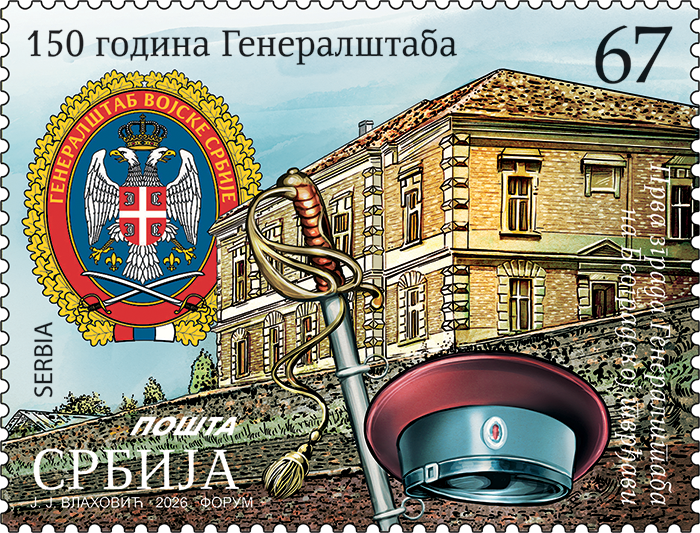
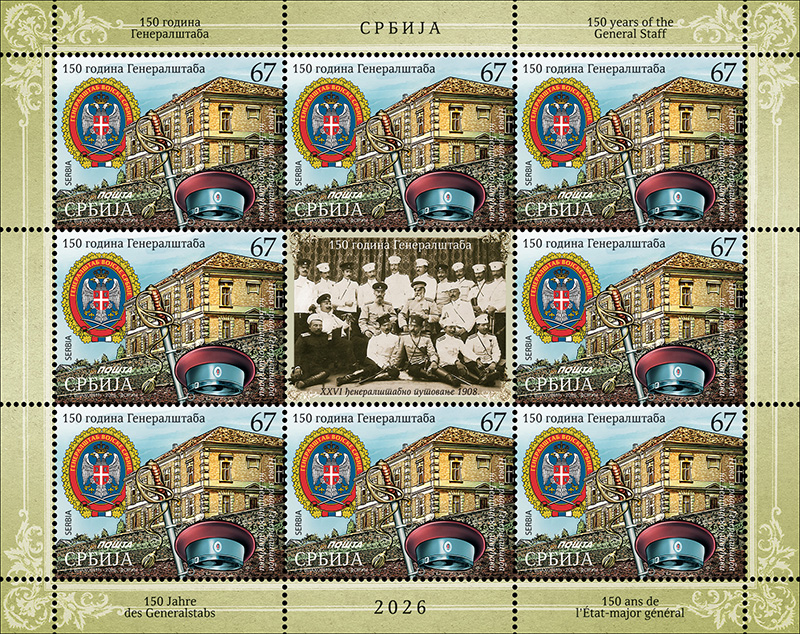
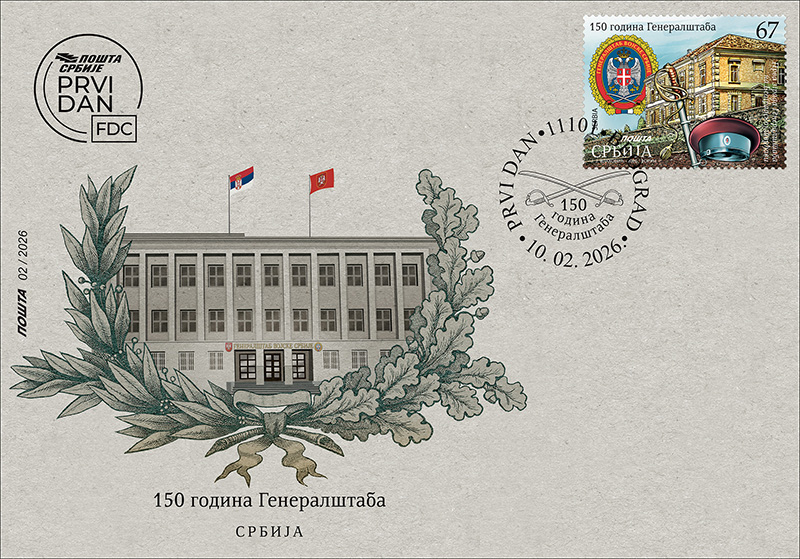

As a military institution, the General Staff originated in the early 19th century in Prussia, when it was first formed as part of reforms aimed at adapting the military organization to changes in warfare brought about by the emergence of large national armies and the rapid development of military technology. Since that time, it has participated in the creation and development of the concept of defence for the entire country, drawing up war plans, conceiving and developing military doctrine and strategy, planning the development, organization and structure of the defence system and mobilization readiness, organizing war planning, and coordinating the development of infrastructure and the arrangement of the state territory for waging war.
In the Serbian Armed Forces, the Main General Staff was formed on February 5, 1876. Its first chief was General František Aleksandr Zach, and over the course of 150 years, the General Staff was headed by some of the most significant figures in Serbian military history – General Jovan Mišković, Dukes Radomir Putnik, Živojin Mišić and Petar Bojović, Colonel Generals and National Heroes of Yugoslavia Arso Jovanović, Koča Popović, Peko Dapčević, Ljubo Vučković and Rade Hamović.
The General Staff played a special role in preparing the defence of the Federal Republic of Yugoslavia against NATO aggression in 1999.
The General Staff of the Serbian Armed Forces is the highest expert and staff body for the preparation and use of the army in times of peace, emergency and war. It proposes and operationalizes decisions for the preparation and use of the Serbian Armed Forces within the competence of the President of the Republic of Serbia and the Chief of the General Staff of the Serbian Armed Forces. Today, the General Staff of the Serbian Armed Forces is a military institution formed on modern foundations in the service of the defence of the Republic of Serbia and its citizens.
Professional cooperation: Colonel Prof. Dalibor Denda, PhD, Strategic Research Institute, University of Defence. Artistic realization: MA Jakša Vlahović, Academic Graphic Artist
Technical details
Датум издања: 10. 02. 2026.
Број марака: 1
1430: 67.00 дин
Тираж: 25.000
Коверат првог дана (FDC) са жигом: 1
Табак: 8
Димензије марке: 42 x 31,9 mm
Штампа: вишебојни офсет
Зупчање: чешљасто 13 3/4
Штампарија: Форум Нови Сад
Artistic realization: Jakša Vlahović
Subject: 110 years of the Australian medical mission in Serbia
1430 – Прва зграда Генералштаба на Београдској тврђави, грб Генералштаба, делови официрске униформе
150 years of the Military Geographical Institute – “General Stevan Bošković”
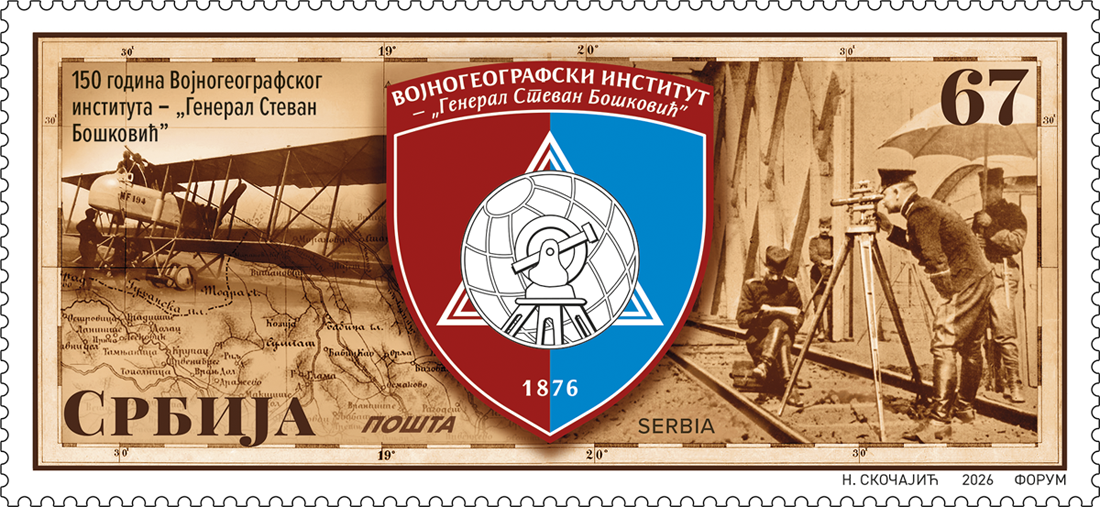
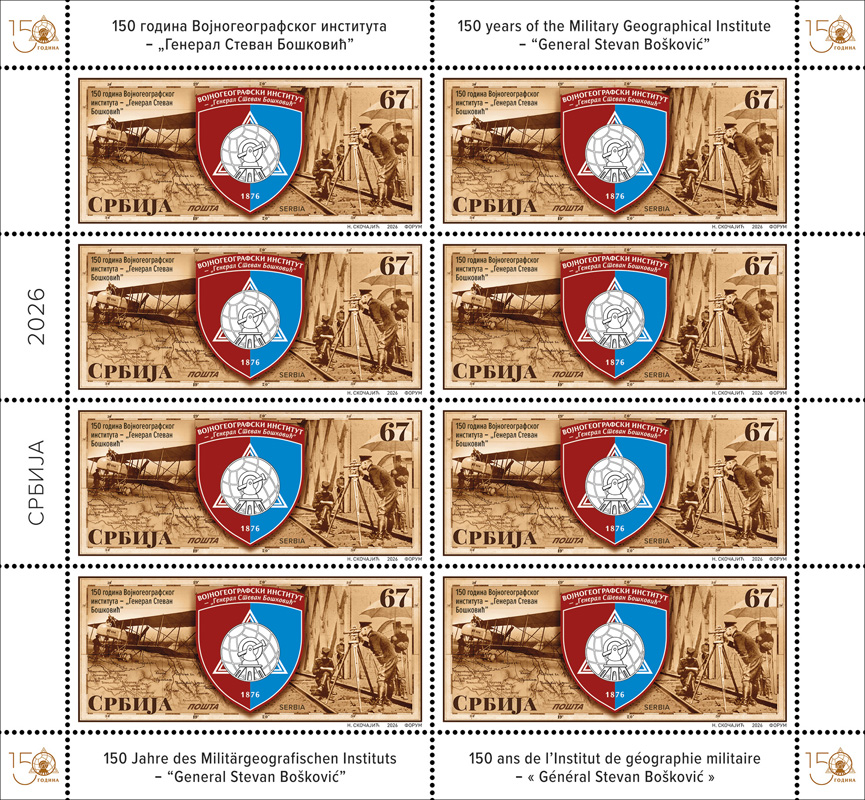
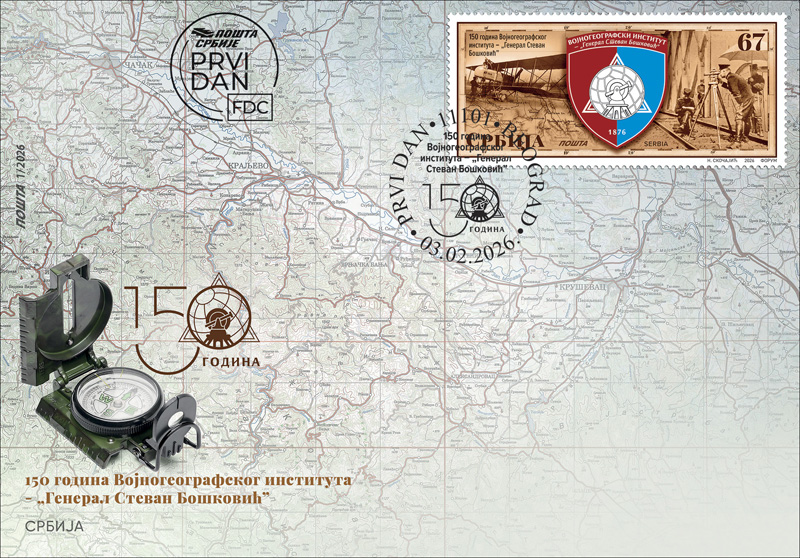

The Military Geographical Institute is one of the oldest institutions of our army. It celebrates its day on February 5, the day when Prince Milan M. Obrenović signed a document on the Establishment of the General Staff in 1876, whereby the Second Department was formed with the task of “carrying out tasks related to the military survey of Serbia, compiling maps necessary for military needs, recording and drawing up various military plans, observing and studying our own and neighbouring countries in terms of geography, topography, statistics, etc.”
In 1920, the Department became the Geographical Institute (in 1923, the Military Geographical Institute), the first military institution to bear the name of an institute. Since its foundation, the Institute has not changed its basic activity – the production of maps for military needs, and has played a very important role in the development of Serbian geodesy, cartography and photogrammetry. It has implemented a number of projects of national importance, such as the design and establishment of the first state trigonometric, levelling, gravimetric and GPS networks. One of the most important tasks of the Institute is the first systematic topographic survey of the entire state territory, on the basis of which numerous topographic maps have been produced.
Today, the Military Geographical Institute is a scientific, research, production and technical institution of the Serbian Armed Forces, which carries out its activities in the fields of geodesy, photogrammetry, cartography, geographic information systems, cartographic reproduction, metrology and other geodisciplines. Inheriting its long-standing tradition, the Military Geographical Institute continues its pioneering work in this century, which is reflected today in the application of the most modern information technologies for the production of topographic maps.
Professional cooperation: Military Geographical Institute – “General Stevan Bošković” Artistic realization: MA Nadežda Skočajić, Academic Graphic Artist
Technical details
Датум издања: 03. 02. 2026.
Број марака: 1
1429: 67.00 дин
Printrun: 25.000
Коверат првог дана (FDC) са жигом: 1
Табак: 8
Димензија марке: 70 x 31,9 mm
Штампа: вишебојни офсет
Зупчање: чешљасто 13 3/4
Штампарија: Форум Нови Сад
Уметничка реализација: Надежда Скочајић
Нацрт: 1429 – амблем Војногеографског института “Генерал Стеван Бошковић“, у позадини фотографија старог премера на којој је генерал Бошковић и фотографија старог авиона, обе из архиве.

