Опис
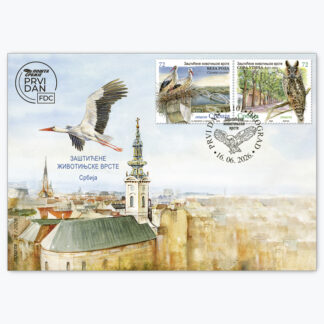
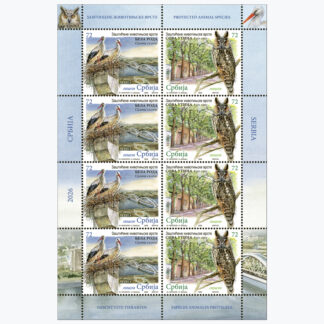
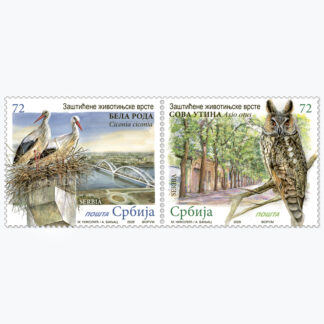
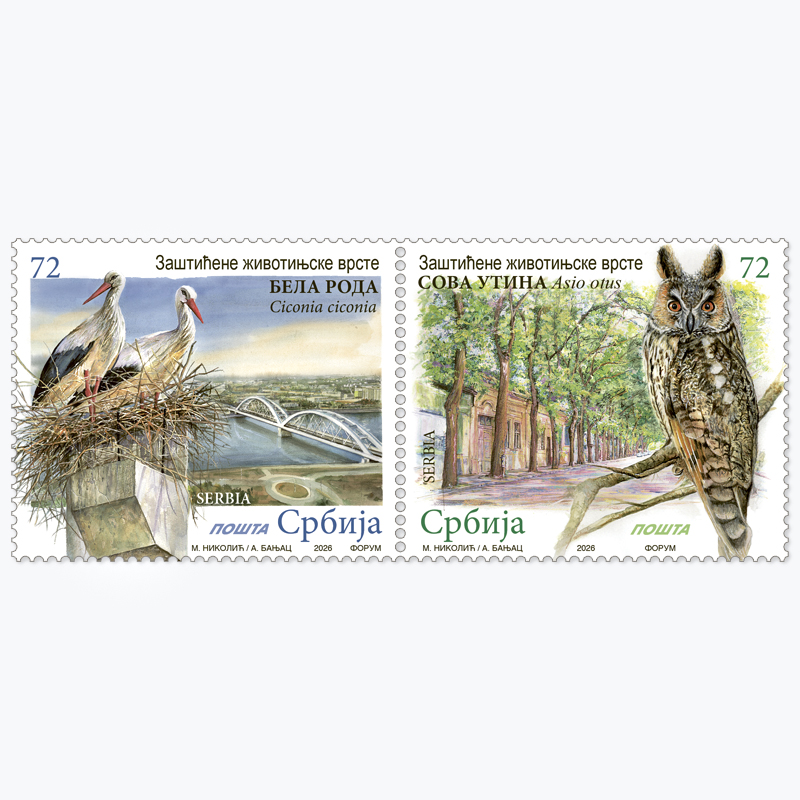
The white stork (Ciconia ciconia), the most famous migratory bird, nests in Europe and parts of Asia and Africa, while spending the winter in sub-Saharan Africa and India. It builds its nests near humans, on buildings and utility poles. It feeds on insects, amphibians, reptiles, fish, and small mammals. Its average lifespan is 15 years. The female lays 3–6 eggs, and both parents take turns incubating them for 34 days. The young set off on their journey to the wintering grounds – spanning about 12,000 km in one direction – in mid-August, while the parents follow in early September.
The journey is extremely dangerous: due to high mortality rates, only one out of ten storks manages to return home after three years. Consequently, they are now depleted or have completely disappeared in many parts of Europe. They are threatened by the loss of wetlands, poaching in the Middle East, and electrocution. However, the population in Serbia is strictly protected, showing a slight growth and counting between 1,900 and 2,000 pairs. More than half of them nest in Vojvodina, and Novi Sad boasts the largest stork colony in a single location in Europe.
The long-eared owl (Asio otus) is a medium-sized owl, recognizable by its long feather tufts that look like ears. Females are larger than males. Males emit a quiet hooting sound, females make a whining call, and the young produce a very piercing sound resembling a squeaking swing. This species does not build nests, but steals them from other birds. From mid-March to late April, the female lays 3–5 eggs. The young hatch after 28 days, leave the nest after 25 days. When they are seven weeks old, they are fully capable of flying.
Long-eared owls are active at night, feeding on rodents and small mammals, while hiding in tree crowns during the day. In winter, they gather into roosts – ranging from a few to several hundred individuals – at traditional locations, often in inhabited areas. As natural regulators of rodent populations, long-eared owls are of immense importance to humans because they reduce the need for chemical poisons that pollute food and the environment. In Serbia, they are a strictly protected species, and in Vojvodina alone, there are around 450 owl roosting sites where about 30,000 individuals winter together. The town square in Kikinda is the largest winter habitat of long-eared owls on planet Earth.
Professional collaboration on the issue: Milan Ružić, Kalman Moldvai, Uroš Stojiljković, Bird Protection and Study Society of Serbia
Artistic realization of the issue: Miroslav Nikolić; Anamari Banjac, MA, Academic Painter