Description
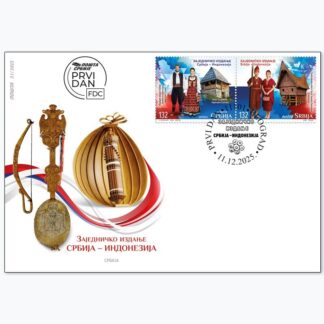
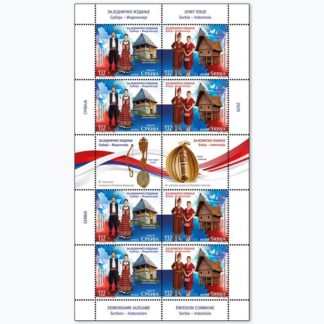
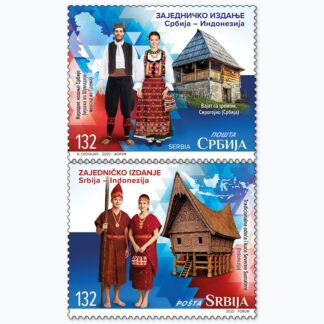
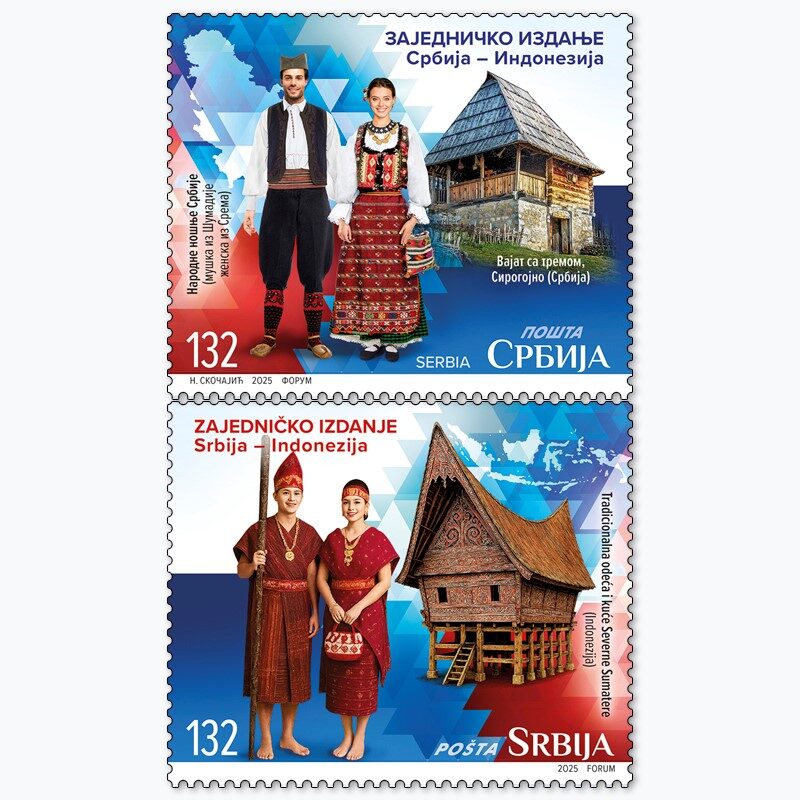
A joint stamp issue between two countries is always an exceptional opportunity to reaffirm and deepen their friendly relations. Through postage stamps, countries communicate with ease, regardless of geographic distance or differences in language. On this occasion, the connection between Serbia and Indonesia is represented through elements of the cultural heritage of both nations: traditional folk costumes and houses depicted on the stamps, as well as musical instruments featured on the vignettes and the commemorative cover.
The traditional women’s costume from Srem (Vojvodina, Serbia), dating from the late 19th century, represents a rich and functional ensemble that reflects the clothing characteristics of Slavic peoples, combined with later elements typical of the wider Pannonian cultural area. The men’s Šumadija folk costume, characteristic of the late 19th and early 20th centuries, consists of a cap (šajkača) as an essential element, breeches trousers, a shirt, a woven belt, a vest (jelek), woolen socks and leather opanci. Over time, this type of attire came to carry a strong national connotation and became a recognizable symbol of traditional Serbian dress. The costumes depicted on the stamps come from the permanent exhibition of the Ethnographic Museum in Belgrade (photo: Vuk Nenezić).
A Vajat with a porch from the village of Alin Potok (1890), is preserved at the open-air museum “Old Village” in Sirogojno (Zlatibor Mountain). Vajati are small buildings traditionally used by younger married couples within extended family households for sleeping and storing their personal belongings. The museum complex comprises 50 examples of vernacular architecture, presenting the construction style, interior organization, and family life characteristic of the hilly and mountainous regions of the Dinaric area of the Balkans. It is designated as a cultural property of exceptional importance for the Republic of Serbia (photo: Tijana Jevtić).
Traditional Batak Toba attire is made from ulos, a traditional hand-woven fabric characterized by predominantly dark colors (black and red), accented with gold or silver threads and patterns that are structurally divided into sections for the head, the body, and the border. Different types and patterns are used for different ceremonies (e.g., Ulos Ragidup for major ceremonies, Ulos Sibolangi for mourning).
Rumah Bolon (Bolon House) is the traditional house of the Batak people of North Sumatra, one of the largest ethnic groups in Indonesia. It consists of two main parts: an elevated living area and a lower section used for storing crops and livestock. The saddle-shaped roof is typically made of palm fibers or thatch, while the walls are constructed from wooden planks. The interior layout is divided into several sections without permanent partition walls, with a central hearth serving as the focal point of the household. The house holds profound symbolic meaning: the high roof represents the connection with the Creator, while the strong supporting pillars symbolize the strength and unity of the family.
Expert collaboration: Ethnographic Museum in Belgrade; Open-Air Museum “Old Village” Sirogojno; Embassy of the Republic of Indonesia in Belgrade.
Stamp design featuring motifs from Serbia: Nadežda Skočajić, academic graphic artist.
Stamp design featuring motifs from Indonesia: Siswanto.