Description
Easter is the most important Christian holiday that Christians celebrate in memory of the resurrection of the Lord Jesus Christ on the third day after his death on the cross and burial. It symbolizes the victory of life over death, light over darkness, good over evil. It is a moveable holiday, but it always falls on a Sunday. Since the Orthodox Church calculates time according to the Julian calendar, this means that this holiday can fall between March 22 and April 25. It is celebrated after the Jewish Passover, on the first Sunday after the full moon. Easter is preceded by a special preparation and feat of fasting, with which Christians prepare for its celebration for seven weeks. It is celebrated for seven days, and in worship service until the feast of Pentecost – the Descent of the Holy Spirit on the Apostles, until when the faithful people greet each other with “Christ is risen!”, and in return respond “Indeed He is risen!”.
Among the Serbian people, in addition to “Uskrs” and “Vaskrs” (Easter), this holiday is also called “Veligdan”, or “Velik-dan” (Great Day), because it represents “the holiday of holidays and the feast of feasts”, a day of eternal joy, because Christ, “by the power of His divinity”, defeated death, after his voluntary sacrifice by crucifixion on the cross, for the salvation of the humankind.
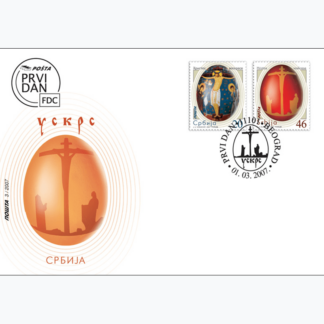
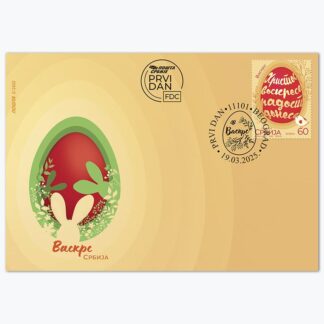
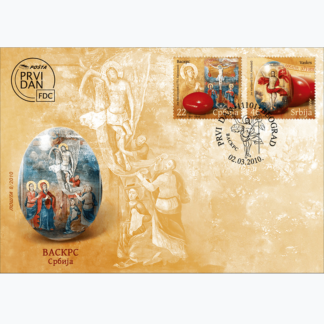
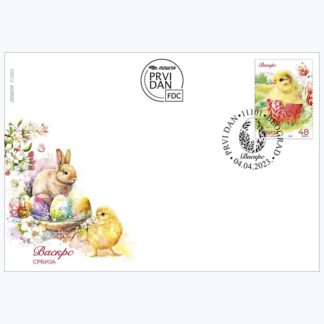
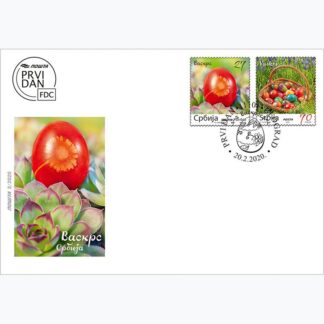
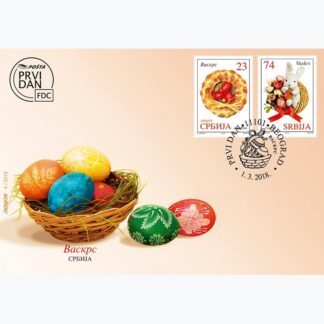
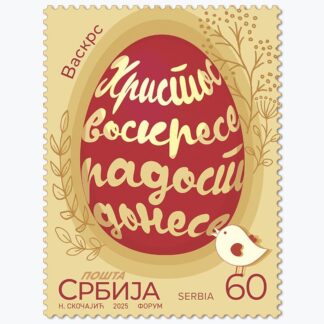
The most famous Easter custom in the entire Christian world, which is directly related to the symbolism of Christ’s resurrection itself, is the painting of eggs. Easter is celebrated at the beginning of spring and the reawakening of nature, which is why various plants are used when painting the eggs, in order to depict the birth of a new life in nature. Among Orthodox Serbs, eggs are dyed on the Great Friday. The first egg, which is kept throughout the entire year, is painted red. It is called the “Housekeeper”.
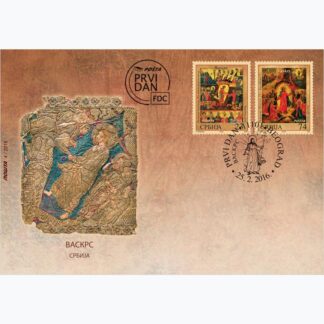
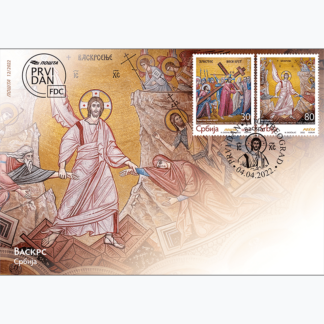
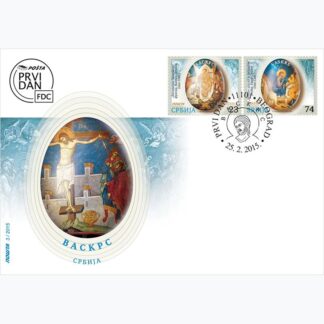
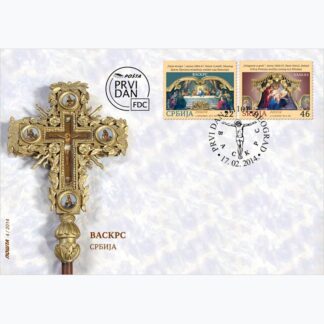
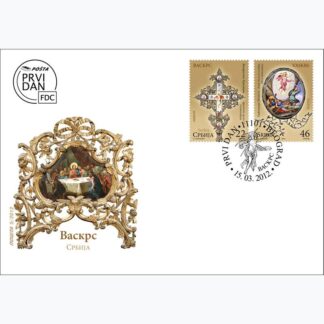
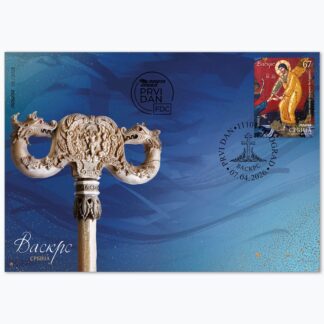
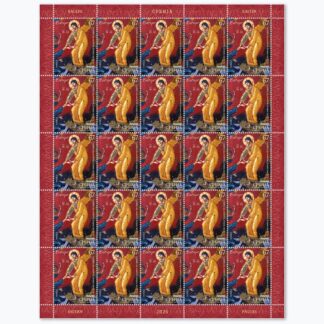
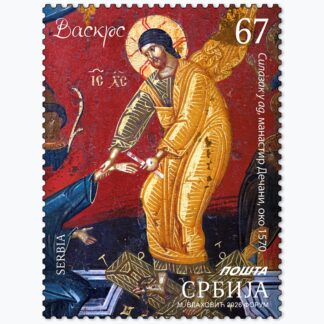
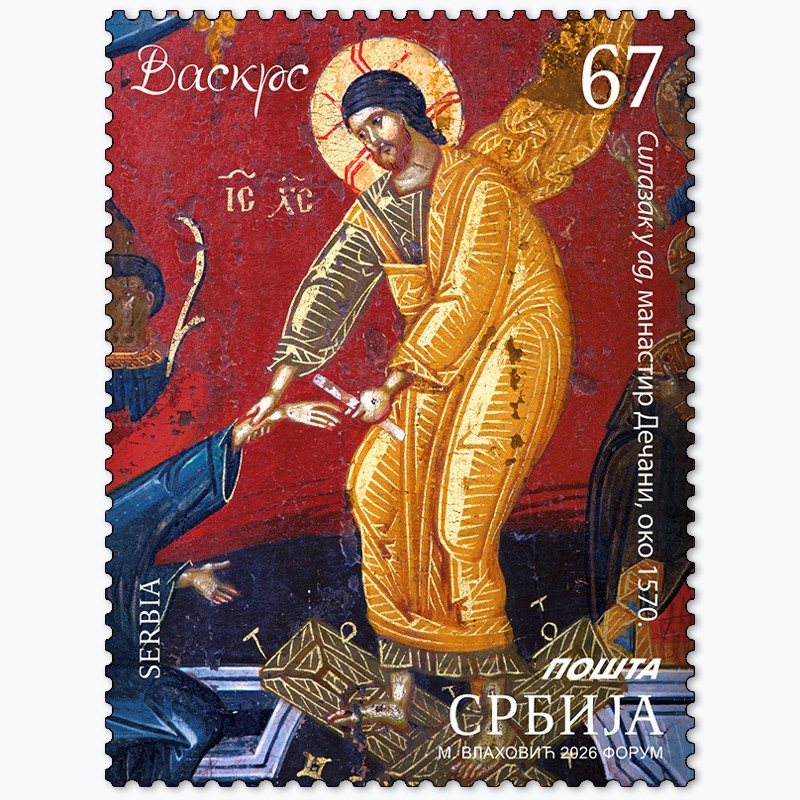
Motif on the stamp: Harrowing of Hell, 44 x 30.1 x 2.6 cm, tempera on panel, Dečani, treasury, iconographer Longinus, around 1570. Motif on the envelope: Archbishop’s sceptre of Serbian Patriarch Arsenije IV Jovanović Šakabenta, carved ivory, dimensions 165 x 18 cm, originally from the Šišatovac Monastery, unknown author, 1725–1748, Serbian Orthodox Church Museum.
Professional cooperation: Serbian Orthodox Church Museum
Artistic realisation of the issue: MA Marija Vlahovic, Academic Graphic Artist